Posts Tagged ‘shooting’

Another Mass Shooting, Another Psychiatric Drug? Federal Investigation Long Overdue

Friday, July 20th, 2012

Fact: Despite 22 international drug regulatory warnings on psychiatric drugs citing effects of mania, hostility, violence and even homicidal ideation, and dozens of high profile shootings/killings tied to psychiatric drug use, there has yet to be a federal investigation on the link between psychiatric drugs and acts of senseless violence.

Fact: At least 31 school shootings and/or school-related acts of violence have been committed by those taking or withdrawing from psychiatric drugs resulting in 162 wounded and 72 killed (in other school shootings, information about their drug use was never made public—neither confirming or refuting if they were under the influence of prescribed drugs).

Fact: Between 2004 and 2011, there have been over 11,000 reports to the U.S. FDA’s MedWatch system of psychiatric drug side effects related to violence.  These include 300 cases of homicide, nearly 3,000 cases of mania and over 7,000 cases of aggression.  Note:  By the FDA’s own admission, only 1-10% of side effects are ever reported to the FDA, so the actual number of side effects occurring are most certainly higher.

Fact: It took months for  the release of information showing that police had found psychiatric drugs in the apartment of Aurora Colorado movie theater shooter, James Holmes—including the anti-anxiety drug clonazepam and the antidepressant sertraline, the generic version of the antidepressant Zoloft.

Colorado shooter James Holmes was under the care of psychiatrist Lynne Fenton prior to the shootings. Police found antidepressant and anti-anxiety drugs in Holmes apartment.

Click here to sign the Petition: Call for Federal Investigation of Psychiatric Drugs, School Shootings & Senseless Violence

Of the 31 people who committed acts of violence that were documented to be under the influence of psychiatric drugs, ten were seeing either a psychiatrist or psychologist.  See the list of school shootings and/or school-related acts of violence by those on psychiatric drugs here.

School-related acts of violence aren’t the only cases commonly found to be under the influence of psychiatric drugs.  There are 12 other recent acts of senseless violence committed by individuals taking or withdrawing from psychiatric drugs resulting in an additional 46 dead and 23 wounded.

A bill introduced in New York in 2000 proposed police investigate psychiatric drug in all cases of violent crimes and suicides. This is a bill that must be reintroduced and passed on state and federal levels. Click image to read the bill

Despite 22 international drug regulatory warnings on psychiatric drugs citing effects of mania, hostility, violence and even homicidal ideation, and dozens of high profile shootings/killings tied to psychiatric drug use, there has yet to be a federal investigation on the link between psychiatric drugs and acts of senseless violence.

The correlation between psychiatric drugs and acts of violence and homicide is well documented – both by international drug regulatory warnings and studies, as well as by hundreds of cases where high profile acts of violence/mass murder were committed by individuals under the influence of psychiatric drugs.

The New York State Senate recognized this as far back as 2000, introducing a bill which would “require police to report to the Division of Criminal Justice Services (DCJS), certain crimes and suicides committed by persons using psychotropic drugs,” citing “a large body of scientific research establishing a connection between violence and suicide and the use of psychotropic drugs.”

Unfortunately that bill stalled out in the finance committee.   By reviewing the international drug regulatory warnings, studies, and adverse reaction reports submitted to the US FDA below, it is evident that the reintroduction of the New York bill is needed on a federal level in order to determine just how many crimes and acts of violence are being committed by individuals under the influence of drugs documented to induce violence, mania, psychosis, aggression, hostility and  homicide.

As the world’s leading mental health watchdog, CCHR has for decades investigated hundreds of acts of senseless violence, working alongside investigative reporters,  law enforcement, as well as legislative hearings, such as those held in Colorado following the 1999 Columbine  massacre  (ringleader Eric Harris was found to be under the influence of the antidepressant Luvox, Dylan Klebold’s autopsy reports were never unsealed).

And while there is never one simple explanation for what drives a human being  to commit such unspeakable acts, all too often one common denominator has surfaced in hundreds of cases—prescribed psychiatric drugs which are documented to cause mania, psychosis, violence, suicide and in some cases,  homicidal ideation. It is an injustice that the general public are not being  informed about the well documented links between psychiatric drugs and violence, and so once again we present the facts:

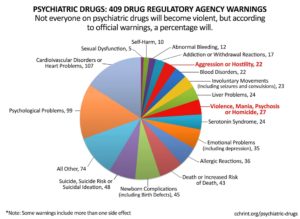
There have been 22 international drug regulatory warnings issued on psychiatric drugs causing violence, mania, hostility, aggression, psychosis, and other violent type reactions.  These warnings have been issued in the United States, European Union, Japan, United Kingdom, Australia and Canada.

Click image to read MANIA—The shocking link between psychiatric drugs, suicide, violence and mass murder

In determining what would prompt a person  to commit such brutal and senseless crimes, the press must ask the right questions,  including:  What, if any, prescribed psychotropic drugs the perpetrator may have been on (or in withdrawal from).

Read the international drug regulatory warnings issued on psychiatric drugs causing violence, mania, hostility, aggression, psychosis, and other violent type reactions.

See the recent study from PLoS One here on psychiatric drugs being linked to violence.

Watch this short interview with Michael Moore, author, director and producer of Bowling for Columbine, where he calls for a federal investigation into the link between prescribed drugs and mass shootings such as the 1999 Columbine massacre.

At least 31 school shootings and/or school-related acts of violence were committed by those taking or withdrawing from psychiatric drugs. It is important to note the following lists cases where the information about the shooters psychiatric drug use was made public.

It took months for  the release of information showing that police had found psychiatric drugs in the apartment of Aurora Colorado movie theater shooter, James Holmes—including the anti-anxiety drug clonazepam and the antidepressant sertraline, the generic version of the antidepressant Zoloft.

Note that all these mass shootings didn’t just occur in the United States.

Of these 31, ten were seeing either a psychiatrist (8 of them) or psychologist (2 of them).  It is not known whether or not the others were seeing a psychiatrist, as it has not been published.

  1. St. Louis, Missouri – January 15, 2013: 34-year-old Sean Johnson walked onto the Stevens Institute of Business & Arts campus and shot the school’s financial aid director once in the chest, then shot himself in the torso. Johnson had been taking prescribed drugs for an undisclosed mental illness.
  2. Snohomish County, Washington – October 24, 2011: A 15-year-old girl went to Snohomish High School where police alleged that she stabbed a girl as many as 25 times just before the start of school, and then stabbed another girl who tried to help her injured friend. Prior to the attack the girl had been taking “medication” and seeing a psychiatrist. Court documents said the girl was being treated for depression.
  3. Planoise, France – December 13, 2010: A 17-year-old youth held twenty pre-school children and their teacher hostage for hours at Charles Fourier preschool.  The teen was reported to be on “medication for depression”.  He took a classroom hostage with two swords. Eventually, all the children and the teacher were released safely.
  4. Myrtle Beach, South Carolina – September 21, 2011: 14-year-old Christian Helms had two pipe bombs in his backpack, when he shot and wounded Socastee High School’s “resource” (police) officer. However the officer was able to stop the student before he could do anything further.  Helms had been taking drugs for attention deficit hyperactivity disorder and depression.
  5. Huntsville, Alabama – February 5, 2010: 15-year-old Hammad Memon shot and killed another Discover Middle School student Todd Brown.  Memon had a history for being treated for ADHD and depression.  He was taking the antidepressant Zoloft and “other drugs for the conditions.” He had been seeing a psychiatrist and psychologist.
  6. Kauhajoki, Finland – September 23, 2008: 22-year-old culinary student Matti Saari shot and killed 9 students and a teacher, and wounded another student, before killing himself.  Saari was taking an SSRI and a benzodiazapine. He was also seeing a psychologist.
  7. Fresno, California – April 24, 2008: 17-year-old Jesus “Jesse” Carrizales attacked the Fresno high school’s officer, hitting him in the head with a baseball bat.  After knocking the officer down, the officer shot Carrizales in self-defense, killing him.  Carrizales had been prescribed Lexapro and Geodon, and his autopsy showed that he had a high dose of the antidepressant Lexapro in his blood that could have caused him to be paranoid, according to the coroner.
  8. Dekalb, Illinois – February 14, 2008: 27-year-old Steven Kazmierczak shot and killed five people and wounded 21 others before killing himself in a Northern Illinois University auditorium. According to his girlfriend, he had recently been taking Prozac, Xanax and Ambien. Toxicology results showed that he still had trace amount of Xanax in his system. He had been seeing a psychiatrist.
  9. Jokela, Finland – November 7, 2007: 18-year-old Finnish gunman Pekka-Eric Auvinen had been taking antidepressants before he killed eight people and wounded a dozen more at Jokela High School in southern Finland, then committed suicide.
  10. Texas – November 7, 2007: 17-year-old Felicia McMillan returned to her former Robert E. Lee High School campus and stabbed a male student and wounded the principle with a knife.  McMillan had been on drugs for depression, and had just taken them the night before the incident.
  11. Cleveland, Ohio – October 10, 2007: 14-year-old Asa Coon stormed through his school with a gun in each hand, shooting and wounding four before taking his own life. Court records show Coon had been placed on the antidepressant Trazodone.
  12. Sudbury, Massachusetts – January 19, 2007: 16-year-old John Odgren stabbed another student with a large kitchen knife in a boy’s bathroom at Lincoln-Sudbury Regional High School. In court his father testified that Odgren was prescribed the drug Ritalin.
  13. North Vernon, Indiana – December 4, 2006: 16-year-old Travis Roberson stabbed another Jennings County High School student in the neck, nearly severing an artery. Roberson was in withdrawal from Wellbutrin, which he had stopped taking days before the attack.
  14. Hillsborough, North Carolina – August 30, 2006: 19-year-old Alvaro Rafael Castillo shot and killed his father, then drove to Orange High School where he opened fire. Two students were injured in the shooting, which ended when school personnel tackled him. His mother said he was on drugs for depression.
  15. Chapel Hill, North Carolina – April 2006: 17-year-old William Barrett Foster took a shotgun to school and took a teacher and a fellow student hostage at East Chapel Hill High School. After being talked out of shooting the hostages, Foster fired two shots through a classroom window before fleeing the school on foot. Foster’s father testified that his son had stopped taking his antidepressants and antipsychotic drugs without telling him.
  16. Red Lake, Minnesota – March 21, 2005: 16-year-old Jeff Weise, on Prozac, shot and killed his grandparents, then went to his school on the Red Lake Indian Reservation where he shot dead 5 students, a security guard, and a teacher, and wounded 7 before killing himself.
  17. Greenbush, New York – February 2004: 16-year-old Jon Romano strolled into his high school in east Greenbush and opened fire with a shotgun. Special education teacher Michael Bennett was hit in the leg. Romano had been taking “medication for depression”. He had previously seen a psychiatrist.
  18. Red Lion, Pennsylvania – February 2, 2001: 56-year-old William Michael Stankewicz entered North Hopewell-Winterstown Elementary School with a machete, leaving three adults and 11 children injured. Stankewicz was taking four different drugs for depression and anxiety weeks before the attacks.
  19. Ikeda, Japan – June 8, 2001: 37-year-old Mamoru Takuma, wielding a 6-inch knife, slipped into an elementary school and stabbed eight first- and second-graders to death while wounding at least 15 other pupils and teachers. He then turned the knife on himself but suffered only superficial wounds. He later told interrogators that before the attack he had taken 10 times his normal dose of antidepressants.
  20. Wahluke, Washington – April 10, 2001: Sixteen-year-old Cory Baadsgaard took a rifle to his high school and held 23 classmates and a teacher hostage. He had been taking the antidepressant Effexor.
  21. El Cajon, California – March 22, 2001: 18-year-old Jason Hoffman, on the antidepressants Celexa and Effexor, opened fire on his classmates, wounding three students and two teachers at Granite Hills High School. He had been seeing a psychiatrist before the shooting.
  22. Williamsport, Pennsylvania – March 7, 2001: 14-year-old Elizabeth Bush was taking the antidepressant Prozac when she shot at fellow students, wounding one.
  23. Oxnard, California – January 2001: 17-year-old Richard Lopez went to Hueneme High School with a gun and shot twice at a car in the school’s parking lot before taking a female student hostage.  Lopez was eventually killed by a SWAT officer.  He had been prescribed Prozac, Paxil and “drugs that helped him go to sleep.”
  24. Conyers, Georgia – May 20, 1999: 15-year-old T.J. Solomon was being treated with the stimulant Ritalin when he opened fire on and wounded six of his classmates.
  25. Columbine, Colorado – April 20, 1999: 18-year-old Eric Harris and his accomplice, Dylan Klebold, killed 12 students and a teacher and wounded 26 others before killing themselves. Harris was on the antidepressant Luvox.  Klebold’s medical records remain sealed. Both shooters had been in anger-management classes and had undergone counseling.  Harris had been seeing a psychiatrist before the shooting.
  26. Notus, Idaho – April 16, 1999: 15-year-old Shawn Cooper fired two shotgun rounds in his school, narrowly missing students. He was taking a prescribed antidepressant and Ritalin.
  27. Springfield, Oregon – May 21, 1998: 15-year-old Kip Kinkel murdered his parents and then proceeded to school where he opened fire on students in the cafeteria, killing two and wounding 25. Kinkel had been taking the antidepressant Prozac. Kinkel had been attending “anger control classes” and was under the care of a psychologist.
  28. Blackville, South Carolina – October 12, 1995: 15-year-old Toby R. Sincino slipped into the Blackville-Hilda High School’s rear entrance, where he shot two Blackville-Hilda High School teachers, killing one. Then Toby killed himself moments later. His aunt, Carolyn McCreary, said he had been undergoing counseling with the Department of Mental Health and was taking Zoloft for emotional problems.
  29. Chelsea, Michigan – December 17, 1993: 39-year-old chemistry teacher Stephen Leith, facing a disciplinary matter at Chelsea High School, shot Superintendent Joseph Piasecki to death, shot Principal Ron Mead in the leg, and slightly wounded journalism teacher Phil Jones. Leith was taking Prozac and had been seeing a psychiatrist.
  30. Houston, Texas – September 18, 1992: 44-year-old Calvin Charles Bell, reportedly upset about his second-grader’s progress report, appeared in the principal’s office of Piney Point Elementary School. Bell fired a gun in the school, and eventually wounded two officers before surrendering. Relatives told police on Friday that Bell was an unemployed Vietnam veteran and had been taking anti-depressants.
  31. Winnetka, Illinois – 20 May 1988: 30-year-old Laurie Wasserman Dann walked into a second grade classroom at Hubbard Woods School in Winnetka, Illinois carrying three pistols and began shooting children, killing an eight-year-old boy, and wounding five others before fleeing. She entered a nearby house where she shot and wounded a 20-year-old man before killing herself. Dann had been seeing a psychiatrist and subsequent blood tests revealed that at the time of the killings, she was taking the antidepressant Anafranil.

Note: Psychiatric Drugs Can Also Cause Severe Withdrawal Symptoms—Violent and Suicidal Thoughts – Watch This 2 Minute Video

12 additional recent murders and murder-suicides, resulting in 46 dead and 23 wounded:

  1. Pittsburgh, Pennsylvania – March 8, 2012:  30-year-old John Shick, former patient of University of Pittsburgh Medical Center (UPMC) and former student at nearby Duquesne University, shot and killed one and injured six inside UPMC’s Western Psychiatrist Institute. Nine antidepressants were identified among the drugs police found in Shick’s apartment.
  2. Seal Beach, California – October 12, 2011:  Scott DeKraai, a harbor tugboat worker, entered the hair salon where his ex-wife worked, killing her and seven others and injuring one. At DeKraai’s initial hearing, his attorney indicated to the judge that DeKraai was prescribed the antidepressant Trazodone and the “mood stabilizer” Topamax.
  3. Lakeland, Florida – May 3, 2009:  Toxicology test results showed that 34-year-old Troy Bellar was on Tegretol, a drug prescribed for “bi-polar disorder,” when he shot and killed his wife and two of his three children in their home before killing himself.
  4. Granberry Crossing, Alabama – April 26, 2009:  53-year-old Fred B. Davis shot and killed a police officer and wounded a sheriff’s deputy who had responded to a call that Davis had threatened a neighbor with a gun. Prescription drug bottles found at the scene showed that Davis was prescribed the antipsychotic drug Geodon.
  5. Middletown, Maryland – April 17, 2009:  Christopher Wood shot and killed his wife, three small children and himself inside their home. Toxicology test results verified that Wood had been taking the antidepressants Cymbalta and Paxil and the anti-anxiety drugs BuSpar and Xanax.
  6. Concord, California – January 11, 2009:  Jason Montes, 33, shot and killed his wife and then himself at home. Montes had earlier begun taking the antidepressant Prozac for depression related to his impending divorce and a recent bankruptcy.
  7. Little Rock, Arkansas – August 14, 2008:  Less than 48 hours after Timothy Johnson shot and killed Arkansas Democratic Party Chairman Bill Gwatney, the Little Rock Police declared they were investigating shooter’s use of the antidepressant Effexor, which was found in Johnson’s house.  A Little Rock city police report later stated that Johnson “was on an antidepressant and that the drug may have played a part in his ‘irrational and violent behavior.’”
  8. Omaha, Nebraska – December 5, 2007:  19-year-old Robert Hawkins killed eight people and wounded five before committing suicide in an Omaha mall. Autopsy results confirmed he was under the influence of the “anti-anxiety” drug Valium.
  9. North Meridian, Florida – July 8, 2003:  Doug Williams killed five and wounded nine of his fellow Lockheed Martin employees before killing himself. Williams was reportedly taking two antidepressants, Zoloft and Celexa, for depression after a failed marriage.
  10. Wakefield, Massachusetts – December 26, 2000:  42-year-old computer technician Michael McDermott had been taking three antidepressants when he hunted down employees in the accounting and human resources offices where he worked, killing seven.
  11. Buffalo, New York – May 1, 1998:  37-year-old Juan Roman, an Erie County sheriff’s deputy, pursued his estranged wife into their children’s elementary school and shot her dead, and a school aide was hit in the elbow. Roman was taking antidepressants and seeing a psychiatrist.
  12. St. Petersburg, FL – May 25, 1992:  30-year-old David Doyle Rittenhouse shot and killed a man that went on a date with his wife. Rittenhouse said he was taking a drug somewhat similar to the controversial drug Prozac, and that the drug impeded his perception abilities and he thought the man had raped his wife, though he said “He knows it didn’t happen that way – but he said that is what was in his mind.”

As far back as 1991, CCHR, along with numerous experts brought evidence before the US FDA that antidepressants were causing suicide and violence. The heavily Pharma-funded FDA panel ignored the evidence provided, and it would take 14 years, and a great deal of public pressure,  for the FDA to finally issue it’s strongest warning, the black box, on antidepressants inducing suicidal ideation.   21 years later, the FDA has yet to issue a black box warning on antidepressants and other classes of psychiatric drugs documented by international regulatory agencies and studies to cause violence.  This is not in the public’s interest, who deserve to be warned, it’s in Big Phama’s interest,  upon whose funding the FDA heavily relies on.

« Return to news items


Share

Law Enfocement finds Pennsylvania Shooter prescribed 43 drugs ranging from psychiatric drugs to pain pills

Wednesday, March 14th, 2012

Pittsburgh Post-Gazette – March 14, 2012
By Michael A. Fuoco

School shooters under the influence of psychiatric drugs documented to cause violence/mania have left 57 dead and 109 wounded

Law enforcement authorities who searched John F. Shick’s North Oakland apartment following his deadly shooting rampage Thursday found 43 medications ranging from psychotropic drugs to pain pills to erectile dysfunction tablets that had been prescribed by about a dozen different doctors, sources close to the probe said.

Additionally, they found the address for Western Psychiatric Institute and Clinic of UPMC, the scene of the shootings, written on a piece of paper hanging from a wall in Mr. Shick’s fourth-floor flat in the Royal York Apartments.

Rambling messages were written on the walls themselves and in notebooks scattered throughout the apartment. And there were handwritten complaints about his medical treatment for a variety of physical ailments, sources reported.

The notations included complaints about various doctors and what Mr. Shick characterized as their misdiagnoses of his ailments. But Mr. Shick’s ire was particularly centered on a UPMC internal medicine physician who appeared to have treated Mr. Shick, sources said. Mr. Shick and the doctor lived in the same apartment building, the sources said, and they had argued. The doctor could not be reached for comment, so the Pittsburgh Post-Gazette is not identifying him.

Mr. Shick, 30, who killed one person and wounded five others in Western Psych’s first floor before University of Pittsburgh police fatally shot him, had the night before the carnage asked someone in his apartment building to call an ambulance. He vomited in the lobby before being taken to UPMC Presbyterian. There, he complained of having worms in his bowels.

Previously, residents of his apartment said, Mr. Shick sometimes left yellow Post-Its on his door that said, “Now cleaning up vomit of pancreatitis. Please do not disturb.”

Mr. Shick also ranted in his writings about the evils of “corporate America,” sources said, and had a gas mask and a biohazard suit in the apartment.

Executives at the Sterling Land Co., which owns the Royal York Apartments, said in a letter delivered to tenants last week that they “had no knowledge of John Shick’s health problems.” They said Mr. Shick moved to the apartment last July. In a second letter sent to residents this week, they advised “worried, upset or grieving” tenants to seek counseling via the re:solve Crisis Network in the East End.

Pittsburgh police Cmdr. Thomas Stangrecki said he had no comment on what investigators found in the apartment and no further update on the investigation into Mr. Shick’s motivation in the attacks.

Neither he nor UPMC officials would say if Mr. Shick had been a patient at Western Psych. But Karl E. Williams, the Allegheny County medical examiner, said Tuesday that as part of his investigation he had obtained a court order compelling UPMC hospitals, including Western Psych, to provide any medical records for Mr. Shick it may have.

Paul Wood, spokesman for UPMC, said Tuesday he knew nothing about such a court order being served on the institution.

“In order for everything to be purely correct, legally correct, the [medical examiner] has to request a subpoena and it has to be ordered by the court and then we supply any records we have on that person,” Mr. Wood said. “We look forward to cooperating with law enforcement.”

Mr. Wood said UPMC’s legal understanding of the federal privacy law is that it cannot confirm or deny that someone has been a patient or received any care at one of its hospitals — even after that person has died.

In another development, a surveillance video from a Rite Aid Pharmacy at 209 Atwood St. in Oakland obtained by WTAE-TV shows a man that appears to be Mr. Shick shopping at the store about an hour before the shootings. On Tuesday afternoon, an employee said she had seen Mr. Shick in the store at least once in the past two weeks, but she declined to comment further.

Cmdr. Stangrecki said he could not confirm if the man was Mr. Shick, but police had formally requested the surveillance video from Rite Aid.

Read the rest of the article here:  http://www.post-gazette.com/stories/local/region/western-psych-shooters-flat-full-of-rants-medications-248336/?p=0

« Return to news items


Share

John Shick, Psychiatric ‘Shooter,’ Had Mental Health History; Pittsburgh Cops Seek Motive

Tuesday, March 13th, 2012

Note from CCHR:  In addition to his history of being committed to a mental institution, the shooter at Western Psychiatric Institute and Clinic at the University of Pittsburgh was reported to have bags of unspecified medication found in his apartment by police according to the Pittsburgh Post-Gazette, as well as in his personal belongings at the time of the shooting, as reported by USA Today.   Psychiatric drugs prescribed to treat “mental illness” are documented to cause mania, psychosis, violence, suicidal and homicidal ideation according to the FDA.  12 recent school shooters were found to be under the influence of, or in withdrawal from psychiatric drugs.

Huffington Post – March 13, 2012

Neighbors who lived in suspected gunman John Shick's Pittsburgh apartment building said he behaved erratically and sometimes seemed to walk around while strongly medicated.

PITTSBURGH — The gunman in a fatal shooting rampage inside a Pittsburgh psychiatric clinic was previously committed to a mental health facility for treatment following an altercation with police in Oregon in 2009, a prosecutor said.

Details of John Shick’s previous involvement with mental health professionals come as investigators piece together a motive for last week’s shooting that killed one person and wounded six others in the lobby of the Western Psychiatric Institute and Clinic at the University of Pittsburgh.

Shick was taken for a mental health evaluation following his Dec. 29, 2009, arrest on a road at Portland International Airport that included a scuffle with police that ended with an officer being kicked in the head, according to court documents.

A judge ordered Shick, at the time living under a different name, to undergo up to 180 days of mental health treatment, Multnomah County Deputy District Attorney Robert Leineweber told the Pittsburgh Post-Gazette for Tuesday’s editions. It was not immediately clear how long he was in treatment. Shick had legally changed his name but later changed his name back.

Shick was killed in an exchange of gunfire with University of Pittsburgh police after he entered the clinic and opened fire, killing one person and wounding six, according to authorities.

Hospital officials have refused to say whether Shick was a patient at Western Psychiatric Institute. Allegheny County Medical Examiner Dr. Karl Williams told The Associated Press there are indications he was a patient there but the matter remains under investigation.

Shick had been enrolled as a graduate biology student at nearby Duquesne University but was banned from campus and withdrew after female students brought harassment complaints against him.

Leineweber told the Post-Gazette Shick was never prosecuted after he didn’t hear back from police after the judge ordered Shick’s commitment. Shick’s 2009 arrest was reported Friday by The Oregonian.

Neighbors who lived in Shick’s Pittsburgh apartment building said he behaved erratically, sometimes seemed to walk around while strongly medicated, and posted angry notes on his apartment door in the days before the shooting.

A 25-year-old clinic worker, Michael Schaab, was killed in the shooting. His funeral is scheduled for Thursday.

All the wounded are expected to recover.

Read article here:  http://www.huffingtonpost.com/2012/03/13/alleged-pa-clinic-shooter_n_1341137.html

« Return to news items


Share

Note to Press Re: Arizona Shooting—Before Touting Pharma’s “More Mental Health Treatment Needed” Line – Try Asking The Right Questions

Wednesday, January 12th, 2011

By CCHR International

10 recent massacres were committed by those under the influence of psychiatric drugs resulting in 54 dead and 105 wounded

Every single time there is a school shooting, or some senseless massacre, the press are quick to start touting the need for more mental health treatment to “prevent” these tragedies—well before the facts of the case have been investigated. In fact, most of the press don’t appear as interested in bringing the facts to light as they are in making “recommendations” based on assumptions and calling for more mental health services/treatments.   How one can make recommendations before finding out what actually occurred seems illogical to us, and we’re hoping we’re not the only ones.   What also seems illogical is the lack of direct questioning and demand for answers given the facts already known about prior massacres/shootings, such as:  The majority of those who committed such acts had already undergone mental health “treatment,”  and were already on psychiatric drugs.   Drugs documented by international drug regulatory agencies to cause violence, mania, psychosis, hallucinations, suicide and even homicidal ideation.

In the case of prior massacres/shootings, what has repeatedly occurred is that when the facts finally came out,  due solely to the efforts of those few  determined investigative reporters (such as Fox National News reporter Douglas Kennedy), and it was revealed that the shooter had been under the influence of psychiatric drugs, or in withdrawal from them,  most of the press were quick to counter the drug/violence connection by featuring some Pharma mouthpiece touting the “there is no evidence that these drugs cause violent or homicidal behavior” line.

Really?    No evidence? There have been 22 International Drug Regulatory Agency Warnings on psychiatric drugs causing violence, mania, psychosis and even homicidal ideation.   These warnings have been issued by drug regulatory agencies in the United States,  the European Union, Japan,  The United Kingdom, Australia and Canada.

And consider that just last week, TIME Magazine reported on a study from the Institute for Safe Medication Practices that  “based on data from the FDA’s Adverse Event Reporting System has identified 31 drugs that are disproportionately linked with reports of violent behavior towards others.”  And out of the Top 10, 8 were psychiatric drugs.

From Time Magazine: “When people consider the connections between drugs and violence, what typically comes to mind are illegal drugs like crack cocaine. However, certain medications — most notably, some antidepressants like Prozac — have also been linked to increase risk for violent, even homicidal behavior.

The Top 10 included  the Antidepressants Pristiq, Effexor, Luvox, Paxil, Prozac, ADHD Drugs, Strattera and the Anti-Anxiety drug,  Halcion.

Now, to be perfectly clear, we’re not saying for a fact that Loughner was taking  psychiatric drugs at the time of the shooting, or in the past, which studies show can cause long-term  damage long after an individual has stopped taking them.   We’re saying, why aren’t the press finding out?   Consider that 10 recent massacres were committed by those under the influence of psychiatric drugs documented to cause mania, psychosis, violence and even homicide, resulting in 54 dead and 105 wounded—and those are just the ones we know about. In several cases, medical records were sealed or autopsy reports not made public or, in some cases, toxicology tests were either not done to test for psychiatric drugs, or not disclosed to the public.   But let’s just consider what we do  know about the mental health “treatment” of those who committed these acts of violence:

  • Dekalb, Illinois – February 14, 2008: 27-year-old Steven Kazmierczak shot and killed five people and wounded 16 others before killing himself in a Northern Illinois University auditorium. According to his girlfriend, he had recently been taking Prozac, Xanax and Ambien. Toxicology results showed that he still had trace amount of Xanax in his system.
  • Omaha, Nebraska – December 5, 2007: 19-year-old Robert Hawkins killed eight people and wounded five before committing suicide in an Omaha mall.  Hawkins’ friend told CNN that the gunman was on antidepressants, and autopsy results confirmed he was under the influence of the “anti-anxiety” drug Valium.

  • Jokela, Finland – November 7, 2007: 18-year-old Finnish gunman Pekka-Eric Auvinen had been taking antidepressants before he killed eight people and wounded a dozen more at Jokela High School in southern Finland, then committed suicide.

  • Cleveland, Ohio – October 10, 2007: 14-year-old Asa Coon stormed through his school with a gun in each hand, shooting and wounding four before taking his own life.  Court records show Coon had been placed on the antidepressant Trazodone.

  • Blacksburg, Virginia – April 16, 2007: 23-year-old Seung Hui Cho shot to death 32 students and faculty of Virginia Tech, wounding 17 more, and then killing himself.  He had received prior mental health treatment, however his mental health records remained sealed.

  • Red Lake, Minnesota – March 2005: 16-year-old Jeff Weise, on Prozac, shot and killed his grandparents, then went to his school on the Red Lake Indian Reservation where he shot dead 7 students and a teacher, and wounded 7 before killing himself.

  • Greenbush, New York – February 2004: 16-year-old Jon Romano strolled into his high school in east Greenbush and opened fire with a shotgun.  Special education teacher Michael Bennett was hit in the leg.  Romano had been taking “medication for depression”.

  • El Cajon, California – March 22, 2001: 18-year-old Jason Hoffman, on the antidepressants Celexa and Effexor, opened fire on his classmates, wounding three students and two teachers at Granite Hills High School.

  • Williamsport, Pennsylvania – March 7, 2001: 14-year-old Elizabeth Bush was taking the antidepressant Prozac when she shot at fellow students, wounding one.

  • Conyers, Georgia – May 20, 1999: 15-year-old T.J. Solomon was being treated with antidepressants when he opened fire on and wounded six of his classmates.

  • Columbine, Colorado – April 20, 1999: 18-year-old Eric Harris and his accomplice, Dylan Klebold, killed 12 students and a teacher and wounded 26 others before killing themselves.  Harris was on the antidepressant Luvox.  Klebold’s medical records remain sealed.

  • Notus, Idaho – April 16, 1999: 15-year-old Shawn Cooper fired two shotgun rounds in his school, narrowly missing students.  He was taking a prescribed SSRI antidepressant and Ritalin.

  • Springfield, Oregon – May 21, 1998: 15-year-old Kip Kinkel murdered his parents and then proceeded to school where he opened fire on students in the cafeteria, killing two and wounding 22.  Kinkel had been taking the antidepressant Prozac.

So, given the fact that these shooters were on psychiatric drugs, given the fact that 22 international drug regulatory agencies warn these drugs can cause violence, mania, psychosis, suicide and even homicide, given the fact that a major study was just released confirming these drugs put people at greater risk of becoming violent,  here are the questions we think deserve to be answered.

1) Court records show that a case against Jared Loughner was dismissed on Dec. 9, 2008, after he completed some type of diversion program.    What was the diversion program?  Did it include mental health treatment or do the case notes include any information about any prior mental health treatment  Loughner may have undergone?  Such was the case of Columbine shooter Eric Harris’s “diversion program”, where case notes dated 4/16/98 revealed that “Eric has been having difficulty with his medication for depression.  A few nights ago he was unable to concentrate and felt restless.  He went to the doctor and the doctor is changing his medication.”

* Further note to press: Sometimes finding the psychiatric drug connection requires a bit more due diligence than just asking the question; case in point,  following the Columbine massacre, the Coroner’s office initially reported no drugs were found in Eric Harris’ tox reports.   Following this, an investigative reporter found that Harris was rejected from the military and psychiatric drug use was suspected as the cause for the rejection.   When this became known,  the coroner’s office seemed to find that  Harris did in fact have the antidepressant Luvox in his system.

2) The Wall Street Journal reported, “One high-school pal said Loughner had become suicidal”.  Considering the FDA has issued black box warnings that antidepressants can cause suicidal ideation (as can other psychiatric drugs) was Loughner already under the influence of these drugs?

3) The press has reported that Loughner was “barred from campus pending a psychological evaluation.”  So what happened?  Did he get one?  Was he ever in mental health treatment, or prescribed a psychiatric drug? Ever?

As a final note:  Whether or not Loughner was yet another in the long list of shooters under the influence of drugs documented to cause mania, psychosis, hallucinations, aggressive behavior, suicidal and homicidal ideation—Given the international drug regulatory agency warnings & studies, the just released Institute for Safe Medication Practices study, this much we know for certain; the  last thing we need is more kids on psychiatric drugs.    And given what we already know about the risks of these drugs, any recommendation for more mental health treatment, meaning more people and more kids put on these drugs, is not only negligent, but considering the possible repercussions, criminal.

« Return to news items


Share

Army psychiatrists who supervised psychiatrist/Fort Hood shooter Nidal Hasan face charges for failing to take action

Thursday, January 21st, 2010

NPR
By Daniel Zwerdling
January 21, 2010

The Army has told some of the psychiatrists who supervised Fort Hood shooting suspect Nidal Hasan that it’s investigating them — and they could face punishments from letters of reprimand to court martial.

The Army said it’s going to decide if the doctors at Walter Reed “failed to take appropriate action” against Hasan and were “derelict” in their duties.

Evidence shows a lot of doctors were worried about Hasan — some for years. Evidence also shows that only one supervisor, Scott Moran, actively tried to kick Hasan out of the psychiatry program. Now sources involved in the investigation say Moran is one of the officers who’s in big trouble. Moran wouldn’t comment, but the sources say the supervisors under investigation are fairly low level officers like Moran, who is a major.

“They’re attacking the wrong target,” says Gary Myers, a lawyer who’s representing Col. Charles Engel, another psychiatrist whom Myers says is under investigation.

Engel was Hasan’s main supervisor in the fellowship program at the military’s medical school, the Uniformed Services University of the Health Sciences. Myers says the Army is trying to find scapegoats and that everybody knows officials in the nation’s intelligence agencies bear at least some responsibility for what happened at Fort Hood.

Read entire article:  http://www.npr.org/templates/story/story.php?storyId=122778372

« Return to news items


Share

Psychiatrist Peter Breggin on the Texas, Fort Hood Shooter “Let’s also see through yet another media smoke screen”

Monday, November 9th, 2009

Dr. Peter Breggin
The Huffington Post
Nov. 8, 2009

Before I begin to look at his role as a psychiatrist, I want to confirm that Major Nidal Malik Hasan was driven by religious ideology. For years he openly claimed that the War on Terror is a war on Muslims. He announced on the Internet and to his fellow soldiers in a course on public health that a Muslim suicide bomber should be praised for killing a hundred soldiers. It’s reported that fellow soldiers warned his superiors that he was a ticking time bomb.

One wonders how and why the army failed to relieve him from active duty. One ridiculous explanation is that they had a lot invested him–his complete medical and psychiatric training. Much more likely, the army was hamstrung by the political correctness that’s been imposed upon it.

Let’s also see through yet another media smoke screen–that Hasan was more a crazy person than a terrorist. During the American revolution Samuel Adams pointed out that he’d never seen a man commit treason without first losing his moral footing in his personal life. As for being a victim of prejudice, Hasan was instead a provocateur whom the army tried to ignore. Hasan is not only a terrorist, he’s a traitor–a man who turned on his nation; on the army that nurtured, educated and paid him; and on his comrades in arms.

Not Surprised He’s a Psychiatrist
Some in the media have expressed surprise that a man whose profession is about caring would turn to violence. According to one theory, poor Dr. Hasan was driven to the breaking point by the stress of counseling returning soldiers and having to listen to their horrific stories. Totally false. Psychiatrists are no longer trained to listen to or to counsel their patients. Nor do they care to.

I’ve given seminars to the staff at both hospitals where Hasan was trained, Walter Reed in DC and the national military medical center in Bethesda, Maryland. The psychiatrists had no interest in anything except medicating their patients.

Modern psychiatry is not about counseling and empowering people. It’s about controlling and suppressing them, and that’s a dismal affair for patients and doctors alike. The armed forces have been taken in by the false claims of modern psychiatry.

Read entire article:  http://www.huffingtonpost.com/dr-peter-breggin/the-fort-hood-shooter-a-d_b_349651.html

« Return to news items


Share

In wake of shootings: Read what psychiatrist Peter Breggin said about psych drugs/military/violence & drug withdrawal

Saturday, November 7th, 2009

Dr. Peter Breggin
The Huffington Post
June 20, 2009

Here are the starting facts: Death by suicide is at record levels in the armed services. Simultaneously the use of antidepressant drugs is also at record levels, including brand names like Prozac, Zoloft, Paxil, Celexa and Lexapro. According to the army, in 2007 17% of combat troops in Afghanistan were taking prescription antidepressants or sleeping pills. Inside sources have given me an even bleaker picture: During Vietnam, a mere 1% our troops were taking prescribed psychiatric drugs. By contrast, in the past year one-third of marines in combat zones were taking psychiatric drugs.

Are the pills helping? The army confirms that since 2002 the number of suicide attempts has increased six-fold. And more than 128 soldiers killed themselves last year.

One theory states that the increased prescription of drugs is a response to increased depression among the soldiers. In reality, the use of psychiatric drugs escalates when, and only when, drug companies and their minions target new markets. In this case, the armed services have been pushing drugs as a cheap alternative to taking genuine care of the young men and women in our military. Instead of shortening tours of duty, instead of temporarily removing stressed-out soldiers from combat zones, and instead of providing counseling–the new army policy is to drug the troops.

Read entire article: http://www.huffingtonpost.com/dr-peter-breggin/antidepressants-cause-sui_b_218465.html

« Return to news items


Share

“Was Fort Hood Killer On Psychotropic Drugs?” – Media fails to ask if Hasan was on SSRI’s

Friday, November 6th, 2009

Paul Joseph Watson
Alex Jones’ Prison Planet.com
November 6, 2009

Despite the fact that Fort Hood gunman Nidal Malik Hasan was a psychiatrist, the media has failed to even raise the question of whether he was taking psychotropic drugs before he gunned down over a dozen of his colleagues during yesterday’s tragic rampage, a hefty indictment of how the establishment rushes to blame politics, religion, gun rights, or any other factor for mass shootings in order to hide the direct link between such massacres and the use of anti-depressant drugs.

It has been confirmed that Hasan was an Army psychiatrist at Fort Hood. Psychiatrists have a history of “self-medication” because of the easy access they have to psychotropic drugs.

In almost every major mass shooting over the past two decades, since anti-depressant drugs became popular, the killer has been on SSRI’s – serotonin reuptake inhibitors.

The establishment media, allied closely as it is with the pharmaceutical industry, uniformly fails to stress this common factor, preferring instead to blame shootings on gun rights or, as in the case of Hasan, political motives.

Read entire article: http://www.prisonplanet.com/was-fort-hood-killer-on-psychotropic-drugs.html

« Return to news items


Share

Was Fort Hood Psychiatrist/Shooter on drugs that cause homicidal/suicidal reactions? 16% of psychiatrists “self medicate”

Thursday, November 5th, 2009

Richard Balon
Psychotherapy and Psychosomatics
Vol. 76, No. 5, 2007

Abstract

Background: Self-treatment and treatments of friends or relatives is a controversial issue, tolerated by some and discouraged by others, including professionals. The author studied the attitudes toward self-treatment of depression among psychiatrists in Michigan. Method: A questionnaire asking whether the psychiatrist would or did self-treat for depression was mailed to 830 members of the Michigan Psychiatric Society. Results: The response rate was 68.3% (567 psychiatrists). Almost 43% of responders would consider self-medication or would self-medicate if afflicted with mild/moderate depression. Seven percent would self-medicate or consider self-medication for severe depression or if suicidal ideation became a component of one’s depression. In the past, 15.7% responders treated themselves for depression. Conclusion: These results suggest that a considerable number of psychiatrists would treat themselves for depression, possibly because of fear of stigma or fear of a permanent record, or other reasons.

Click here for article

« Return to news items


Share

Fort Hood Texas Shooter was Army Psychiatrist

Thursday, November 5th, 2009

Adam Arnold
Sky News
November 5, 2009

At least 12 people have been shot dead and 31 others wounded after a US soldier went on the rampage at a military base in Texas.

The suspect, named as Major Malik Nadal Hasan, was killed on site after opening fire at the massive Fort Hood complex in Killeen.

Major Hasan, who was armed with two handguns, was thought to be in his late 30s and was an army psychiatrist.

He was due to be sent to Iraq soon but had aired grievances about the planned deployment, Texas Senator Kay Bailey Hutchinson told CNN.

Two other soldiers are being held as suspects following the mass shooting.

It took place at the Soldier Readiness Centre, where troops preparing for overseas deployment were getting last-minute medical checkups.

The two suspects were detained at a nearby building on the base.

Read entire article

Shootings took place at Soldier Readiness Centre.  See this: http://www.crdamc.amedd.army.mil/default.asp?page=behavh

« Return to news items


Share