

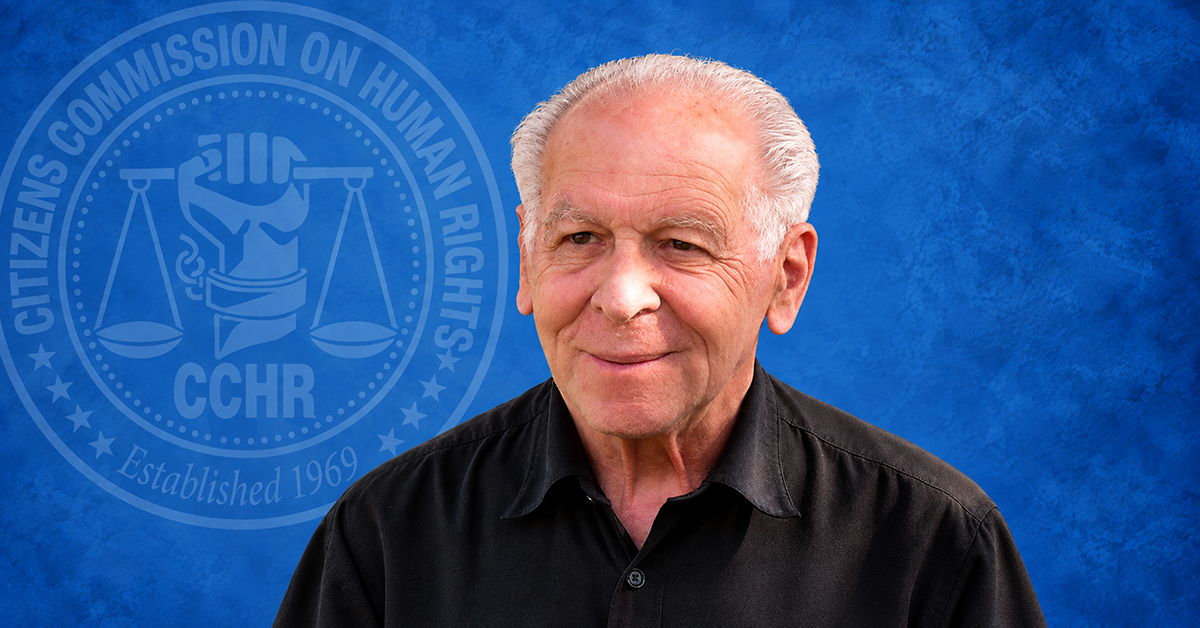
The psychiatrist and CCHR co-founder spent decades condemning involuntary commitment and forced treatment. United Nations human rights authorities now say coercive psychiatric practices violate liberty, autonomy and personal integrity.
By Jan Eastgate
President, CCHR International
September 14, 2026
Professor Thomas Szasz, CCHR’s co-founder (1969), spent decades arguing that involuntary psychiatric hospitalization was imprisonment, not medicine, and a fundamental deprivation of liberty. Today, that warning is reflected in the human rights framework of the United Nations Convention on the Rights of Persons with Disabilities (CRPD), in the CRPD Committee’s call to abolish forced psychiatric treatment and detention, and in World Health Organization guidance urging governments to end coercive practices in mental health care. On the anniversary of his death (15 April 1920–8 September 2012), CCHR honors his work and legacy, as these international standards are increasingly being pressed on governments reforming mental health laws.
Congressman Ron Paul called Szasz “one of those rare individuals who could not be silent when liberty was threatened.”[1] Szasz held that “the most important deprivation of human and constitutional rights inflicted upon persons said to be mentally ill is involuntary mental hospitalization….”[2] He equated psychiatric coercion with slavery, quoting Abraham Lincoln, who said: “If slavery is not wrong, nothing is wrong. I cannot remember when I did not so think, and feel.” To which Szasz added: “If the domination of the mental patient by the psychiatrist is not wrong, then nothing is wrong. I cannot remember when I did not so think and feel.”[3]
He refused to make that practice look kinder: “Refining the standards for commitment is like prettifying the slave plantations. The problem is not how to improve commitment, but how to abolish it.”[4]
I was honored to know him from shortly after I joined CCHR in Australia in 1978, and in the United States from 1994. He taught at State University of New York Upstate Medical University in Syracuse (then often called Upstate Medical Center) from 1956 until he became professor emeritus in 1990.
To sit with him was to be held to a standard: no euphemism, no “for their own good,” no medical costume on a psychiatric jailer’s key.
Prisons Called Hospitals
He also believed the insanity defense had no place in a court of law. When criminal courts can send a person to a mental hospital for life, the building is a prison, not a ward; involuntary hospitalization is imprisonment, not care; the coercive psychiatrist acts as judge and jailer, not physician. He asked us to treat mental illnesses and psychiatric responses to them as matters of law and rhetoric, not matters of medicine or science.
He was unsparing about psychiatric testimony: “It is unlikely that toxicologists would be tolerated in courts of law if one would observe that he found a large quantity of arsenic in the body of a deceased person, and another stated that he found by the same operation none. Yet this sorry spectacle is commonplace in regard to psychiatric findings.”[5]
Psychiatric Coercion Is “a Crime against Humanity”
Szasz was against coercive psychiatry in the same sense taken up by the United Nations (UN) and World Health Organization (WHO) texts on liberty, consent and the need to abolish forced detainment and treatment—dating back, at least, to 2013. That year, the UN Special Rapporteur against Torture stated: “It is essential that an absolute ban on all coercive and non-consensual measures, including restraint and solitary confinement of people with psychological or intellectual disabilities, should apply in all places of deprivation of liberty, including in psychiatric and social care institutions.”[6]
He wrote that involuntary commitment “is a form of imprisonment; that such deprivation of liberty is contrary to the moral principles embodied in the Declaration of Independence and the Constitution of the United States; and that it is a crass violation of contemporary concepts of fundamental human rights.” He compared “sane” men locking “insane” fellow men in “mental hospitals” to enslavement. “In short, I consider commitment a crime against humanity.”[7]
That argument is now reflected in the Convention on the Rights of Persons with Disabilities. The CRPD Committee “prohibits involuntary placement and involuntary treatment, and institutionalization of persons with disabilities on the basis of disability, without exceptions.” Such practices, “whether as measures of last resort or subject to certain safeguards,” are treated as incompatible with ending coercion. The Committee has said involuntary detention and treatment “perpetuate institutional power imbalances” and expose people to “torture and ill-treatment,” and that studies document trauma, harm, and death.[8]
Szasz had already named the abuse: “For centuries, involuntary psychiatric interventions were regarded as things done for the so-called patient rather than as things done to him… increasing numbers of persons… have come to acknowledge that involuntary psychiatric interventions are methods of social control.”[9]
A nationwide Swedish study from the Karolinska Institutet found that of 72,275 people under involuntary psychiatric care from 2010 to 2020, 2,104 died by suicide—far above other psychiatric populations and about 55 times the general population: “an excess suicide risk among involuntary psychiatric care patients compared to other clinical populations.”[10] A July 2025 U.S. study found these individuals were nearly twice as likely to die by suicide or overdose within just three months of release. A 2017 JAMA Psychiatry meta-analysis further confirmed that suicide risk is 100 times greater than the global suicide rate during the first three months after psychiatric discharge.[11]
The CRPD was adopted in 2006. The Convention text does not name forced psychiatric treatment. That interpretation was set out by the Committee in General Comment No. 1 (2014) Paragraph 42: “Forced treatment by psychiatric and other health and medical professionals is a violation of the right to equal recognition before the law and an infringement of the rights to personal integrity.” States “must abolish” policies and laws that “allow or perpetuate forced treatment,” as is found in mental health laws across the globe.[12] As of 2026, 194 parties have ratified or acceded to the CRPD.[13] The United States is a signatory but has not ratified it.[14]
The Book Psychiatrists Could Not Bury
Psychiatrists who cling to a biomedical right to lock up, drug and electroshock have long misused Szasz’s book The Myth of Mental Illness (1961). In it, he showed why “mental illness” is not physical disease—not a lesion like pneumonia, and how conduct and behavior were relabeled and branded as “medical” so psychiatry could claim it.[15]
“My great, unforgivable sin in The Myth of Mental Illness,” he wrote, “was calling public attention to the linguistic pretensions of psychiatry and its preemptive rhetoric. Who can be against ‘helping suffering patients’ or ‘treating treatable diseases? Who can be for ‘ignoring sick people’ or, worse, ‘refusing patients life-saving treatment’?”[16] Of this “Therapeutic State,” he explained: “it’s therapeutic for the people who are doing the locking up, who are doing the therapy, it’s not therapeutic for the victims, for the patients.”[17]
He never said people in distress should be abandoned. He said they could be helped voluntarily by those “who understand their predicament to help themselves overcome the obstacles they face.”[18]
Anti-slavery & Coercion
Szasz was a Fellow of the American Psychiatric Association. Those colleagues who tried to dismiss him as an “anti-psychiatrist” missed his own correction. In 1967, he refused the banner of psychiatrists David Cooper (1931-1986) and R. D. Laing (1927-1989), who did not want to abolish institutional psychiatry; they rebranded it. “By means of this dramatic misnomer, they attracted attention to themselves and deflected attention from what they did, which included coercions and excuses based on psychiatric authority and power.”[19]
“The more aggressively I reminded psychiatrists that individuals incarcerated in mental hospitals are deprived of liberty, the more zealously they insisted that ‘mental illnesses are like other illnesses’…. Critics of psychiatry, journalists, and the public alike regularly fail to distinguish between counseling voluntary clients and coercing and excusing captives of the psychiatric system.”[20]
Lethal “Deep Sleep Treatment” and a Question that Still Stands
In 1980, while living in Australia, I introduced 60 Minutes producer Anthony McClellan to Szasz. McClellan could barely find Australian psychiatrists willing to condemn deep sleep treatment—drug-induced coma combined with electroshock—that led to 48 deaths and was brought to New South Wales by psychiatrist Harry Bailey.
McClelland asked Szasz why Bailey used this damaging, potentially lethal treatment. Szasz’s verdict was unequivocal: “I would say that Bailey did what he did because he was an evil, sadistic killer,” citing other examples such as Hitler and Stalin, adding “all that, plus the psychiatric Zeitgeist, made it easier for him to disguise his brutalities as medical treatment.”[21] He concluded, “I have seen and heard plenty of horror stories, but this is one of the worst.”[22]
Born in Hungary to Jewish parents who fled to the United States in 1938, Szasz wrote of Nazi psychiatry.[23] “The extermination of Jews in Nazi gas chambers was a medical matter.”[24] In that vocabulary, he said, “Jew” did not mean a faith. “It meant ‘Vermin,’ ‘Gas it.’”[25] He laid that language at psychiatry’s door.
He lived to see his own profession admit it. After decades of silence, the German psychiatric association acknowledged psychiatrists’ role in the euthanasia killings. On 26 November 2010, Professor Frank Schneider told some 3,000 colleagues that psychiatrists had founded that program, chosen who would die, forced patients to be “sterilized, arranged their deaths and even performed killings themselves,” and “abused and killed vast numbers of people.” The hall stood for a minute of silence.[26]
In 1982, Szasz came to Sydney and sat with me at the inquest into Miriam Podio, who died while undergoing deep sleep treatment. After listening to the evidence, he asked me the only question that mattered: “How is it that Bailey is still practicing? Why isn’t he in jail?” He had already seen the 60 Minutes exposé: “This kind of awfulness was shown on television…. Where were the pillars of society? Why were they silent?”[27]
It took CCHR another year to get deep sleep treatment banned (1983 New South Wales Mental Health Act)—a precedent law that enacted criminal penalties, including jail, for any psychiatrist who practiced it.
The brutality did not end with deep sleep. Electroshock, psychosurgery, other brain stimulation interventions, damaging drugs and polypharmacy can still be given against a person’s will. Psychiatry, he said, is “politics and economics. Behavior control, it is not science, it is not medicine.” He named control with the use of the pill: “Pharmacracy” (from the Greek roots pharmakon, for “medicine” or ”drug,” and kratein, for ”to rule” or “to control”).[28]
What He Asked of Us: The World, Catching Up
Szasz’s words have not aged out: “And if some doctors harm—torture rather than treat, murder the soul rather than minister to the body—that is, in part, because society, through the state, asks them, and pays them, to do so. We saw it happen in Nazi Germany…. We see it happen in the Soviet Union…. But when will we see that the same things are happening in the so-called free societies? When will we recognize—and publicly identify—the medical criminals among us?”[29]
I asked him how people can protect themselves. He answered: “To that question, there can only be one answer: we, ourselves.” Protection “must rest on an informed public.” [30]
“The best, indeed, the only, hope for remedying the problem of ‘mental illness’ lies in weakening—not in strengthening—the power of institutional psychiatry.”[31]
At a CCHR anniversary celebration, near the end of his life, he said: “As long as psychiatrists operate willingly and eagerly in a social [setting] in which they have the duty and power to imprison so-called mental patients and ‘treat’ them against their will, they are practicing psychiatric slavery…. Psychiatric slavery cannot be reformed—it must be abolished.”
In October 2020, the World Psychiatric Association adopted Implementing Alternatives to Coercion, conceding that coercion collides with “rights to: life, liberty and security of person; autonomy; freedom from torture, inhuman or degrading treatment,” and listing compulsory treatment, seclusion, physical restraint and chemical restraint as practices that constitute coercion.[32] WHO and UN guidance now treat coercion as failure and torture.
A May 2026 BMJ Psych Open published international survey of 491 healthcare professionals from 41 countries reported that common restrictive practices are recognized as physical/mechanical restraints, chemical restraints, seclusion, involuntary treatment and other measures that limit an individual’s autonomy or choice, freedom of movement and ability to act independently, causing physical and psychological harms. The study concluded: “Restrictive practices are now considered a breach of human rights and safety that must be urgently avoided. The World Health Organization has excluded seclusion and restraint from its classification of healthcare interventions, explicitly considering them as non-therapeutic responses .”[33]
What was said of Szasz at his death still stands—and the years since have confirmed it.
David Healy, a professor of psychiatry in Wales, acknowledged Szasz’s “long-lasting influence,” while UK psychiatrist Joanna Moncreiff said, “His challenge to the idea that mental illness is a disease like any other, and his analysis of the social uses of this idea and the political reasons for its survival, continue to influence current thinking in sociology, philosophy, politics, and law.”[34] Jacob Sullum from Reason magazine said that, driven by a “passion against coercion,” his critique “may be more relevant today than ever.”[35] That judgment has been borne out: Szasz’s case against involuntary psychiatry has not receded with his death. It now stands at the center of a cultural shift: a living, global movement against psychiatric coercion.
We are closer to the refuge Szasz described was needed: “Mental patients do not need mental hospitals… they need asylums—places of refuge where they would be protected from coercion by persecutors posing as protectors.”[36]
CCHR was founded in 1969 by the Church of Scientology to restore human rights in the mental health field and end psychiatric coercion. Szasz joined as co-founder because that purpose matched convictions he already had. As a physician his profession could not write off, he named what we were fighting.
“I got affiliated with an organization long after I was established as a critic of psychiatry called Citizens Commission for Human Rights,” he said, because they were “the only organization and they still are the only organization who were active in trying to free mental patients who were incarcerated in mental hospitals with whom there was nothing wrong, who had committed no crimes, who wanted to get out of the hospital. And that to me was a very worthwhile cause; it’s still a very worthwhile cause.”[37]
He called forced psychiatric hospitalization by its correct name: imprisonment. He refused the costume of coercion as “care.” He urged that no one rest while a key still turns on someone who has committed no crime and is institutionalized by psychiatrists. I am grateful beyond measure that I knew him—and that his sentences now appear, often uncredited, in UN comments, WHO guidance, and statutes that aim to end restraint. CCHR will carry that work until coercive psychiatry is gone.
As he further said of CCHR: “The only organization that, for the first time in human history, has organized a politically, socially, internationally significant voice to combat psychiatry. This has never happened before.”
Our continued work is imperative in light of what Szasz implored: “The task we set ourselves, to combat psychiatric coercion, is important. It is a noble task in the pursuit of which we must, regardless of obstacles, persevere. Our conscience demands we do no less.”[38]
We honor him by finishing what he and our founders started.
[1] https://www.cchrint.org/about-us/co-founder-dr-thomas-szasz/; Ron Paul, “Tribute to Thomas Szasz,” Congressional Record, 112th Cong., 2nd sess., 13 Nov. 2012, p. E1750, https://www.congress.gov/112/crec/2012/11/13/158/144/CREC-2012-11-13.pdf
[2] Thomas Szasz, M.D., The Therapeutic State: Psychiatry in the Mirror of Current Events, Prometheus Books, 1984
[3] https://www.cchrint.org/2020/09/01/cchr-honors-co-founder-thomas-szaszs-legacy-against-coercive-psychiatry/; Bob Adelmann, “The Passing of Dr. Thomas Szasz,” New American, 13 Sept. 2012, https://www.thenewamerican.com/usnews/health-care/item/12839-the-passing-of-dr-thomas-szasz
[4] https://www.cchrint.org/about-us/co-founder-dr-thomas-szasz/; Thomas S. Szasz, The Second Sin (Routledge & Kegan Paul), 1973, p. 79
[5] https://www.cchrint.org/about-us/co-founder-dr-thomas-szasz/; Thomas Szasz, “Psychiatric Expert Testimony—Its Covert Meaning and Social Function,” Psychiatry: Journal for the Study of Interpersonal Processes, vol. 20, no. 3, Aug. 1957, p. 314
[6] https://www.cchrint.org/2023/09/18/who-guideline-condemns-coercive-psychiatric-practices/; A/HRC/22/53, “Report of the Special Rapporteur on torture and other cruel, inhuman or degrading treatment or punishment, Juan E. Méndez,” United Nations, General Assembly, Human Rights Council, Twenty-second Session, Agenda Item 3, 1 Feb. 2013, p. 15, http://www.ohchr.org/Documents/HRBodies/HRCouncil/RegularSession/Session22/A.HRC.22.53_English.pdf
[7] https://www.cchrint.org/about-us/the-anti-psychiatry-movement/ citing: Thomas Szasz, Ideology and Insanity, Essays on the Psychiatric Dehumanization of Man (Syracuse University Press, 1970, 1991), p. 113
[8] Committee on the Rights of Persons with Disabilities, 35th session (12-27 August), Geneva, 27 Aug. 2026
[9] https://www.cchrint.org/about-us/co-founder-dr-thomas-szasz/ citing Thomas Szasz, M.D., The Therapeutic State: Psychiatry in the Mirror of Current Events (Prometheus Books, 1984)
[10] Torsten Hjelmar, “Council of Europe: Struggles caused by a minority of countries set back the implementation of international human rights on mental health,” The European Times, 19 Aug. 2026, https://europeantimes.news/2026/08/council-of-europe-struggles-caused-by-a-minority-of-countries-set-back-the-implementation-of-international-human-rights-on-mental-health/; “Suicide after involuntary psychiatric care: a nationwide cohort study in Sweden,” The Lancet Regional Health Europe, Jan. 2026, https://www.thelancet.com/journals/lanepe/article/PIIS2666-7762(25)00296-0/fulltext
[11] https://www.cchrint.org/2025/11/14/study-involuntary-commitment-fails-to-prevent-suicide/; Natalia Emanuel, et al. “A Danger to Self and Others: Health and Criminal Consequences of Involuntary Hospitalization,” Federal Reserve Bank of New York Staff Reports, no. 1158, July 2025, https://www.newyorkfed.org/medialibrary/media/research/staff_reports/sr1158.pdf?sc_lang=en; Daniel Thomas Chung, “Suicide Rates After Discharge From Psychiatric Facilities: A Systematic Review and Meta-analysis,” JAMA Psych, July 2017, https://jamanetwork.com/journals/jamapsychiatry/fullarticle/2629522
[12] CRPD Committee, General Comment No. 1, 2014 (11th Session, 31 Mar.-11 Apr. 2014), published 19 May 2014
[13] “Convention on the Rights of Persons With Disabilities (CRPD),” United Nations Division of Economic and Social Affairs, https://social.desa.un.org/issues/disability/crpd/convention-on-the-rights-of-persons-with-disabilities-crpd
[14] https://www.cchrint.org/2026/08/07/action-urged-after-un-committee-condemns-forced-psychiatric-detention-and-treatment/; https://indicators.ohchr.org/
[15] https://www.cchrint.org/about-us/the-anti-psychiatry-movement/ citing: David J. Rissmiller, D.O. and Joshua H. Rissmiller, “Evolution of the Antipsychiatry Movement Into Mental Health Consumerism,” Psychiatric Services published by American Psychiatric Association, 1 Jun. 2006, https://mindfreedom.org/campaign/apa-essay-on-movement
[16] https://www.cchrint.org/about-us/co-founder-dr-thomas-szasz/ citing: Thomas Szasz, M.D., “Fifty Years After The Myth of Mental Illness,” Preface for the new edition of The Myth of Mental Illness, https://www.upstate.edu/psych/pdf/szasz/pies-50years-myth-mental-illness.pdf
[17] https://www.cchrint.org/about-us/co-founder-dr-thomas-szasz/ citing CCHR Interview Video with Thomas Szasz, 29 Feb. 2004
[18] https://www.cchrint.org/about-us/the-anti-psychiatry-movement/ citing: Thomas Szasz, M.D., “Fifty Years After The Myth of Mental Illness,” Preface for the new edition of The Myth of Mental Illness, https://www.upstate.edu/psych/pdf/szasz/pies-50years-myth-mental-illness.pdf
[19] https://www.cchrint.org/about-us/the-anti-psychiatry-movement/ citing: Thomas Szasz, M.D., “Fifty Years After The Myth of Mental Illness,” Preface for the new edition of The Myth of Mental Illness, https://www.upstate.edu/psych/pdf/szasz/pies-50years-myth-mental-illness.pdf
[20] https://www.cchrint.org/about-us/the-anti-psychiatry-movement/ citing: Thomas Szasz, M.D., “Fifty Years After The Myth of Mental Illness,” Preface for the new edition of The Myth of Mental Illness, https://www.upstate.edu/psych/pdf/szasz/pies-50years-myth-mental-illness.pdf
[21] https://www.cchrint.org/2023/06/29/deep-sleep-treatment-ban-end-electroshock/; “Harry Bailey: a sadist dressed up as a doctor, or just insane? Psychiatry Gone Mad,” The Sydney Morning Herald, Aug. 1988
[22] https://www.cchrint.org/2025/07/25/cchrs-legacy-of-reform-exposing-abuse/; CCHR submission to the Royal Commission into Deep Sleep Therapy, 1989; “The Chelmsford Report,” CCHR, 1986.
[23] Lloyd I Sederer, “Thomas Szasz: An Appraisal of His Legacy,” Psychiatric Times, 5 July 2026, https://www.psychiatrictimes.com/view/thomas-szasz-appraisal-his-legacy
[24] René Talbot, “Revised English version: Neo-Nazi Eugenics: Are many Anti-Fascists Turning a Blind Eye?” IAAPA, 2012, https://www.iaapa.de/blog/allgemein/antifa_blind/, citing Thomas Szasz, The Theology of Medicine: The Political-Philosophical Foundations of Medical Ethics (Harper & Row, New York, 1977), p. xvii.
[25] René Talbot, “Revised English version: Neo-Nazi Eugenics: Are many Anti-Fascists Turning a Blind Eye?” IAAPA, 2012, https://www.iaapa.de/antifa_blind.htm, citing “Interview with Thomas S. Szasz, M.D.”, The New Physician, 18 June 1969, p. 460
[26] https://www.cchrint.org/mock-trial-in-new-york-convicts-former-nazi-psychiatrist-ernst-rudin-of-crimes-against-humanity/; Lempp T., “F. Schneider (ed): Psychiatry under National Socialism – Remembrance and Responsibility,” GMS Z Med Ausbild, 2012 Aug 8;29(4), https://pmc.ncbi.nlm.nih.gov/articles/PMC3420113/; Frank Schneider, M.D., “Psychiatry under National Socialism: Remembrance and Responsibility,” European Archives of Psychiatry and Clinical Neuroscience, Volume 261, Article number: 111 (2011), https://link.springer.com/article/10.1007/s00406-011-0243-1
[27] https://www.cchrint.org/2023/06/29/deep-sleep-treatment-ban-end-electroshock/; CCHR submission to the Royal Commission into Deep Sleep Therapy, 1989; “The Chelmsford Report,” CCHR, 1986
[28] https://www.cchrint.org/about-us/co-founder-dr-thomas-szasz/
[29] https://truthaboutect.org/camouflaging-electroshock-assault-as-therapy/;, Thomas Szasz, The Theology of Medicine: The Political=Philosophical Foundations of Medical Ethics, (Harper Colophon Books, Harper & Row Publishers, New York, 1977, p. 139, also partially quoted in Revision of the Federal Criminal Code, Hearings before the Subcommittee on Criminal Justice of the Committee on the Judiciary House of Representatives, Serial No. 80, Part 2, U.S. Govt. Printing Office, 1982, p. 1736
[30] https://www.cchrint.org/2025/07/25/cchrs-legacy-of-reform-exposing-abuse/ citing Dr. Thomas Szasz Foreword for NSW Committee on Mental Health Advocacy Psychiatric Drugs report, Australia, 1981
[31] https://www.cchrint.org/2022/12/23/end-coercive-psychiatric-practices/; Thomas S. Szasz, M.D., The Manufacture of Madness, (New York, NY, Harper & Row, 1970), p. xvii
[32] “Implementing Alternatives to Coercion: A Key Component of Improving Mental Health Care,” World Psychiatric Association, Oct. 2020, https://www.wpanet.org/supporting-and-implementing-alternatives-to-coercion-in-mental-health-care/; ; “The WPA programme on implementing alternatives to coercion,” Cambridge University Press, 13 Aug. 2021, https://www.cambridge.org/core/journals/european-psychiatry/article/wpa-programme-on-implementing-alternatives-to-coercion/BB6E2D5C288DED58F0CF5E56791FE5DF
[33] “Discrepancies in classification and reporting of restrictive practices (restraints, seclusion and other coercive measures) in mental health services: multi-scenario analysis of an international survey,” BJ Psych Open, 11 May 2026, https://pmc.ncbi.nlm.nih.gov/articles/PMC13169055/
[34] “Thomas Stephen Szasz,” The Lancet, 20 Oct. 2012, https://www.thelancet.com/journals/lancet/article/PIIS0140-6736(12)61790-5/fulltext
[35] Jacob Sullum, “Thomas Szasz, Relentless Freedom Fighter, Dead at 92,” Reason, 11 Sept. 2012, https://reason.com/2012/09/11/thomas-s-szasz-relentless-freedom-fighte/
[36] https://www.cchrint.org/about-us/co-founder-dr-thomas-szasz/
[37] https://www.cchrint.org/2025/07/25/cchrs-legacy-of-reform-exposing-abuse/
[38] https://www.cchrint.org/2025/07/25/cchrs-legacy-of-reform-exposing-abuse/
SHARE YOUR STORY/COMMENT