

Exposed: Forced Electroshock on Minors, Misleading Claims That 460 Volts Through the Brain Is Safer Than Childbirth or a Dentist Visit; Concerns Extend to Psychiatric Drugs Linked to 720 Deaths in Acts of Senseless Violence
By Jan Eastgate
President CCHR International
May 16, 2026
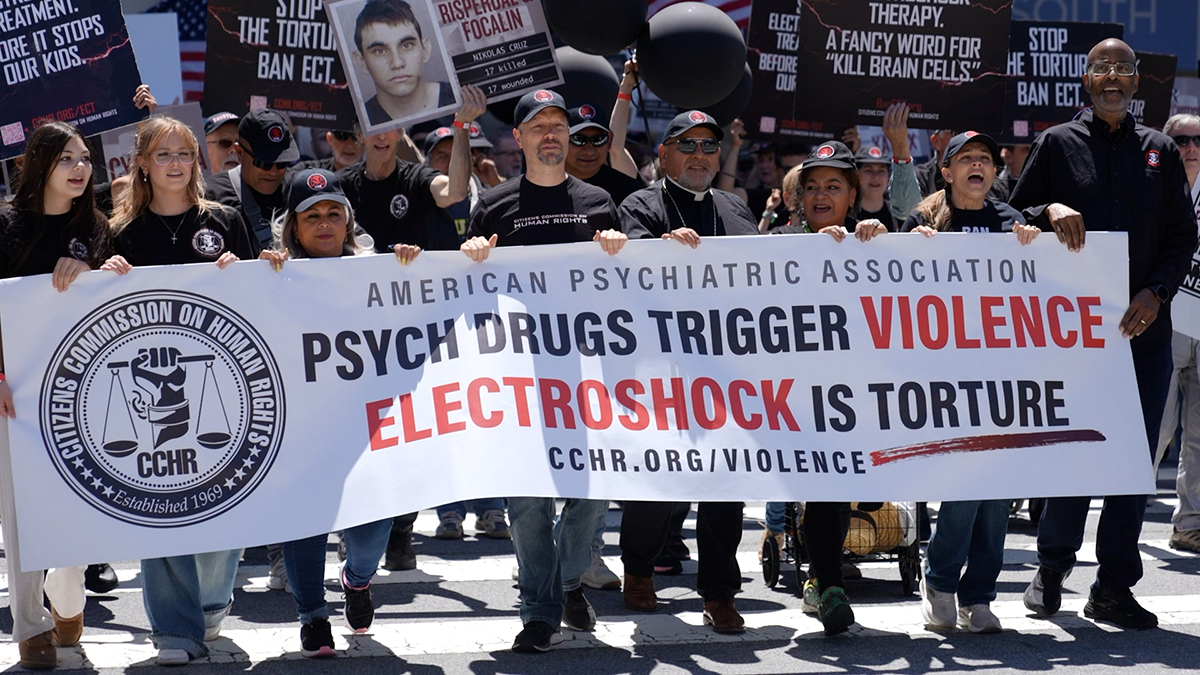
Citizens Commission on Human Rights International and its Bay Area chapters protested outside the American Psychiatric Association’s annual convention at San Francisco’s Moscone Center on May 16, demanding the APA adopt policies to eliminate coercive mental health interventions, including electroshock treatment and psychotropic drugs linked to violent side effects.
One seminar, “Care Without Coercion,” admitted that seclusion and restraint remain routine in American psychiatry despite their traumatic, abusive, and sometimes deadly consequences.[1] Yet the APA recently strenuously endorsed electroshock (ECT) on children and its forcible use on those who cannot or will not consent.[2]

The U.N. Special Rapporteur on Torture classifies non-consensual electroshock as torture. The World Health Organization says there are no medical indications for its use in minors, and it should be prohibited.[3]
CCHR secured the first ban on ECT for children in 1976, followed by stronger prohibitions in Texas (1993) and Western Australia (2014), where violations carry jail time.[4]
Psychiatric Drugs Trigger Violence
The APA was also sharply criticized for ignoring the well-documented violence-inducing effects of psychiatric drugs— risks that may be imposed on approximately 1.2 million Americans who are involuntarily committed each year, as well as those in court-ordered mental health “diversion” programs. On March 29, 2026, Luis Alvarado, compliant with his court-ordered diversion plan to take the antipsychotic olanzapine, set a deadly house fire in San Marcos, California, killing two homeowners.[5]
CCHR’s new report documents 145 cases of senseless violence by individuals taking or withdrawing from psychiatric drugs, resulting in 720 killed and 1,602 wounded. The cases include mass shootings, stabbings, arsons, and assaults. While not everyone will experience violent adverse urges, a percentage will. The U.S. Violence Prevention Project’s Mass Shooter Database reveals that 24% of mass shooters had been taking psychiatric drugs. Due to sealed records and limited toxicology disclosures, the true figure is likely much higher.[6] Toxicology for psychotropic drugs is rarely performed or reported. Drugs include antidepressants, antipsychotics, sedative-hypnotics, and mood stabilizers. Cases include a 10-year-old California boy on the antidepressant Anafranil who stabbed his 12-year-old friend to death in 2012.[7] In another case, a 6-year-old Virginia boy on ADHD drugs shot his teacher (2023).[8]
In California alone, a sample of 14 cases produced 37 deaths and 55 injuries.
Coinciding with the protest, CCHR opened its Psychiatry: An Industry of Death exhibit. Prominent California trial attorney Brent Wisner joined the call for mandatory toxicology testing in mass violence cases and supported a National Institutes of Health investigation into the issue ordered last year. Wisner’s firm helped secure Texas attorney Andy Vickery’s $6.4 million verdict against GlaxoSmithKline after Donald Schell (60) killed his wife, daughter, and granddaughter—then himself—after just two days on Paxil. The jury held the drug 80% responsible.[9]
Mr. Wisner stated, “We cannot ignore this issue anymore. People do not normally commit mass murder. It is inhuman.” He warned that “long-term use of antidepressants and antipsychotic drugs allows dehumanization. It allows dark thoughts to take over, and violence can ensue.”
Attendees at the opening learned that CCHR had obtained Central Intelligence Agency (CIA) documents on its MKULTRA mind-control experiments from the 1950s and 1960s, many conducted by prominent psychiatrists. A 1954 memo revealed the CIA formally studied whether a person could be secretly induced to commit an assassination against their will. This raises serious questions about whether such techniques continue to influence psychiatric practices in hospitals and communities today.
Misleading ECT Promotion Vs. Reality
Beyond psychiatric drugs, CCHR also reviewed how psychiatric facilities grossly mislead patients and their families about electroshock treatment, which was also used in MKULTRA experiments. CCHR Int’s review of over 50 psychiatric facilities promoting ECT on their websites reveals gross minimization of its risks. Riverpoint Behavioral Health, owned by Universal Health Services in Florida, calls ECT “minimally invasive… like jump-starting a car battery.”[10] Fort Lauderdale Behavioral Health’s video, “ECT with Dr. Pascal,” claims it can “turn the brain on and off just like a computer.”[11]
Dr. Sanjay Gupta, who heads the electroconvulsive therapy (ECT) program at BryLin Hospital in Buffalo, New York, delivered the APA’s opening plenary address on May 16.[12] The hospital’s website promotes ECT as a first resort treatment and claims most patients find it “no worse than going to the dentist,” with a mortality risk “far below the risk of child birth.”[13]
APA has denied concerns about the adverse effects of applying electricity to the developing brains of minors.[14] Yet, a Colorado psychiatric hospital cautions against using on children and adolescents “as their brains are still developing.”[15] Through FOIA reports, CCHR has documented cases of children as young as five receiving ECT—460 volts of electricity through their developing brains—in some states.
As part of its review, CCHR examined five psychiatric hospitals in San Francisco that promote ECT and compared their disclosures to the adverse effects the Food and Drug Administration (FDA) recommended in December 2018. None of the facilities disclosed the risk of permanent memory loss or the need for neuropsychological testing to assess cognitive damage before, during, and after treatment. None warned that long-term safety and effectiveness have not been demonstrated, that ECT cannot cure the underlying condition, or that relapse rates range from 70% to 84%—often requiring maintenance ECT (frequently combined with psychiatric drugs).[16]
ECT has also been shown to significantly lengthen inpatient stays (by 4–29 days), which drives up insurance and overall healthcare costs. In some cases, it adds between $5,700 and $52,700 in total healthcare costs (before, during, and after hospitalization) compared to non-ECT patients.[17] Early 1990s data estimated ECT was a $2–3 billion per year industry, equivalent today to $5.05 – $7.6 billion, adjusted for inflation.[18]
None of the facilities studied report the potential for brain damage; in a few cases, their websites emphatically state that ECT does not cause this. This contradicts a landmark California Supreme Court decision in which Wisner Baum successfully argued that ECT device manufacturer Somatics Inc. had a duty to warn physicians—and therefore their patients—that its device can cause brain damage and permanent memory loss. In the lower court, Somatics did not dispute that it failed to warn doctors of the risk of brain damage and permanent memory loss, nor did it dispute that plaintiff Michelle Himes sustained a brain injury. The company instead argued it should be immune from liability because the plaintiff’s doctor testified he would have prescribed ECT even if warned. The ruling underscores that patient autonomy must be considered sacrosanct in pharmaceutical and medical device product liability “failure to warn” cases.[19]
In another California case, in October 2018, the U.S. District Court for the Central District of California ruled that there was sufficient evidence for a reasonable jury to find that an ECT device caused brain injury.[20] More recent expert testimony before the Nebraska Supreme Court (2025) concluded that “ECT causes persistent or permanent memory loss and brain damage in a substantial proportion of recipients—somewhere between 12% and 55%.”[21]
BryLin Psychiatric Hospital claims that ECT’s resultant nerve-cell activity “releases chemicals in the brain” and helps restore normal functioning—a claim mirroring the debunked chemical imbalance theory used to justify SSRI antidepressants for depression.[22] It makes no mention of potential brain damage, despite decades of research documenting brain damage, memory loss, mortality risks, and an absence of verified long-term efficacy.[23]
APA has denied concerns about the “adverse effects of applying electricity to developing brains” of minors.[24] Yet, a Colorado psychiatric hospital cautions against using on children and adolescents “as their brains are still developing.”[25] CCHR has documented through FOIA requests that children as young as five have been administered ECT in several states.
Despite $139.6 billion spent in 2021 on mental health and substance services—a 241% increase since 2000—outcomes have worsened. The U.S. Department of Health and Human Services now urges deprescribing and safe tapering.
The American psychiatric system has failed spectacularly. After decades of mass drugging and electroshocking vulnerable individuals, and prescribing drugs that can trigger violence, leaving in their wake murdered victims, we face billions of dollars of waste on worsening mental health outcomes. It’s time to end the abuse and coercion.
Government agencies and insurers must stop financing this failed system and hold the psychiatric profession accountable. Electroshock and coercive practices must be banned. Mandated toxicology testing for psychiatric drugs in incidents of mass murder is vital, with a public record of the findings.
Implementing these points, and united with the many who share our deep concern, we can end psychiatric torture and restore human rights to the field of mental health.
[1] Care Without Coercion: A National Framework to Eliminate Seclusion and Restraint in Psychiatry, APA program, Saturday, May 16, 2026, 8:30 AM – 10:00 AM
[2] https://www.cchrint.org/2026/04/13/cchr-rejects-psychiatric-associations-push-to-expand-electroshock-on-children/
[3] https://www.cchrint.org/2026/04/13/cchr-rejects-psychiatric-associations-push-to-expand-electroshock-on-children/, Benedetto Saraceno, MD, “WHO RESOURCE BOOK ON MENTAL HEALTH, HUMAN RIGHTS AND LEGISLATION WHO 2005,” p. 64, http://www.lhac.eu/resources/library/who_resource-book-on-mental-health-human-rights-and-legislation–2.pdf
[4] https://www.cchrint.org/2026/04/13/cchr-rejects-psychiatric-associations-push-to-expand-electroshock-on-children/; Electroshock therapy on under-14s banned in WA after law passes Parliament,” ABC News, 17 Oct. 2014, http://www.abc.net.au/news/2014-10-17/mental-health-bill-passes-wa-parliament/5822874
[5] Eric S. Page, “San Marcos arson suspect was a tenant in home that burned, killing two,” NBC 7 San Diego, 30 Mar. 2026, https://www.nbcsandiego.com/news/local/san-marcos-fire-victims-ids-as-married-couple; Leo Place, “Suspect arraigned in San Marcos fire that killed ‘two incredible people,’” The Coast News Group, 3 Apr. 2026, https://thecoastnews.com/suspect-arraigned-in-san-marcos-fire-that-killed-two-incredible-people/
[6] https://www.cchrint.org/2026/04/28/cchrs-latest-report-links-145-violent-incidents-to-psychiatric-drugs/; “Mass Shooter Database,” The Violence Prevention Project, https://www.theviolenceproject.org/mass-shooter-database/; “Autopsies sealed in ongoing investigation,” Uvalde Leader News, 24 Nov. 2022, https://www.uvaldeleadernews.com/articles/autopsies-sealed-in-ongoing-investigation/
[7] https://www.cchrint.org/2026/04/28/cchrs-latest-report-links-145-violent-incidents-to-psychiatric-drugs/l James Nye, “I’m the mother of a 10-year-old murderer: Adopted mom of boy who stabbed 12 year old to death reveals how she struggled with his behavior for years but insists he’s no monster,” Daily Mail, 20 Oct. 2013, https://www.dailymail.co.uk/news/article-2469939/Adopted-mom-El-Cajon-boy-stabbed-Ryan-Carter-12-death-reveals-struggle.html
[8] https://www.cchrint.org/2026/04/28/cchrs-latest-report-links-145-violent-incidents-to-psychiatric-drugs/
“Mother of 6-year-old who shot Virginia teacher says son has ADHD,” ABC 30 Action News, 10 May 2023, https://abc30.com/post/deja-taylor-son-6-year-old-shoots-teacher-newport-news-virginia-abby-zwerner/13230688/
[9] “Jury Finds Glaxo to Blame in Shooting,” Los Angeles Times, 8 June 2001, https://www.latimes.com/archives/la-xpm-2001-jun-08-fi-7872-story.html; David Healy, Andrew Herxheimer, and David B Menkes, “Antidepressants and Violence: Problems at the Interface of Medicine and Law,” PLoS Medicine, Sept. 2006, 3(9): e372, https://www.ncbi.nlm.nih.gov/pmc/articles/PMC1564177/; “Jury: Paxil Maker Must Pay $8 Million,” ABC News, 6 June 2001, https://abcnews.go.com/Health/story?id=117410&page=1; Philip J. Hits, “Jury Awards $6.4 Million In Killings Tied to Drug,” The New York Times, 8 June 2001, https://www.nytimes.com/2001/06/08/us/jury-awards-6.4-million-in-killings-tied-to-drug.html
[10] https://riverpointbehavioral.com/treatments-services/adult-programs/electroconvulsive-therapy-ect/
[11] Fort Lauderdale Hospital, video, ECT with Dr. Pascal, https://youtu.be/V2vBnKOgCYM?si=TBKb4g093czOPiF5
[12] https://www.psychiatry.org/psychiatrists/meetings/annual-meeting/blog/explore-featured-sessions-at-the-2026-annual-meeti
[13] https://www.brylin.com/programs-services/electroconvulsive-therapy/
[14] https://www.cchrint.org/2026/04/13/cchr-rejects-psychiatric-associations-push-to-expand-electroshock-on-children/; Zilles-Wegner D, et al., “Joint statement by the World Psychiatric Association, the American Psychiatric Association, the European Psychiatric Association, and the Global Expert Task Force on ECT on the portrayal of electroconvulsive therapy in the WHO Guidance on Mental Health Policy and Strategic Action Plans,” The Lancet Psychiatry, 2026
[15] https://www.uchealth.com/en/treatments-and-procedures/electroconvulsive-therapy
[16] Ana Jelovac, et al., “Relapse Following Successful Electroconvulsive Therapy for Major Depression: A Meta-Analysis,” Neuropsychopharmacology, Nov 2013, https://www.ncbi.nlm.nih.gov/pmc/articles/PMC3799066/; James Luccarelli et al. “Maintenance ECT is associated with sustained improvement in depression symptoms without adverse cognitive effects in a retrospective cohort of 100 patients each receiving 50 or more ECT treatments,” J Affect Disord, 13 Apr. 2020, 15 June 2021, https://pmc.ncbi.nlm.nih.gov/articles/PMC7289157/; Youssef N, and McCall W. Relapse Prevention after Index Electroconvulsive Therapy in Treatment-Resistant Depression. Ann Clin Psychiatry. 2014 November; 26(4): 288–296, https://pmc.ncbi.nlm.nih.gov/articles/PMC4420179/
[17] Ganesh G, Ithman M, and Malwitz K. Predictors of length of stay in a psychiatric hospital, International Journal of Psychiatry in Clinical Practice, 2015; 19:4, 238-244, abstract https://pubmed.ncbi.nlm.nih.gov/26073671/; “Electroconvulsive therapy linked to longer hospital stays, increased costs,” Penn State, Science Daily 15 July 2021, https://www.sciencedaily.com/releases/2021/07/210714131856.htm
[18] Leonard Roy Frank, “Electroshock: Death, Brain Damage, Memory Loss, and Brainwashing,” The Journal of Mind and Behavior. Summer and Autumn 1990, Vol. 11
[19] https://www.wisnerbaum.com/defective-medical-device-injuries/ect/; https://www.madinamerica.com/2024/06/landmark-win-for-patient-autonomy-in-ca-supreme-court-ect-device-ruling/
[20] https://www.cchrint.org/2024/08/23/the-collapse-of-electroshock/; David Karen, “ECT Litigation Update: Are Patients Being Warned of Brain Damage Risk?” MAD, 13 June 2019, https://www.madinamerica.com/2019/06/ect-litigation-patients-not-warned-brain-damage-risk/
[21] Global Wellness Forum, GWF Perspective: Electroconvulsive Therapy (ECT) Ending the Waste, Fraud and Abuse of a Failed Protocol, White Paper, https://stopect.com/, citing Harold Robertson & Robin Pryor, “Memory and cognitive effects of ECT: informing and assessing patients,” Advances in Psychiatric Treatment (2006), vol. 12, 228–238, https://www.wisnerbaum.com/wp-content/uploads/28.-Robertson-and-Pryor.2006-Memory-and-cognitive-effects-of-ECT.pdf
[22] https://www.brylin.com/programs-services/electroconvulsive-therapy/
[23] Global Wellness Forum, GWF Perspective: Electroconvulsive Therapy (ECT) Ending the Waste, Fraud and Abuse of a Failed Protocol, citing John Read and Richard Bentall, “The effectiveness of electroconvulsive therapy: A literature review,” Epidemiol Psichiatr Soc., Oct-Dec. 2010, https://pubmed.ncbi.nlm.nih.gov/21322506/
[24] https://www.cchrint.org/2026/04/13/cchr-rejects-psychiatric-associations-push-to-expand-electroshock-on-children/; Zilles-Wegner D, et al., “Joint statement by the World Psychiatric Association, the American Psychiatric Association, the European Psychiatric Association, and the Global Expert Task Force on ECT on the portrayal of electroconvulsive therapy in the WHO Guidance on Mental Health Policy and Strategic Action Plans,” The Lancet Psychiatry, 2026
[25] https://www.uchealth.com/en/treatments-and-procedures/electroconvulsive-therapy
SHARE YOUR STORY/COMMENT