

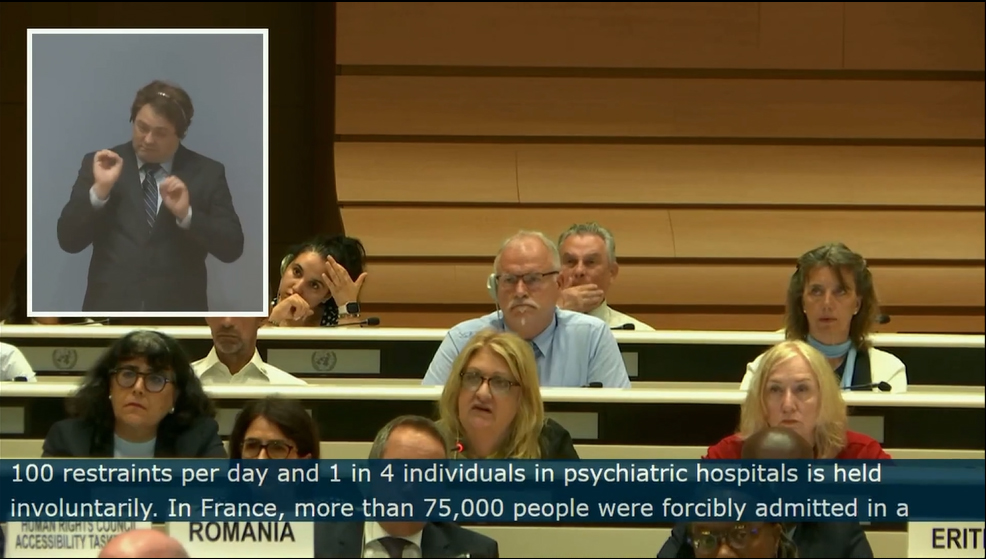
At the United Nations’ global human rights epicenter in Geneva, CCHR International addressed a UN committee, calling for the abolition of electroshock and forced drugging—especially of children—while citing governments’ failure to enforce strong penalties against those responsible for such abuse.
By CCHR International
The Mental Health Industry Watchdog
August 15, 2025
On August 11, 2025, executives from the Citizens Commission on Human Rights International (CCHR) addressed the United Nations Committee on the Convention on the Rights of Persons with Disabilities (CRPD), supporting the CRPD’s ban on coercive psychiatric practices. Founded in 1969, CCHR has spent over five decades exposing and working to end involuntary commitment, electroshock treatment (ECT), psychosurgery, and forced psychotropic drugging. The organization commended the Committee for its leadership in advancing a human rights-based approach to mental health.
Electroshock on Children: A Global Scandal
CCHR’s testimony focused sharply on the ongoing use of electroshock, not only on children but on all ages—an issue the group has fought since its inception in 1969. The organization’s executive director, Fran Andrews, detailed how CCHR helped secure the first U.S. ban on ECT for children under 12 in California (1976), in Texas (1993) for those under 16, and in Western Australia in 2014, where criminal penalties now apply for administering ECT to children under 14. The Australian Capital Territory banned electroshocking children under 12 in 2015. Despite these successes, the practice continues globally—with devastating consequences.
CCHR also spoke of a New Zealand government inquiry, which in recent years acknowledged the torture of children subjected to electroshock without anesthetic at the country’s now closed Lake Alice psychiatric hospital.
In the United States, children as young as 5 can still be electroshocked, endorsed by both the American Psychiatric Association and the American Academy of Child and Adolescent Psychiatry, which have advocated expanding ECT use in minors. The U.S. has been a signatory to the CRPD since 2009.[1] CCHR informed the CRPD committee that ongoing forced treatment in the U.S. violates the CRPD and World Health Organization (WHO)/UN guidance on mental health, urging an end to such practices.
The situation is no better in Europe. A 2022 review revealed alarming levels of ECT use among 10–18-year-olds in the Czech Republic, Finland, Denmark, and Sweden. [2]
Prominent Australian psychiatrist Dr. Niall McLaren has been clear: “No psychiatrist needs to use ECT.”[3]
Mass Antipsychotic Drugging of Children
Jan Eastgate, President of CCHR International, spoke about the alarming global rise in psychotropic drugging of children, especially antipsychotics. A Lancet Psychiatry report confirms worldwide increases. [4]
In 2024, Frontier Psychiatry reported that the U.S. leads the world in high prevalence rates of psychotropic drug use for youth. In Europe and Australia, the increasing rates exist, but more moderately. Most concerning is the fact that the number of youths receiving antipsychotics has increased by 50%-200% over the past 20 years, depending on the cohort. Researchers found that parents are seldom aware of the risks (e.g., weight gain, metabolic changes, diabetes, sedation, tremor, somnolence, and restlessness) associated with these drugs.[5]
The antipsychotic risperidone, often prescribed to children, can cause severe side effects, including obesity, diabetes, gynecomastia (female breast growth in boys, sometimes requiring mastectomies), and sudden death.[6] A 2020 study found risperidone to be the most frequently prescribed antipsychotic in the Netherlands, Denmark, UK, and Germany—including for children as young as 4 years old.[7]
In England, risperidone is the most prescribed antipsychotic for 3–18-year-olds, accounting for 61.4% of prescriptions. Boys comprised 63.2% of those receiving an antipsychotic, according to Lancet Psychiatry.[8] In the UK, boys made up over 76% of 0–9-year-olds on antipsychotics, and risperidone accounted for more than 53% of prescriptions in this age group.[9] Ms. Eastgate estimated that combined between 40% to over 60% of young boys prescribed antipsychotics could be on risperidone.
While there are efforts to scale back the number of children prescribed antipsychotics, many are prescribed these off-label, in combination with other psychotropics. The number of children receiving polypharmacy (two or more psychiatric drugs) in the U.S. rose from 81.7% to 86.4% between 2009 and 2017.[10]
Salvador Fernández, President of CCHR Spain, spoke of the dangers of “ADHD” drugs prescribed to children, such as methylphenidate, “which continue to be widely prescribed, despite warnings in the technical sheets of several of these drugs about serious risks, such as suicidal behavior, psychotic episodes, and cardiovascular complications.”
Ms. Eastgate also raised the alarm about restraint deaths, pointing to children as young as 7 who, confined in U.S. for-profit psychiatric hospitals, are often subjected to seclusion, restraint, and forced drugging. Deaths ruled as homicides have rarely led to convictions, and most hospitals continue operating with impunity, profiting from Medicaid and other insurance coverage.
Federal and State Investigations into U.S. Psychiatric Hospital Chains
A New York Times investigation (Sept. 2024) found Acadia Healthcare often detains people against their will to maximize insurance billing. In some cases, judges had to intervene to release wrongfully held individuals.
Mr. Fernández added that in Spain, involuntary hospitalizations of children occur, as well as “mechanical and chemical restraints, sometimes prolonged for hours.”
CCHR International’s written submission also revealed studies showing psychiatric hospitalization can raise the risk of suicide by 44-fold, and forced psychiatric drugging increases suicide risk sixfold.[11] A July 2025 study found that those involuntarily hospitalized were nearly twice as likely to die by suicide or overdose within three months of discharge.[12]
CCHR emphasized that coercive psychiatric practices are not isolated, but part of a global pattern. A 2022 European study confirmed widespread use of mechanical and chemical restraints, with significant differences in regulations.[13]
A Harvard Law School report found that U.S. state hospitals continue to use practices—including forced ECT—that may constitute torture under international law.[14]
Eastgate concluded to the CRPD Committee: “Electroshock, psychosurgery, forced drugging, seclusion, and restraint are not care—they are state-sanctioned abuse and must end. Upholding autonomy, dignity, and liberty is non-negotiable. Rights-based alternatives must replace outdated, violent psychiatric practices.”
An End to Psychiatric Abuse
CCHR urged the CRPD to call for:
- A global ban on electroshock.
- Prohibition of forced drugging and the use of mechanical and chemical restraints.
- Strong criminal penalties for perpetrators of psychiatric abuse, with full enforcement.
- International adoption of WHO/UN human-rights-based mental health guidelines.
- Transparent reporting of psychiatric abuse cases, with public access to enforcement outcomes.
[1] Patsy Widakuswara, “32 Years After US Disabilities Act, No Plans to Ratify UN Treaty It Inspired,” VOA News, 26 July 2022, https://www.voanews.com/a/years-after-us-disabilities-act-no-plans-to-ratify-un-treaty-it-inspired-/6675363.html
[2] Olaf Rask, et al., “Electroconvulsive therapy in children and adolescents: results from a population‑based study utilising the Swedish National Quality Register,” Eur Child Adolesc Psychiatry, 13 Dec. 2022, https://pmc.ncbi.nlm.nih.gov/articles/PMC10682289/
[3] https://www.cchrint.org/2023/04/11/uk-legislators-call-for-ban-electroshock-treatment/, citing Niall McLaren, “No Psychiatrist Needs to Use ECT,” 27 June 2017, https://www.madinamerica.com/2017/06/no-psychiatrist-needs-use-ect/
[4] “Trends in antipsychotic prescribing to children and adolescents in England: cohort study using 2000–19 primary care data,” The Lancet Psychiatry, Vol. 19, Issue 2, Feb. 2023, https://www.thelancet.com/journals/lanpsy/article/PIIS2215-0366(22)00404-7/fulltext
[5] “Editorial: Psychotropic overprescribing to youth: scope of the problem, causes, and possible solutions,” Frontier Psychiatry, 6 May 2024, https://pmc.ncbi.nlm.nih.gov/articles/PMC11107288/
[6] Gardiner Harris, No More Tears: The Dark Histories of Johnson & Johnson, (Random House, New York) 2025, pp. 192-193; https://www.accessdata.fda.gov/drugsatfda_docs/label/2025/020272s088%2C020588s074%2C021444
s060lbl.pdf
[7] Kaguelidou F, et al., “‘Use of antipsychotics in children and adolescents: a picture from the ARITMO population-based European cohort study,’” Epidemiol Psychiatr Sci, 20 Apr. 2020, https://pmc.ncbi.nlm.nih.gov/articles/PMC7214736/
[8] https://nhsbsa-opendata.s3.eu-west-2.amazonaws.com/mumh/mumh_0402_2425_v001.html
[9] ‘Use of antipsychotics in children and adolescents: a picture from the ARITMO population-based European cohort study,” Epidemiol Psychiatr Sci., 20 April 2020, https://pmc.ncbi.nlm.nih.gov/articles/PMC7214736/
[10] “Antipsychotic Use in Young Children Declining, but Concerning Trends Remain,” Psychiatry Online, 1 Dec. 2020, https://psychiatryonline.org/doi/10.1176/appi.pn.2020.12a15
[11] Matthew M. Large, Christopher J. Ryan, “Disturbing findings about the risk of suicide and psychiatric hospitals,” Soc. Psychiatry Psychiatr Epidemiology (2014), 49: 1353-1355, https://link.springer.com/article/10.1007/s00127-014-0912-2
[12] Natalia Emanuel, et al., “A Danger to Self and Others: Health and Criminal Consequences of Involuntary Hospitalization,” Federal Reserve Bank of New York, staff reports, July 2025, https://www.newyorkfed.org/medialibrary/media/research/staff_reports/sr1158.pdf?sc_lang=en
[13] David O’Donovan, “Currenttrends in restrictive interventions in psychiatry: a European perspective,” Cambridge University Press, 22 June 2022, https://www.cambridge.org/core/journals/bjpsych-advances/article/current-trends-in-restrictive-interventions-in-psychiatry-a-european-perspective/287C3187376FA5C987106BE108603819
[14] Matthew S. Smith & Michael Ashley Stein, “WHEN DOES MENTAL HEALTH COERCION CONSTITUTE TORTURE?: IMPLICATIONS OF UNPUBLISHED U.S. IMMIGRATION JUDGE DECISIONS DENYING NON-REFOULEMENT PROTECTION,” FORDHAM INTERNATIONAL LAW JOURNAL, Vol 45:5, 2022, https://ir.lawnet.fordham.edu/ilj/vol45/iss5/2/, pp. 785-786
SHARE YOUR STORY/COMMENT