Posts Tagged ‘National Institute of Mental Health’

The Psychopharmaceutical Industrial Complex—creating epidemic of mental illness through psychiatry’s chemical imbalance hoax

Tuesday, June 8th, 2010

Dissident Voice
By Evelyn Pringle
June 8, 2010

For the past two decades, the Psychopharmaceutical Industrial Complex has been the driving force behind the epidemic of mental illness in the United States with the promotion of biological psychiatry and a bogus “chemical imbalance” in the brain theory.

The Psychopharmaceutical Industrial Complex (PPIC) is a symbiotic system composed of the American Psychiatric Association, the pharmaceutical industry, public relations and advertising firms, patient support organizations, the National Institute of Mental Health, managed care organizations, and the flow of resources and money among these groups, according to an October 1, 2009 paper in the Journal of Mental Health Counseling, by Dr Thomas Murray, director of Counseling and Disability Services at the University of North Caroline School of Art.

Murray’s paper draws parallels between cult indoctrination and PPIC techniques and notes the similarities between cult members and mental health consumers who are vulnerable to losing their identities to the PPIC.

The PPIC and “its adherence to the disease model pervades mainstream culture and greatly impacts psychotherapy,” he says. “Consequently, the effects of the PPIC may have resulted in some psychiatric consumers adopting disease-model messages in ways similar to cult indoctrination.”

“Consumer adoption of the disease model can create obstacles to treatment when hope is fundamental,” he advises.

Murray says his most difficult cases “involve clients who have in essence been drawn into the PPIC and have become resigned to the disease model with little sense of empowerment to overcome their emotional problems.”

“These are the consumers who have little self-efficacy and little hope that they have options other than to suffer,” he reports.

“Insurance companies rely on pharmaceuticals to contain costs (and limit psychotherapy sessions), and reimbursement depends on a diagnosis of a diseased brain,” Murray notes.

Read entire article:  http://dissidentvoice.org/2010/06/tracking-the-american-epidemic-of-mental-illness-part-iii/

« Return to news items


Share

Former Head of Psychiatric Billing Bible—Theres no lab test, X-ray or any test that can prove someone has a mental disorder

Wednesday, June 2nd, 2010

Normality is an endangered species.

Psychology Today
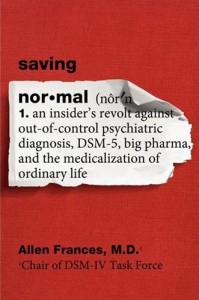
By Allen Frances, Former Chairman, DSM-IV Task Force
June 2, 2010

Fads in psychiatric diagnosis come and go and have been with us as long as there has been a psychiatry. The fads meet a deeply felt need to explain, or at least to label, what would otherwise be unexplainable human suffering and deviance. In recent years the pace has picked up and false “epidemics” have come in bunches involving an ever increasing proportion of the population. We are now in the midst of at least three such epidemics- of autism, attention deficit, and childhood bipolar disorder.  And unless it comes to its senses, DSM5 threatens to provoke several more  (hypersexuality, binge eating, mixed anxiety depression, minor neurocognitive, and others).

Fads punctuate what has become a basic background of overdiagnosis. Normality is an endangered species. The NIMH estimates that, in any given year, twenty five percent of the population (that’s almost sixty million people) has a diagnosable mental disorder. A prospective study found that, by age thirty two, fifty percent of the general population had qualified for an anxiety disorder, forty percent for a depression, and thirty percent for alcohol abuse or dependence. Imagine what the rates will be like by the time these people hit fifty, or sixty five, or eighty.  In this brave new world of psychiatric overdiagnosis, will anyone get through life without a mental disorder?

What accounts for the recent upsurge in diagnosis? I feel quite confident we can’t blame it on our brains. Human physiology and human nature change slowly if at all.  Could it be that the surge in mental disorders is caused by our stressful society? I think not.  There is no particular reason to believe that life is any harder now than it has always been-more likely we are the most pampered and protected generation  ever to face its inevitable challenges. It is also tempting to find environmental (eg toxins) or iatrogenic causes(eg vaccinations), but there is no credible evidence supporting either of these. There is really only one viable environmental candidate to explain the growth of mental disorder – the widespread recreational use of psychotropic substances.  But this cannot account for the extent of the “epidemics”, particularly since most have centered on children.

No. The “epidemics” in psychiatry are caused by changing diagnostic fashions – the  people don’t change, the labels do. There are no objective tests in psychiatry-no X-ray, laboratory, or exam finding that says definitively that someone does or does not have a mental disorder.  What is diagnosed as mental disorder is very sensitive to professional and social contextual forces. Rates of disorder rise easily  because mental disorder has such fluid boundaries with normality.

Read entire article:  http://www.psychologytoday.com/blog/dsm5-in-distress/201006/psychiatric-fads-and-overdiagnosis

« Return to news items


Share

Psychiatrists And Pharma: Undue Influence? Concern about corruption increasing…

Friday, March 26th, 2010

Pharmalot
By Ed Silverman
March 25, 2010

Two essays published in separate periodicals this week raise troubling questions about the extent to which psychiatrists may be unduly influenced by the pharmaceutical industry, and how this relationship may effect public trust in psychiatry. The upshot? The concern about corruption, or at least the appearance of corruption is palpable. Sigmund Freud would not be pleased. Interestingly, one of the authors is Tom Insel, the director of the National Institute of Mental Health.

For instance, Lisa Cosgrove and Harold Bursztajn write in Psychiatric Times that they looked at the two philanthropic arms of the American Psychiatric Association – the American Psychiatric Foundation and the American Psychiatric Institute for Research and Education – and found that APF’s 15-member board includes four high-level pharma execs that either make meds recommended by APA or are developing products targeted to treat mental disorders. Other board members include two more with industry ties and a senior vp at Fleishman Hillard, the public relations firm whose clients include six drugmakers.

APF’s corporate advisory council lists drugmakers, they continue, that contribute “significant funding” to APF and that make meds recommended in the APA’s clinical practice guidelines. Although it was not possible to discern the total amount of industry funding given to APF, in fiscal year 2008 APF lists 11 pharmaceutical companies and 1 medical device manufacturer that contributed monies; 6 of the companies are listed as giving $40,000 “and above” per year.

They go on to write that APIRE, like APF, doesn’t require disclosure of financial conflicts of interests, and that nine of 16 APIRE board members have ties to drugmakers. They also note current disclosure policies don’t require reporting of pooled industry money to academic departments, units, hospitals, and med schools. And because there is no independent monitoring of industry ties, they maintain “underreporting is very likely a problem. For example, one board member who reported ‘no disclosure’ in an APA publication was found to be on the speakers’ bureau of multiple pharmaceutical companies.”

Read entire article:  http://www.pharmalot.com/2010/03/psychiatrists-and-pharma-undue-influence/

« Return to news items


Share

Citing public’s growing distrust of psychiatry, NIMH Chief says psychiatry must “Clean up our act”

Wednesday, March 24th, 2010

FiercePharma
By Tracy Staton
March 24, 2010

Is the new Journal of the American Medical Association a special issue on reform? It doesn’t stop with its demands for new publication standards. It’s also showcasing a rallying cry from National Institute of Mental Health Director Dr. Thomas Insel, who calls on his fellow psychiatrists to “clean up our act.”

In Insel’s estimation, psychiatry has grown too close to drugmakers. All the money flowing from pharma to psychiatrists and psychiatric researchers has created a “culture of influence,” he says, and psychiatrists need to rise above all that. He wants all financial ties between drugmakers and psychiatry to be disclosed, and for psychiatrists to take a step back from branded meds in favor of generic drugs and non-drug treatments such as talk therapy.

This is far from the first call for change in psychiatry. Over the past three years, congressional probes have repeatedly highlighted influential psychiatrists’ financial relationships with industry. In some cases, payments from drugmakers went undisclosed even though researchers were obliged to report them to their universities.

- read the JAMA extract

« Return to news items


Share

Sen Grassley’s bill now requires public disclosure of ALL Pharma $$ to doctors— Top Psychiatrist calls for “Ethics Cleanup”

Tuesday, March 23rd, 2010

Associated Press
Carla K. Johnson
March 23, 2010

American psychiatrists need to break away from a “culture of influence” created by their financial dealings with the drug industry, the head of the National Institute of Mental Health said in a leading medical journal.

Dr. Thomas Insel stops short of calling researchers corrupt or asking them to stop taking money from drug companies. But he highlights a “bias in prescribing practices” that favors brand names drugs over cheaper generics and non-drug treatments. And he says the situation must change with new standards for transparency and full disclosure of psychiatry’s collaborations with industry.

“We can show the rest of medicine how to clean up our act,” Insel told The Associated Press. His commentary appears in Wednesday’s Journal of the American Medical Association.

His efforts got a boost Tuesday with the signing of the health care overhaul legislation which requires drugmakers and others to file annual reports to the government on their financial ties to doctors. The law requires reporting of gifts, entertainment, food, research money and other fees and grants. Consumer advocates applaud the “sunshine” provision because it also requires a database the public can search for their own doctors’ ties to industry.

“Transparency is the first step toward giving patients and the public the tools they need to evaluate those relationships,” said Allan Coukell, director of the Pew Prescription Project, a consumer health project of the nonprofit Pew Charitable Trusts.

Current National Institutes of Health rules on financial disclosure are confusing, Insel said. They allow researchers seeking federal funds to make their own judgments about what constitutes a significant financial interest, which they must report to their academic or research institutions. The rules also exempt disclosures of anything below $10,000 annually or 5 percent equity interest in a company. Insel is helping oversee a revision of the NIH’s rules, which date back to 1995.

Industry pays for much of the medical research in the United States and many scientists have financial relationships with drug and device makers. Researchers at many institutions are expected to fully disclose those ties to their universities, to the NIH and to the medical journals that publish their research.

Beginning in 2008, an inquiry by Sen. Chuck Grassley, R-Iowa, uncovered millions of dollars in unreported fees paid by drug industry to prominent researchers. The investigation prompted universities and NIH to reassess their conflict-of-interest policies.

When the Grassley inquiry accused seven psychiatrists of failing to report payments they received from drug companies, Insel, himself a psychiatrist, said he tried to determine whether psychiatrists were being targeted unfairly.

He found, instead, evidence that psychiatry may have more drug ties than other medical specialties. In Vermont, for example, which requires public disclosure of industry payments to doctors, psychiatrists receive more money from drug companies than do other types of doctors.

Psychiatric journals report slightly higher rates of industry funding of published studies than other medical journals. And one study found that 90 percent of the advisers who help write American Psychiatric Association guidelines had undisclosed financial ties to industry, Insel writes in JAMA.

Read entire article:  http://www.google.com/hostednews/ap/article/ALeqM5i0eFhYRg8tB3fLeCNO4Ka1IXc_9wD9EKIA103

« Return to news items


Share

Manufacturing Depression—Are Docs Over Prescribing Antidepressants to a Tune of $10 Billion a Year for Drug Companies?

Wednesday, March 3rd, 2010

AlterNet
By Amy Goodman
March 3, 2010

A psychotherapist says depression can be debilitating — but that it’s also been largely created by doctors and drug companies as a medical condition.

Is depression manufactured? Two decades after the introduction of antidepressants, it’s become commonplace to assume that our sadness can be explained in terms of a disease called depression. The National Institute of Mental Health estimates more than 14 million Americans suffer from major depression every year and more than three million suffer from minor depression. Some 30 million Americans take antidepressants at a cost of over $10 billion a year.

My next guest argues while depression can be debilitating, it’s also been largely manufactured by doctors and drug companies as a medical condition with a biological cause that can be treated with prescription medication. Psychotherapist and writer Gary Greenberg participated in a clinical trial for antidepressant medication and found that more often than not the drugs failed to outperform placebos. His latest book is a scientific, medical, historical and cultural exploration of the antidepressant revolution here in the United States. It’s called Manufacturing Depression: The Secret History of a Modern Disease.

Read entire article:  http://www.alternet.org/health/145850/%27manufacturing_depression%27:_are_doctors_over-prescribing_antidepressants_to_a_tune_of_$10_billion_a_year_for_drug_companies/

« Return to news items


Share

Senator Grassley’s investigation of pharma funded psychiatrists leads to National Institute of Mental Health probe

Thursday, January 21st, 2010

Science Insider
By Jocelyn Kaiser
January 20, 2010

As part of his ongoing investigation of conflicts of interest in biomedicine, Senator Charles Grassley (R–IA) now wants to comb through the e-mails of Thomas Insel, director of the National Institute of Mental Health (NIMH). Grassley points out in a letter today to NIH Director Francis Collins that his 2-year probe has found five psychiatrists who failed to report drug company income or had other conflict issues—all of them researchers with funding from NIMH. “I wonder if there is something in particular about this institute that leads to so many funding problems,” the letter says. It asks for Insel’s e-mails and his calendar since 2 May; his phone records for 2009 and 2010; and NIMH staff members’ e-mails and communications regarding Senate investigations or conflicts of interest back to June 2008. Grassley wants all of this by 3 February.

Read entire article:  http://blogs.sciencemag.org/scienceinsider/2010/01/grassley-goes-f.html

« Return to news items


Share

Ritalin Use Linked with 500% Increase of Sudden Death in Children

Wednesday, December 30th, 2009

E. Huff
NaturalNews.com
December 30, 2009

Research from The National Institute of Mental Health has revealed that popular Attention Deficit Disorder (ADD) drugs like Ritalin are responsible for causing sudden death in many children. Study numbers indicate a 500 percent increased risk in childhood death from taking such mental health drugs.

For years, many experts, scientists, and health practitioners have speculated that ADD drugs are dangerous and can cause serious injury and death. Etta Brown, a licensed educational psychologist and author of Learning Disabilities: Understanding the Problem and Managing the Challenges explained in response to the study that drugs like Ritalin actually destroy the neural function in children’s brains. As a result, children who have undergone treatment with Ritalin will actually have a much more difficult time processing information and learning new things.

Brown also notes that Ritalin is responsible for causing a permanent tic in the face, neck, and head of many of the children who have taken or are taking it. Ironically, Ritalin is responsible for causing far more serious neurological damage than the problems it is alleged to treat. Comprehensive studies over the years have revealed that while drugs like Ritalin visibly calm children, these drugs destroy their delicate, developing nervous systems and can permanently cripple their ability to function as normal human beings.

Read entire article: http://www.naturalnews.com/027833_ritalin_sudden_death.html

« Return to news items


Share

Psychiatrists want depression tests and treatment for 3 year olds

Monday, August 3rd, 2009

Lindsay Tanner
AP Medical Writer
August 3, 2009

CHICAGO — Depression in children as young as 3 is real and not just a passing grumpy mood, according to provocative new research.

The study is billed as the first to show major depression can be chronic even in very young children, contrary to the stereotype of the happy-go-lucky preschooler.

Until fairly recently, “people really haven’t paid much attention to depressive disorders in children under the age of 6,” said lead author Dr. Joan Luby, a psychiatrist at Washington University in St. Louis. “They didn’t think it could happen … because children under 6 were too emotionally immature to experience it.”

Previous research suggested that depression affects about 2 percent of U.S. preschoolers, or roughly 160,000 youngsters, at one time or another. But it was unclear whether depression in preschoolers could be chronic, as it can be in older children and adults

Luby’s research team followed more than 200 preschoolers, ages 3 to 6, for up to two years, including 75 diagnosed with major depression. The children had up to four mental health exams during the study.

Among initially depressed children, 64 percent were still depressed or had a recurrent episode of depression six months later, and 40 percent still had problems after two years. Overall, nearly 20 percent had persistent or recurrent depression at all four exams.

Read entire article: http://www.pantagraph.com/news/article_fbf13b80-8087-11de-b7d8-001cc4c03286.html

« Return to news items


Share