Posts Tagged ‘James Holmes’

Random Violence & Senseless Shootings: Police data may I.D. psychiatric drug use in violent crimes

Friday, October 26th, 2012

By Kelly Patricia O’Meara
October 26, 2012

Law enforcement is in a unique position to collect data that may actually provide the most accurate information about the possible connection between psychotropic  drugs and violence.

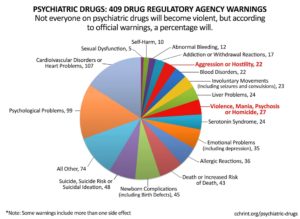
22 international drug regulatory warnings cite psychiatric drugs causing violent reactions including mania, psychosis, hostility, violence and homicide.

In an effort to summarize attempts by law enforcement to identify the reason(s) behind  James Holmes killing 12 innocent people and injuring 58 others in an Aurora, Colo., movie theatre, one writer reports that  ”the search for an explanation has been elusive.”   Maybe.  But one could argue that the answers for such random, senseless violence isn’t  so much “elusive,”  as they are ignored and actually may lie in data that currently are in the hands of law enforcement.

Given the ever-increasing list of “shooters,” (Aurora, Virginia Tech, Columbine, etc.,) law enforcement has its hands full not only trying to keep the peace, but also attempting to determine the cause of the random violent behavior that plagues the nation’s cities.  Because firearms are used in the execution of these violent acts, immediately attention is directed, or deflected, at instituting tougher gun control laws.

Conversely, the spotlight is rarely, if ever, directed at the very documentable fact that America is being “medicated” – having their brains chemically altered – at increasingly alarming rates.  Recent analysis of pharmacy claims data by Medco Health Solutions, Inc., reveals that one in five American adults take at least one psychiatric drug and that the use of psychiatric drugs among adults grew 22 percent from 2001 and 2010. The data further revealed that 10 percent of men and a whopping 21 percent of adult women used antidepressants, adding $11.6 billion to pharmaceutical coffers.

A bill introduced in New York in 2000 proposed police investigate psychiatric drug in all cases of violent crimes and suicides. Click image to read the bill

Antidepressants and other psychotropic drugs long have been the center of a raging debate about a connection between  violence and  psychiatric drug use. This debate came to a head when , in 2004, the Food and Drug Administration, FDA, added “black box” warnings (its most serious warnings) to most of the approved antidepressants because of suicidal thoughts reported in children taking the mind-altering drugs.   And there are other reported adverse side effects associated with antidepressants including, but not limited to mania, (violent, abnormal behavior), hypomania, amnesia, manic reaction, psychotic reaction, delirium, delusion, hallucinations, hostility, psychosis and homicidal ideation.

Do any of these adverse reactions resemble the information provided to the public about James Holmes?  Anyone who had viewed Holmes’ s first courtroom appearance would have to admit that, aside from his orange colored hair, he  didn’t look quite “right.”   Furthermore, Holmes apparently had been seeing at least three psychiatrists and, at a minimum, had been diagnosed with  “Dysphoric Mania.”  What the public has not been told is what cocktail of mind-altering drugs had his team of psychiatrists prescribed and at what levels.

A similar scenario recently unfolded with the shooting at the Atlanta World Changers Church International. Floyd Palmer, had been committed to a psychiatric hospital for a 2001 shooting at a mosque in Baltimore, Md.  Having been released from that facility in 2005, Palmer made his way to Atlanta and unknown to the Atlanta church, the former psychiatric patient gained employment with the church as a maintenance man. As was the case in the 2001 shooting, earlier this month, Palmer inexplicably shot and killed a volunteer leading a prayer service at the megachurch.  Again, the question must be raised: what mind-altering drugs had Palmer been prescribed?

It is precisely this information that may provide answers to Holmes’  deadly actions that to some seems so  “elusive” and also to Palmer’s recent violence.   The question that is conspicuously missing from the debate is whether Holmes’s  seemingly uncharacteristic behavior, and Palmer’s not so uncharacteristic behavior, is the result of the mind-altering drugs they had been prescribed. In other words,  did these men “go off” because of one or several of the known adverse reactions of psychiatric drugs?

To support the “psychiatric drugs cause violence” argument, a 2010 study from the Institute for Safe Medication Practices and published in the journal PloS One, and based on the FDA’s Adverse Event Reporting System, found that “adverse events are indeed associated with antidepressants and several other types of psychotropic medications.”  The study “identified 31 drugs responsible for most of the FDA case reports of violence toward others, with antidepressants near the top of that list.”

Between 2004 and 2011, there have been over 11,000 reports to the U.S. FDA’s MedWatch system of psychiatric drug side effects related to violence. These include 300 cases of homicide, nearly 3,000 cases of mania and over 7,000 cases of aggression. Note: By the FDA’s own admission, only 1-10% of side effects are ever reported to the FDA, so the actual number of side effects occurring are most certainly higher.

While the FDA’s Adverse Event Reporting System is helpful, those data are based on self-reporting and many agree it represents a small percentage of the actual adverse events that occur. In fact, between 2004 and 2011, there were more than 11,000 reports to the FDA’s MedWatch System pertaining to psychiatric drug side effects relating to violence, including 300 cases of homicide, nearly 3,000 cases of mania and more than 7,000 cases of aggression.  By the FDA’s own admission, only 1-10% of side effects are ever reported to the FDA.

Law enforcement, however, is in a unique position to collect data that may actually provide the most accurate information about the possible connection between psychotropic  drugs and violence.   Sue Todd, a retired Northern California detective,  recalls that when she retired in 2001 “there was no training or focus on whether a suspect had been medicated with psychiatric drugs. The focus was on illegal drugs.”  “Even today for the officer’s purposes,” explains Todd, “the arrest process is the same no matter what drugs they may be taking.”

The cop on the street may not be immediately concerned with whether a psychiatric drug plays a part in a violent act, but as the arrest process proceeds, law enforcement officials are on the frontline of data collection.  “Currently,” says Todd, “the booking form that goes to reporting crime statistics on a national level could have a question about what medications are being taken by the suspect being booked.” “The Sheriff’s Departments usually are the primary housing authority,” explains Todd, “and they ask questions about the detainee’s medications.”  “In light of the recent circumstances with people ‘going Postal,’ says Todd, “it seems reasonable that this medication information would be collected.  It would be a perfect ground zero to analyze the data to see if there is any correlation.”

A veteran officer of the Los Angeles Police Department, who asked not to be identified, was in agreement with Todd’s assessment of past police practices and verified that detainee’s today must answer questions about any medications they may be taking.  According to this source,  “unlike arrests of the past, where people would tell us the drugs they were prescribed for diabetes, heart problems or blood pressure, today they’ll give us a shopping list of prescribed psychiatric medications.”  “This data,” the source explains, “already is collected and is a gold mine of information that should be analyzed and the findings released to law enforcement, the government and the community.”

Just a cursory review of State and County police booking forms on the internet reveals that detainees most definitely are required to list any medications, including psychiatric medications, they may be taking. Like the FDA’s MedWatch, there would be no reason to collect personal identifying information and, therefore, no violation of HIPPA (federal law protecting individual health records) and no reason that this medication/offense data could not be collected and analyzed on a national level.

Setting up a national database that reflects the category of crime and what, if any, psychiatric drug the inmate may have been on at the time of arrest isn’t unheard of .  In 2001, former New York State Senator, Owen H. Johnson, introduced a bill, S1784 that would effectively require law enforcement agencies in New York to collect data on certain violent crimes and what, if any, psychiatric drugs the offender may have been on during the commission of the crime.

Click the image to read the proposed NY Law which would have required police to investigate psychiatric drug use by any violent offenders

New York Senate Bill 1784, which passed the Senate, was very specific in its language as for the need for such legislation. “There is a large body of scientific research establishing a connection between violence and suicide and the use of psychotropic drugs in some cases. ”

The bill’s authors describe the research backing up the need for the legislation stating, “this research, which has been published in peer reviewed publications such as the American Journal of Psychiatry, the Journal of the American Academy of Child and Adolescent Psychiatry and the Journal of Forensic Science, has shown, among other things that: certain drugs can induce mania, some patients on psychotropic drugs have an increase in suicidal thoughts and/or violent behavior, self-injurious ideation or behavior is intensified, users of certain drugs can become aggressive or suffer hallucinations and/or suicidal thoughts and certain drugs can produce an acute psychotic reaction.”

While S1784 is remarkable in its insight and detail, it did not make it out of committee in the Assembly.  But the seriousness of the problem has not lessened and New York is not the only state seriously looking into this matter.

A majority of legislatures already are focusing on the growing prescription drug abuse problems with their prospective states.  According to the National Association of State Alcohol and Drug Abuse Directors (NASADAD) 32 states reported that state legislation pertaining to prescription drug abuse had been passed within the past five years and twenty-nine states currently have  task forces designed to specifically address the problem of prescription drug abuse.

Clearly the reasons behind these tragic shootings don’t have to be “elusive.”  The data are available, collected daily by law enforcement officials and may provide insight into these inexplicable acts of violence.

Kelly Patricia O’Meara is an award winning investigative reporter for the Washington Times, Insight Magazine, penning dozens of articles exposing the fraud of psychiatric diagnosis and the dangers of the psychiatric drugs – including her ground-breaking 1999 cover story, Guns & Doses, exposing the link between psychiatric drugs and acts of senseless violence.  She is also the author of the highly acclaimed book, Psyched Out: How Psychiatry Sells Mental Illness and Pushes Pills that Kill.  Prior to working as an investigative journalist, O’Meara spent sixteen years on Capitol Hill as a congressional staffer to four Members of Congress. She holds a B.S. in Political Science from the University of Maryland.

« Return to news items


Share

InfoWars—Dr. Lynne Fenton, the Batman killer, drugs and drug money

Tuesday, July 31st, 2012

Jon Rappoport
Infowars.com
July 31, 2012

“This is a high stakes game. WHAT DRUGS WAS HOLMES TAKING?”

People don’t get it. The media don’t get it and they don’t want to get it. Billions of dollars are riding on the drugs Dr. Lynne Fenton may have prescribed to her patient, James Holmes, the accused Batman shooter.
And when billions of dollars in potentially lost revenue are hanging in the balance, the interested parties take action. They’re serious about their money. They don’t screw around.

You see, if James Holmes was, for example, taking Prozac, all of a sudden no one wants to take it. If doctors prescribe it to patients, the patients say, “Hey, wasn’t this the drug that nutcase took before he killed all those people in the theater?”

So right now, in Aurora, there are pharmaceutical people on the scene

And that’s not all. Congress holds hearings, not because they want to, but because they want to look like they’re doing the right thing. And at those hearings, all sorts of nasty stuff comes out about Prozac. It’s big news. The studies that showed the drug was dangerous, that it could and would cause people to commit suicide and homicide. Boom. More bad press for the manufacturer. More investigations. More lost revenue. So right now, in Aurora, there are pharmaceutical people on the scene. Not just low-level goofballs, but competent investigators. They want to know what drugs James Holmes was prescribed. They need to know. And behind the scenes, people with clout are making phone calls. These pharma types are talking to government agents and it’s crazy time and damage-control time, and nobody is laughing. This is a high-stakes game. WHAT DRUGS WAS HOLMES TAKING?

There is pressure on both attorneys in the case, too. And the cops. With an insanity plea lurking in the wings, Holmes’ medical records could very well see the light of day. That would let everybody know what the drugs were. So somebody is calling the governor of Colorado, and other state officials, and they’re trying to maneuver and manipulate the legal process, to make the medical records vanish.

Come on. This isn’t just a murder case. Now it’s about money. Big pharma lawyers are reading up on Colorado law to find loopholes, ways to get around revealing Holmes’ medical history.

Holmes is now a pawn. He’s the nowhere kid who is going to be shuttled around on the game board to save the drug money for the people who own it.

Holmes’ psychiatrist, Lynne Fenton, was reprimanded by the Colorado Board of Medical Examiners, in 2005, for prescribing drugs to several patients, including herself, without entering the information in patient records

The money is dirty. It always was. It’s filthy. It’s been made on the backs of people who have died at the rate of 100,000 a year in the US alone. That’s a million people per decade—pharmaceutically caused deaths. The heads of these drug companies and their allied banks are Mafiosa. They inflict more human damage in a day than all the goombahs who have ever shot up pizza joints on Mulberry Street or dealt narcotics to addicts across the world, since Sicily puts itself on the map as the center of the Cosa Nostra.

Holmes’ psychiatrist, Lynne Fenton, was reprimanded by the Colorado Board of Medical Examiners, in 2005, for prescribing drugs to several patients, including herself, without entering the information in patient records. She could now find a target painted on her back, as the drug companies try to make her a patsy, an “irresponsible and incompetent doctor who didn’t give Mr. Holmes what he truly needed.” They would do this to take the drugs off the hook. “In the hands of a good psychiatrist, the proper medications would have worked well.” Who knows? Maybe they’ll claim she didn’t even treat Holmes directly, but supervised interns or grad students, who actually worked with Holmes.

I wrote the following as part of a 1999 white paper for The Truth Seeker Foundation, in the wake of the Columbine massacre. So the information is from that period. The white paper was titled: WHY DID THEY DO IT? THE SCHOOL SHOOTINGS ACROSS AMERICA.

It’s quite long; I’ve only printed an excerpt here. You can go to my blog and read the whole thing. It’s very relevant to the issues at hand.

http://jonrappoport.wordpress.com

The bulk of American media is afraid to go after psychiatric drugs as a cause of violence. This fear stems, in part, from the sure knowledge that expert attack dogs are waiting in the wings, funded by big-time pharmaceutical companies.

There are doctors and researchers as well who have seen a dark truth about these drugs in the journals, but are afraid to stand up and speak out. After all, the medical culture punishes no one as severely as its own defectors.

if the mothers of the young killers and young victims began to see a terrible knowledge about the psychiatric drugs swim into view, a knowledge they hadn’t imagined, and if THEY joined forces, the earth would shake.

And what of the federal government itself? The FDA licenses every drug released for public use and certifies that it is safe and effective. If a real tornado started at the public level, if the mothers of the young killers and young victims began to see a terrible knowledge about the psychiatric drugs swim into view, a knowledge they hadn’t imagined, and if THEY joined forces, the earth would shake.

After commenting on some of the adverse effects of the antidepressant drug Prozac, psychiatrist Peter Breggin notes, “From the initial studies, it was also apparent that a small percentage of Prozac patients became psychotic.”

Prozac, in fact, endured a rocky road in the press for a time. Stories on it rarely appear now. The major media have backed off. But on February 7th, 1991, Amy Marcus’ Wall Street Journal article on the drug carried the headline, “Murder Trials Introduce Prozac Defense.” She wrote, “A spate of murder trials in which defendants claim they became violent when they took the antidepressant Prozac are imposing new problems for the drug’s maker, Eli Lilly and Co.”

Also on February 7, 1991, the New York Times ran a Prozac piece headlined, “Suicidal Behavior Tied Again to Drug: Does Antidepressant Prompt Violence?”

In his landmark book, Toxic Psychiatry, Dr. Breggin mentions that the Donahue show (Feb. 28, 1991) “put together a group of individuals who had become compulsively self-destructive and murderous after taking Prozac and the clamorous telephone and audience response confirmed the problem.”

Breggin also cites a troubling study from the February 1990 American Journal of Psychiatry (Teicher et al, v.147:207-210) which reports on “six depressed patients, previously free of recent suicidal ideation, who developed intense, violent suicidal preoccupations after 2-7 weeks of fluoxetine [Prozac] treatment.’ The suicidal preoccupations lasted from three days to three months after termination of the treatment. The report estimates that 3.5 percent of Prozac users were at risk. While denying the validity of the study, Dista Products, a division of Eli Lilly, put out a brochure for doctors dated August 31, 1990, stating that it was adding ‘suicidal ideation’ to the adverse events section of its Prozac product information.”

An earlier study, from the September 1989 Journal of Clinical Psychiatry, by Joseph Lipiniski, Jr., indicates that, in five examined cases, people on Prozac developed what is called akathisia. Symptoms include intense anxiety, inability to sleep, the “jerking of extremities,” and “bicycling in bed or just turning around and around.” Breggin comments that akathisia “may also contribute to the drug’s tendency to cause self-destructive or violent tendencies … Akathisia can become the equivalent of biochemical torture and could possibly tip someone over the edge into self-destructive or violent behavior … The June 1990 Health Newsletter, produced by the Public Citizen Research Group, reports, ‘Akathisia, or symptoms of restlessness, constant pacing, and purposeless movements of the feet and legs, may occur in 10-25 percent of patients on Prozac.’”

The well-known publication, California Lawyer, in a December 1998 article called “Protecting Prozac,” mentions other highly qualified critics of the drug: “David Healy, MD, an internationally renowned psychopharmacologist, has stated in sworn deposition that ‘contrary to Lilly’s view, there is a plausible cause-and-effect relationship between Prozac’ and suicidal-homicidal events. An epidemiological study published in 1995 by the British Medical Journal also links Prozac to increased suicide risk.”

When pressed, proponents of these SSRI drugs sometimes say, “Well, the benefits for the general population far outweigh the risk,” or, “Maybe in one or two tragic cases the dosage prescribed was too high.” But the problem will not go away on that basis. A shocking review-study published in The Journal of Nervous and Mental Diseases (1996, v.184, no.2), written by Rhoda L. Fisher and Seymour Fisher, called “Antidepressants for Children,” concludes: “Despite unanimous literature of double-blind studies indicating that antidepressants are no more effective than placebos in treating depression in children and adolescents, such medications continue to be in wide use.”

In wide use. This despite such contrary information and the negative, dangerous effects of these drugs.

There are other studies: “Emergence of self-destructive phenomena in children and adolescents during fluoxetine treatment,” published in the Journal of the American Academy of Child and Adolescent Psychiatry (1991, vol.30), written by RA King, RA Riddle, et al. It reports self-destructive phenomena in 14% (6/42) of children and adolescents (10-17 years old) who had treatment with fluoxetine (Prozac) for obsessive-compulsive disorder.

July, 1991. Journal of Child and Adolescent Psychiatry. Hisako Koizumi, MD, describes a thirteen-year-old boy who was on Prozac: “full of energy,” “hyperactive,” “clown-like.” All this devolved into sudden violent actions which were “totally unlike him.” [Sound like James Holmes?]

September, 1991. The Journal of the American Academy of Child and Adolescent Psychiatry. Author Laurence Jerome reports the case of a ten-year old who moves with his family to a new location. Becoming depressed, the boy is put on Prozac by a doctor. The boy is then “hyperactive, agitated … irritable.” He makes a “somewhat grandiose assessment of his own abilities.” Then he calls a stranger on the phone and says he is going to kill him. The Prozac is stopped, and the symptoms disappear.

[What is true about Prozac is true about Paxil or Zoloft or any of the other SSRI antidepressants. And be warned: suddenly withdrawing from any psychiatric drug can be extremely dangerous to the patient. See www.breggin.com on this subject and how to handle it.]

Ritalin, manufactured by Novartis, is the close cousin to speed which is given to millions of American schoolchildren for a condition called Attention Deficit Disorder (ADD), or ADHD (Attention Deficit Hyperactivity Disorder). ADD and ADHD, for which no organic causes have ever been found, are touted as disease-conditions that afflict the young, causing hyperactivity, unmanageability, and learning problems. Of course, when you name a disorder or a syndrome and yet can find no single provable organic cause for it, you have nothing more than a loose collection of behaviors with an arbitrary title.

Correction: you also have a pharmaceutical bonanza.

Read the rest of the article here:

To see a list of international drug advisory warnings and studies on psychiatric drugs and violence  click here

To see a partial list of school shooters documented to be under the influence of psychiatric drugs, click here

To visit the psychiatric drug side effects search engine – click here


« Return to news items


Share

Another Mass Shooting, Another Psychiatric Drug? Federal Investigation Long Overdue

Friday, July 20th, 2012

Fact: Despite 22 international drug regulatory warnings on psychiatric drugs citing effects of mania, hostility, violence and even homicidal ideation, and dozens of high profile shootings/killings tied to psychiatric drug use, there has yet to be a federal investigation on the link between psychiatric drugs and acts of senseless violence.

Fact: At least 31 school shootings and/or school-related acts of violence have been committed by those taking or withdrawing from psychiatric drugs resulting in 162 wounded and 72 killed (in other school shootings, information about their drug use was never made public—neither confirming or refuting if they were under the influence of prescribed drugs).

Fact: Between 2004 and 2011, there have been over 11,000 reports to the U.S. FDA’s MedWatch system of psychiatric drug side effects related to violence.  These include 300 cases of homicide, nearly 3,000 cases of mania and over 7,000 cases of aggression.  Note:  By the FDA’s own admission, only 1-10% of side effects are ever reported to the FDA, so the actual number of side effects occurring are most certainly higher.

Fact: It took months for  the release of information showing that police had found psychiatric drugs in the apartment of Aurora Colorado movie theater shooter, James Holmes—including the anti-anxiety drug clonazepam and the antidepressant sertraline, the generic version of the antidepressant Zoloft.

Colorado shooter James Holmes was under the care of psychiatrist Lynne Fenton prior to the shootings. Police found antidepressant and anti-anxiety drugs in Holmes apartment.

Click here to sign the Petition: Call for Federal Investigation of Psychiatric Drugs, School Shootings & Senseless Violence

Of the 31 people who committed acts of violence that were documented to be under the influence of psychiatric drugs, ten were seeing either a psychiatrist or psychologist.  See the list of school shootings and/or school-related acts of violence by those on psychiatric drugs here.

School-related acts of violence aren’t the only cases commonly found to be under the influence of psychiatric drugs.  There are 12 other recent acts of senseless violence committed by individuals taking or withdrawing from psychiatric drugs resulting in an additional 46 dead and 23 wounded.

A bill introduced in New York in 2000 proposed police investigate psychiatric drug in all cases of violent crimes and suicides. This is a bill that must be reintroduced and passed on state and federal levels. Click image to read the bill

Despite 22 international drug regulatory warnings on psychiatric drugs citing effects of mania, hostility, violence and even homicidal ideation, and dozens of high profile shootings/killings tied to psychiatric drug use, there has yet to be a federal investigation on the link between psychiatric drugs and acts of senseless violence.

The correlation between psychiatric drugs and acts of violence and homicide is well documented – both by international drug regulatory warnings and studies, as well as by hundreds of cases where high profile acts of violence/mass murder were committed by individuals under the influence of psychiatric drugs.

The New York State Senate recognized this as far back as 2000, introducing a bill which would “require police to report to the Division of Criminal Justice Services (DCJS), certain crimes and suicides committed by persons using psychotropic drugs,” citing “a large body of scientific research establishing a connection between violence and suicide and the use of psychotropic drugs.”

Unfortunately that bill stalled out in the finance committee.   By reviewing the international drug regulatory warnings, studies, and adverse reaction reports submitted to the US FDA below, it is evident that the reintroduction of the New York bill is needed on a federal level in order to determine just how many crimes and acts of violence are being committed by individuals under the influence of drugs documented to induce violence, mania, psychosis, aggression, hostility and  homicide.

As the world’s leading mental health watchdog, CCHR has for decades investigated hundreds of acts of senseless violence, working alongside investigative reporters,  law enforcement, as well as legislative hearings, such as those held in Colorado following the 1999 Columbine  massacre  (ringleader Eric Harris was found to be under the influence of the antidepressant Luvox, Dylan Klebold’s autopsy reports were never unsealed).

And while there is never one simple explanation for what drives a human being  to commit such unspeakable acts, all too often one common denominator has surfaced in hundreds of cases—prescribed psychiatric drugs which are documented to cause mania, psychosis, violence, suicide and in some cases,  homicidal ideation. It is an injustice that the general public are not being  informed about the well documented links between psychiatric drugs and violence, and so once again we present the facts:

There have been 22 international drug regulatory warnings issued on psychiatric drugs causing violence, mania, hostility, aggression, psychosis, and other violent type reactions.  These warnings have been issued in the United States, European Union, Japan, United Kingdom, Australia and Canada.

Click image to read MANIA—The shocking link between psychiatric drugs, suicide, violence and mass murder

In determining what would prompt a person  to commit such brutal and senseless crimes, the press must ask the right questions,  including:  What, if any, prescribed psychotropic drugs the perpetrator may have been on (or in withdrawal from).

Read the international drug regulatory warnings issued on psychiatric drugs causing violence, mania, hostility, aggression, psychosis, and other violent type reactions.

See the recent study from PLoS One here on psychiatric drugs being linked to violence.

Watch this short interview with Michael Moore, author, director and producer of Bowling for Columbine, where he calls for a federal investigation into the link between prescribed drugs and mass shootings such as the 1999 Columbine massacre.

At least 31 school shootings and/or school-related acts of violence were committed by those taking or withdrawing from psychiatric drugs. It is important to note the following lists cases where the information about the shooters psychiatric drug use was made public.

It took months for  the release of information showing that police had found psychiatric drugs in the apartment of Aurora Colorado movie theater shooter, James Holmes—including the anti-anxiety drug clonazepam and the antidepressant sertraline, the generic version of the antidepressant Zoloft.

Note that all these mass shootings didn’t just occur in the United States.

Of these 31, ten were seeing either a psychiatrist (8 of them) or psychologist (2 of them).  It is not known whether or not the others were seeing a psychiatrist, as it has not been published.

  1. St. Louis, Missouri – January 15, 2013: 34-year-old Sean Johnson walked onto the Stevens Institute of Business & Arts campus and shot the school’s financial aid director once in the chest, then shot himself in the torso. Johnson had been taking prescribed drugs for an undisclosed mental illness.
  2. Snohomish County, Washington – October 24, 2011: A 15-year-old girl went to Snohomish High School where police alleged that she stabbed a girl as many as 25 times just before the start of school, and then stabbed another girl who tried to help her injured friend. Prior to the attack the girl had been taking “medication” and seeing a psychiatrist. Court documents said the girl was being treated for depression.
  3. Planoise, France – December 13, 2010: A 17-year-old youth held twenty pre-school children and their teacher hostage for hours at Charles Fourier preschool.  The teen was reported to be on “medication for depression”.  He took a classroom hostage with two swords. Eventually, all the children and the teacher were released safely.
  4. Myrtle Beach, South Carolina – September 21, 2011: 14-year-old Christian Helms had two pipe bombs in his backpack, when he shot and wounded Socastee High School’s “resource” (police) officer. However the officer was able to stop the student before he could do anything further.  Helms had been taking drugs for attention deficit hyperactivity disorder and depression.
  5. Huntsville, Alabama – February 5, 2010: 15-year-old Hammad Memon shot and killed another Discover Middle School student Todd Brown.  Memon had a history for being treated for ADHD and depression.  He was taking the antidepressant Zoloft and “other drugs for the conditions.” He had been seeing a psychiatrist and psychologist.
  6. Kauhajoki, Finland – September 23, 2008: 22-year-old culinary student Matti Saari shot and killed 9 students and a teacher, and wounded another student, before killing himself.  Saari was taking an SSRI and a benzodiazapine. He was also seeing a psychologist.
  7. Fresno, California – April 24, 2008: 17-year-old Jesus “Jesse” Carrizales attacked the Fresno high school’s officer, hitting him in the head with a baseball bat.  After knocking the officer down, the officer shot Carrizales in self-defense, killing him.  Carrizales had been prescribed Lexapro and Geodon, and his autopsy showed that he had a high dose of the antidepressant Lexapro in his blood that could have caused him to be paranoid, according to the coroner.
  8. Dekalb, Illinois – February 14, 2008: 27-year-old Steven Kazmierczak shot and killed five people and wounded 21 others before killing himself in a Northern Illinois University auditorium. According to his girlfriend, he had recently been taking Prozac, Xanax and Ambien. Toxicology results showed that he still had trace amount of Xanax in his system. He had been seeing a psychiatrist.
  9. Jokela, Finland – November 7, 2007: 18-year-old Finnish gunman Pekka-Eric Auvinen had been taking antidepressants before he killed eight people and wounded a dozen more at Jokela High School in southern Finland, then committed suicide.
  10. Texas – November 7, 2007: 17-year-old Felicia McMillan returned to her former Robert E. Lee High School campus and stabbed a male student and wounded the principle with a knife.  McMillan had been on drugs for depression, and had just taken them the night before the incident.
  11. Cleveland, Ohio – October 10, 2007: 14-year-old Asa Coon stormed through his school with a gun in each hand, shooting and wounding four before taking his own life. Court records show Coon had been placed on the antidepressant Trazodone.
  12. Sudbury, Massachusetts – January 19, 2007: 16-year-old John Odgren stabbed another student with a large kitchen knife in a boy’s bathroom at Lincoln-Sudbury Regional High School. In court his father testified that Odgren was prescribed the drug Ritalin.
  13. North Vernon, Indiana – December 4, 2006: 16-year-old Travis Roberson stabbed another Jennings County High School student in the neck, nearly severing an artery. Roberson was in withdrawal from Wellbutrin, which he had stopped taking days before the attack.
  14. Hillsborough, North Carolina – August 30, 2006: 19-year-old Alvaro Rafael Castillo shot and killed his father, then drove to Orange High School where he opened fire. Two students were injured in the shooting, which ended when school personnel tackled him. His mother said he was on drugs for depression.
  15. Chapel Hill, North Carolina – April 2006: 17-year-old William Barrett Foster took a shotgun to school and took a teacher and a fellow student hostage at East Chapel Hill High School. After being talked out of shooting the hostages, Foster fired two shots through a classroom window before fleeing the school on foot. Foster’s father testified that his son had stopped taking his antidepressants and antipsychotic drugs without telling him.
  16. Red Lake, Minnesota – March 21, 2005: 16-year-old Jeff Weise, on Prozac, shot and killed his grandparents, then went to his school on the Red Lake Indian Reservation where he shot dead 5 students, a security guard, and a teacher, and wounded 7 before killing himself.
  17. Greenbush, New York – February 2004: 16-year-old Jon Romano strolled into his high school in east Greenbush and opened fire with a shotgun. Special education teacher Michael Bennett was hit in the leg. Romano had been taking “medication for depression”. He had previously seen a psychiatrist.
  18. Red Lion, Pennsylvania – February 2, 2001: 56-year-old William Michael Stankewicz entered North Hopewell-Winterstown Elementary School with a machete, leaving three adults and 11 children injured. Stankewicz was taking four different drugs for depression and anxiety weeks before the attacks.
  19. Ikeda, Japan – June 8, 2001: 37-year-old Mamoru Takuma, wielding a 6-inch knife, slipped into an elementary school and stabbed eight first- and second-graders to death while wounding at least 15 other pupils and teachers. He then turned the knife on himself but suffered only superficial wounds. He later told interrogators that before the attack he had taken 10 times his normal dose of antidepressants.
  20. Wahluke, Washington – April 10, 2001: Sixteen-year-old Cory Baadsgaard took a rifle to his high school and held 23 classmates and a teacher hostage. He had been taking the antidepressant Effexor.
  21. El Cajon, California – March 22, 2001: 18-year-old Jason Hoffman, on the antidepressants Celexa and Effexor, opened fire on his classmates, wounding three students and two teachers at Granite Hills High School. He had been seeing a psychiatrist before the shooting.
  22. Williamsport, Pennsylvania – March 7, 2001: 14-year-old Elizabeth Bush was taking the antidepressant Prozac when she shot at fellow students, wounding one.
  23. Oxnard, California – January 2001: 17-year-old Richard Lopez went to Hueneme High School with a gun and shot twice at a car in the school’s parking lot before taking a female student hostage.  Lopez was eventually killed by a SWAT officer.  He had been prescribed Prozac, Paxil and “drugs that helped him go to sleep.”
  24. Conyers, Georgia – May 20, 1999: 15-year-old T.J. Solomon was being treated with the stimulant Ritalin when he opened fire on and wounded six of his classmates.
  25. Columbine, Colorado – April 20, 1999: 18-year-old Eric Harris and his accomplice, Dylan Klebold, killed 12 students and a teacher and wounded 26 others before killing themselves. Harris was on the antidepressant Luvox.  Klebold’s medical records remain sealed. Both shooters had been in anger-management classes and had undergone counseling.  Harris had been seeing a psychiatrist before the shooting.
  26. Notus, Idaho – April 16, 1999: 15-year-old Shawn Cooper fired two shotgun rounds in his school, narrowly missing students. He was taking a prescribed antidepressant and Ritalin.
  27. Springfield, Oregon – May 21, 1998: 15-year-old Kip Kinkel murdered his parents and then proceeded to school where he opened fire on students in the cafeteria, killing two and wounding 25. Kinkel had been taking the antidepressant Prozac. Kinkel had been attending “anger control classes” and was under the care of a psychologist.
  28. Blackville, South Carolina – October 12, 1995: 15-year-old Toby R. Sincino slipped into the Blackville-Hilda High School’s rear entrance, where he shot two Blackville-Hilda High School teachers, killing one. Then Toby killed himself moments later. His aunt, Carolyn McCreary, said he had been undergoing counseling with the Department of Mental Health and was taking Zoloft for emotional problems.
  29. Chelsea, Michigan – December 17, 1993: 39-year-old chemistry teacher Stephen Leith, facing a disciplinary matter at Chelsea High School, shot Superintendent Joseph Piasecki to death, shot Principal Ron Mead in the leg, and slightly wounded journalism teacher Phil Jones. Leith was taking Prozac and had been seeing a psychiatrist.
  30. Houston, Texas – September 18, 1992: 44-year-old Calvin Charles Bell, reportedly upset about his second-grader’s progress report, appeared in the principal’s office of Piney Point Elementary School. Bell fired a gun in the school, and eventually wounded two officers before surrendering. Relatives told police on Friday that Bell was an unemployed Vietnam veteran and had been taking anti-depressants.
  31. Winnetka, Illinois – 20 May 1988: 30-year-old Laurie Wasserman Dann walked into a second grade classroom at Hubbard Woods School in Winnetka, Illinois carrying three pistols and began shooting children, killing an eight-year-old boy, and wounding five others before fleeing. She entered a nearby house where she shot and wounded a 20-year-old man before killing herself. Dann had been seeing a psychiatrist and subsequent blood tests revealed that at the time of the killings, she was taking the antidepressant Anafranil.

Note: Psychiatric Drugs Can Also Cause Severe Withdrawal Symptoms—Violent and Suicidal Thoughts – Watch This 2 Minute Video

12 additional recent murders and murder-suicides, resulting in 46 dead and 23 wounded:

  1. Pittsburgh, Pennsylvania – March 8, 2012:  30-year-old John Shick, former patient of University of Pittsburgh Medical Center (UPMC) and former student at nearby Duquesne University, shot and killed one and injured six inside UPMC’s Western Psychiatrist Institute. Nine antidepressants were identified among the drugs police found in Shick’s apartment.
  2. Seal Beach, California – October 12, 2011:  Scott DeKraai, a harbor tugboat worker, entered the hair salon where his ex-wife worked, killing her and seven others and injuring one. At DeKraai’s initial hearing, his attorney indicated to the judge that DeKraai was prescribed the antidepressant Trazodone and the “mood stabilizer” Topamax.
  3. Lakeland, Florida – May 3, 2009:  Toxicology test results showed that 34-year-old Troy Bellar was on Tegretol, a drug prescribed for “bi-polar disorder,” when he shot and killed his wife and two of his three children in their home before killing himself.
  4. Granberry Crossing, Alabama – April 26, 2009:  53-year-old Fred B. Davis shot and killed a police officer and wounded a sheriff’s deputy who had responded to a call that Davis had threatened a neighbor with a gun. Prescription drug bottles found at the scene showed that Davis was prescribed the antipsychotic drug Geodon.
  5. Middletown, Maryland – April 17, 2009:  Christopher Wood shot and killed his wife, three small children and himself inside their home. Toxicology test results verified that Wood had been taking the antidepressants Cymbalta and Paxil and the anti-anxiety drugs BuSpar and Xanax.
  6. Concord, California – January 11, 2009:  Jason Montes, 33, shot and killed his wife and then himself at home. Montes had earlier begun taking the antidepressant Prozac for depression related to his impending divorce and a recent bankruptcy.
  7. Little Rock, Arkansas – August 14, 2008:  Less than 48 hours after Timothy Johnson shot and killed Arkansas Democratic Party Chairman Bill Gwatney, the Little Rock Police declared they were investigating shooter’s use of the antidepressant Effexor, which was found in Johnson’s house.  A Little Rock city police report later stated that Johnson “was on an antidepressant and that the drug may have played a part in his ‘irrational and violent behavior.’”
  8. Omaha, Nebraska – December 5, 2007:  19-year-old Robert Hawkins killed eight people and wounded five before committing suicide in an Omaha mall. Autopsy results confirmed he was under the influence of the “anti-anxiety” drug Valium.
  9. North Meridian, Florida – July 8, 2003:  Doug Williams killed five and wounded nine of his fellow Lockheed Martin employees before killing himself. Williams was reportedly taking two antidepressants, Zoloft and Celexa, for depression after a failed marriage.
  10. Wakefield, Massachusetts – December 26, 2000:  42-year-old computer technician Michael McDermott had been taking three antidepressants when he hunted down employees in the accounting and human resources offices where he worked, killing seven.
  11. Buffalo, New York – May 1, 1998:  37-year-old Juan Roman, an Erie County sheriff’s deputy, pursued his estranged wife into their children’s elementary school and shot her dead, and a school aide was hit in the elbow. Roman was taking antidepressants and seeing a psychiatrist.
  12. St. Petersburg, FL – May 25, 1992:  30-year-old David Doyle Rittenhouse shot and killed a man that went on a date with his wife. Rittenhouse said he was taking a drug somewhat similar to the controversial drug Prozac, and that the drug impeded his perception abilities and he thought the man had raped his wife, though he said “He knows it didn’t happen that way – but he said that is what was in his mind.”

As far back as 1991, CCHR, along with numerous experts brought evidence before the US FDA that antidepressants were causing suicide and violence. The heavily Pharma-funded FDA panel ignored the evidence provided, and it would take 14 years, and a great deal of public pressure,  for the FDA to finally issue it’s strongest warning, the black box, on antidepressants inducing suicidal ideation.   21 years later, the FDA has yet to issue a black box warning on antidepressants and other classes of psychiatric drugs documented by international regulatory agencies and studies to cause violence.  This is not in the public’s interest, who deserve to be warned, it’s in Big Phama’s interest,  upon whose funding the FDA heavily relies on.

« Return to news items


Share