Posts Tagged ‘DSM-5’

CBS Health News: Will New Psych “Bible” Make Everyone Crazy?

Thursday, July 29th, 2010

CBS News
By David W. Freeman
July 29, 2010

Is anyone normal anymore?

An updated edition of the medical reference doctors use to diagnose mental illnesses could include a range of brand-new disorders, including some that describe thought patterns and behaviors that have long been considered mere quirks or examples of eccentric behavior.

Like what?

Are you angry at something or do you have “temper dysregulation disorder?”

Feeling upset or do you have “mild anxiety depression?”

And then there’s “psychosis risk syndrome,” a diagnosis that could apply to people who seem merely to be at increased risk for full-blown psychosis,.

The new edition of the book – the “Diagnostic and Statistical Manual,” or “DSM” – is considered the bible of mental illness. It contains specific criteria for diagnosing mental illness and is used around the world.

The new edition of the DSM isn’t due out till 2013. But medical experts met on Tuesday to discuss changes being considered to the text, Reuters reports.

Will the revised DSM help people get treatment for psychological problems that now go undiagnosed and treated? Or will it understate the impact of mental illness by suggesting that the term applies to a much wider swath of the population?

Some doctors worry that with so many new disorders, few people will be classified as mentally healthy.

Read entire article here:  http://www.cbsnews.com/8301-504763_162-20012048-10391704.html

« Return to news items


Share

The BBC—new report challenges psychiatry’s billing bible, the DSM—”Mental Health: Are we all sick now?”

Wednesday, July 28th, 2010

BBC News
By Philippa Roxby
July 28, 2010

Diagnosing psychiatric illness has always been controversial, mental health experts say. Now some are worried that a new draft of the diagnostic ‘bible’ for mental health medicine could result in almost everyone being diagnosed with a mental condition.

The diagnostic ‘bible’ in question is the Diagnostic and Statistical Manual of Mental Disorders, published by the American Psychiatric Association.

The US manual is used worldwide as a basis for diagnosis, research and medical education.

Its forthcoming fifth edition – known in the profession as as DSM-5 – is set to contain a range of new diagnoses, including conditions such as “mixed anxiety depression, psychosis risk syndrome and temper dysregulation disorder”, as well as the more mundane binge eating.

The danger, say experts writing in a special issue of the Journal of Mental Health, is that there has not been enough research to back up these changes.

Even the smallest shift in how to define something like depression could have huge implications.

Self-fulfilling

Dr Felicity Callard, senior research fellow at the Institute of Psychiatry, King’s College London, says it is crucial to understand what happens when people are over-diagnosed.

“There are very big potential implications on how people, particularly adolescents, respond to being told they have a mental illness. It’s likely there will be harmful consequences,” she said.

She cites the “at risk psychosis syndrome” diagnosis as an example of a label which is given to young people who ‘might’ have psychosis – characterised by abrupt changes in personality. It is a diagnosis of something which could result in a disorder, but only potentially. That can have complicated effects, she says.

“Imagine a young person being told that they are “at risk” of developing a mental illness. How would that affect that individual’s behaviour? Could it lead to increased stigma or even discrimination? And how might it affect the parents and family of that person too?”

Jerome Wakefield of New York University’s Department of Psychiatry writes: “One of the most frightening scenarios is the potential for medicating people – particularly children – who haven’t yet shown any signs of illness in a bid to ‘treat’ them.”

These concerns are shared by a number of clinical experts in the Journal of Mental Health.

Read entire article here:  http://www.bbc.co.uk/news/health-10787342

« Return to news items


Share

British psychiatrists warn APA’s new “mental disorders” will turn large numbers of normal people into psychiatric patients

Tuesday, July 27th, 2010

The Press Association
July 27, 2010

A further step in the Americanisation of mental healthcare threatens to turn large numbers of “normal” people into psychiatric patients, British experts warned.

Sweeping changes to a diagnostic “bible” that influences practitioners around the world could make it far easier to be labelled with a psychological problem, it is claimed.

One suggestion of the US authors is a new diagnosis of “psychosis risk syndrome” which singles out people thought to be at risk of developing a psychotic illness such as schizophrenia.

Individuals falling into this category might experience occasional mood changes, feelings of distress, anxiety or paranoia, or fleeting episodes of hearing voices.

In the past they might have been considered difficult or eccentric. Under the new proposals they could receive a diagnosis that affects their future lives and job prospects. Yet they may never develop “full blown” psychosis.

Other diagnoses under consideration include “mixed anxiety depression”, “binge eating, and “temper dysregulation disorder with dysphoria”. In addition, the bar could be lowered on some common existing disorders, such as depression, so that more people are considered to have symptoms that warrant a diagnosis.

Professor Til Wykes, from the Institute of Psychiatry at King’s College London, spoke of a trend that was “leaking into normality”. She said: “It shrinks the pool of normality to a puddle, and there are going to be fewer people who won’t end up having a diagnosis of mental illness.”

Prof Wykes edits the Journal of Mental Health which carries a “health warning” about the proposals in its latest issue. The changes have been put forward for discussion by a powerful group of US experts working on the fifth edition of the Diagnostic and Statistical Manual of Mental Disorders (DSM-5).

Read entire article here:  http://www.google.com/hostednews/ukpress/article/ALeqM5gHnD0Z3xJQt8sJ8PEIComLTtomvg

« Return to news items


Share

The Los Angeles Examiner: Psychiatric Overdiagnosis Means “Normal” Could Become Obsolete

Tuesday, July 20th, 2010

Examiner.com
By jenny Westberg
July 13, 2010

An intolerance of individual differences, according to some, has led to overdiagnosis.

Are you normal? Are you sure?

A growing number of behaviors and moods are being relabeled as mental disorders, according to two recent articles. Sadness, shyness, personality quirks and the ups and downs of everyday life may qualify almost anyone for a psychiatric diagnosis, effectively pathologizing normality.

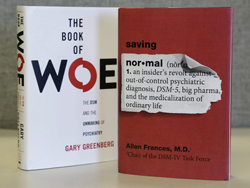
Allen Francis, MD writes in the Psychiatric Times that almost everyone meets the criteria for one or another of the conditions listed in the Diagnostic and Statistical Manual of Mental Disorders, the book psychiatrists use to determine whether you have a mental illness. The fifth edition of the manual (DSM-5), due in 2013, will relax these criteria even further, giving psychiatric labels to even more people.

According to 2010 figures from the National Institute of Mental Health (NIMH), more than 25 percent of the adult population has a diagnosable mental disorder. That’s approximately 60 million people. A prospective study found that, by age 32, half of U.S. adults could be diagnosed with anxiety; 40 percent with depression; and 30 percent with alcohol abuse or dependence.

With criteria proposed for the DSM-5, psychiatrists could diagnose “Nicotine Use Disorder” or “Caffeine-Induced Sleep Disorder.” If your child has temper tantrums, that’s one of the signs of “Temper Dysregulation Disorder with Dysphoria.” Bad dreams? It could be a case of “Nightmare Disorder.”

Why is this a problem? Mental illness carries a stigma. A diagnostic label can follow you for the rest of your life. It is shared with your insurance company. Your family and friends might make certain assumptions about you. Your doctor may insist you need psychiatric drugs.

More and more behaviors, however, are being stamped as “mental illnesses.”

Francis writes that individual differences that were once accepted as normal have become medicalized. Our society, he says, has become perfectionistic and intolerant of even short-term distress.

Read entire article:  http://www.examiner.com/x-31400-Portland-Mental-Health-Examiner~y2010m7d13-Psychiatric-overdiagnosis-means-normal-could-become-obsolete

« Return to news items


Share

Psychiatric Times – Let’s Call the Whole Thing Off

Thursday, May 27th, 2010

“The proposed DSM5 would be a giant step backwards for psychiatry. American psychiatrists should petition the APA to drop this ill-conceived and badly executed project.”

Psychiatric Times
By Irwin Feinberg, MD
May 27, 2010

A vital consideration we learn in medicine is that continuing life support for a moribund patient past a certain point is harmful to the lives of all concerned. We have reached that point with DSM5. Dr Allen Frances has outlined compelling clinical arguments against many of the new disorders DSM5 proposes and he has shown how their adoption could have far-reaching, unintended, and damaging consequences for the patients we have pledged not to harm, and for society generally.

I write from the vantage point of 50 years of psychobiological research. Most of it is in the field of sleep neuroscience. However, as often happens in science, one thing leads to another and my observations enabled me to propose that the human brain undergoes a profound reorganization during adolescence driven by synaptic pruning and that some cases of schizophrenia might be caused by errors in this process. My association at NIMH with Edward V. Evarts, one of the great neurophysiologists of the last half century, stimulated me to propose that the hallucinations of schizophrenia result from a failure of feed-forward mechanisms that distinguish self-initiated neural activity from that produced by external stimulation, resulting in auditory hallucinations and other first-rank symptoms.

It is difficult and time-consuming to produce reliable new knowledge; it cannot be accomplished by committee fiat, as Drs Kupfer, Schatzberg and Regier seem to be believe. Dr Frances has mentioned the damage to psychiatric research that several new, ill-conceived categories in DSM5 could inflict. He also pointed out that changing nomenclature and diagnostic standards in the absence of compelling scientific justification will severely damage psychiatric research as well as clinical practice. Many of these changes would make it impossible to compare decades of epidemiological results with new findings. Moreover, the sloppy thinking and language in the proposed revision will be apparent to any educated layman. The “field trials” and timetables proposed for new categories are laughable to any statistically trained psychologist. The inevitable public exposure of the gross defects in DSM5 will bring our entire field into disrepute and diminish public support for the research we need.

There have been no research advances that demand new diagnoses and syndromes. Despite many intriguing findings, no psychiatric disease can be diagnosed by a biological or psychological test.

Read entire article:  http://www.psychiatrictimes.com/display/article/10168/1576554?CID=rs

« Return to news items


Share

DSM Panel Members Still Getting Pharma Funds

Friday, May 21st, 2010

Despite promises to cut back on Pharma funds, 56% of DSM V panel members have reported industry ties— Zero improvement over the percent of DSM-IV members.


By CCHR International
May 21, 2010

Due to Senate investigations into the American Psychiatric Association, psychiatrists have promised to cut back on their conflicts of interest (pharma funds), but of the current DSM task force members, those who will be deciding on the holy grail of psychiatric disorders (DSM) and what constitutes a “mental illness” are still heavily funded by Pharma. In fact, there is no improvement over cutting down the number of panel members who are getting paid by industry over the last DSM revision in 1994. It was 56% then and its 56% now. So much for psychiatry’s promises…

Former APA president Nada Stotland stated: “We are in the midst of a revolution caused by public and legislative concern about the influence of the for-profit sector….” [Emphasis added] Part of that public pressure for the APA to disclose its conflicts of interest with pharmaceutical companies was driven by Lisa Cosgrove Ph.D. et al’s study of DSM-IV and DSM-IV-TR committee members, which found that of the 170 members, 56% had one or more financial associations with companies in the pharmaceutical industry.  Pharma’s psychotropic drug profits have soared commensurately with the increased numbers of disorders voted into the DSM.

  • Of the 137 DSM-V panel members who have posted disclosure statements, 56% have reported industry ties—no improvement over the percent of DSM-IV members.
  • Writing in Psychiatric Times (March 6, 2010), Cosgrove and Harold J. Bursztajn, MD, stated: “Although the APA recently announced that it would phase out the visibly industry-supported educational programs, the organization has remained curiously silent about acknowledging and monitoring industry funding of the 2 philanthropic arms of the APA—the American Psychiatric Foundation (APF) and the American Psychiatric Institute for Research and Education (APIRE).”
  • APF’s 15-member board of directors includes 4 high-level executives from pharmaceutical companies that either manufacture drugs recommended by APA (i.e.; in APA’s Clinical Practice Guidelines [CPG]) or have products in development targeted for mental disorders.
  • Other board members include 2 more with industry ties and a senior vice president at one of the largest public relations agencies in the world, whose clients include 6 drug companies.
  • APF’s corporate advisory council comprises pharmaceutical companies that contribute significant funding to APF and manufacture drugs recommended in the APA’s CPG; 6 of the companies give $40,000 “and above” per year.
  • APIRE, like APF, does not require disclosure of financial conflicts of interests, yet 9 of 16 of its board members have industry ties.
  • At least a quarter of the presenters at this year’s APA congress have significant pharmaceutical company ties.

The APA should sever all ties to pharmaceutical company interests. The US Senate Finance Committee has investigated at least a dozen APA psychiatrists over their undisclosed financial ties to drug companies, including:

Investigated - Alan Schatzberg, APA President: Owned $6 million equity in and as co-founder of drug developer Corcept Therapeutics while principle investigator in an NIH-funded, Stanford-based study of Corcept’s drug mifepristone. Schatzberg initiated the patent application on mifepristone to “treat psychotic depression” in 1997. In 2008, after months of Congressional scrutiny, Schatzberg stepped down from his position as principal investigator in the study.


Investigated – Joseph Biederman: Chief of the Program in Pediatric Psychopharmacology, Massachusetts General Hospital, he earned $1.6 million in consulting fees from drug makers between 2000 and 2007, most of which was not disclosed to Harvard University officials. In March 2009, court documents showed Biederman promised Johnson & Johnson in advance that his studies of their antipsychotic Risperidone would prove effective when used on preschool age children.


Investigated - Melissa DelBello: Research psychiatrist, University of Cincinnati failed to disclose all her Pharma earnings. In 2002, she was the lead author of a study that reported patients benefited from Seroquel by AstraZeneca, which paid her $180,000. She disclosed receiving $100,000 from the company between 2005 and 2007, but federal investigators discovered it was more than double that—$238,000.


Investigated - Frederick Goodwin: Former NIMH director, Goodwin earned at least $1.3 million between 2000 and 2007 for marketing lectures to physicians on behalf of drug makers, which he did not reveal to the producers of “The Infinite Mind” that he hosted on the National Public Radio during its 10-year run. NPR removed the program.


Investigated - Charles Nemeroff: Perhaps the most egregious case exposed was that of Dr. Nemeroff, chair of Emory University’s department of psychiatry and, along with Schatzberg, coeditor of the influential Textbook of Psychopharmacology. He received more than $960,000 from GSK, but reported to Emory $35,000.  He earned a further $2.8 million from various drug makers but failed to report at least $1.2 million. Nemeroff resigned his position at Emory in 2008.


Investigated - Martin Keller: Professor of Psychiatry at Brown University. His (and others’) Study 329 (ghostwritten by a GSK rep.) on Paxil use in children allegedly misrepresented data and suppressed information linking Paxil to suicidal tendencies. Keller didn’t disclose the full extent of his financial ties with companies to medical journals that published his research. In another matter, following a criminal investigation, Brown University returned $300,170 to the state of Massachusetts for research Keller’s department never performed. Keller stepped down as chair of psychiatry at Brown.


Investigated - Augustus John Rush: Former Vice-Chairman of the Dept. of Clinical Sciences at the University of Texas Southwestern Medical Center. He reported only $3,000 of the nearly $18,000 that Eli Lilly paid him in 2001.  Between 2000 and 2007, he failed to report another $12,000 from various drug companies.


Investigated - Karen Wagner: Professor, University of Texas Medical Branch failed to disclose more than $160,000 in payments from GSK, reporting only $18,000. Wagner worked on NIH-funded studies on the use of Paxil to treat teen depression and was a co-researcher on Study 329 (see Keller), for which she was paid more than $18,000. In 2002, Eli Lily paid her over $11,000, which was not disclosed.


Investigated – Thomas Spencer: Assistant Director of the Pediatric Psychopharmacology Unit at Massachusetts General Hospital and Associate Professor of Psychiatry, Harvard Medical School, reportedly failed to disclose at least $1 million in earnings from drug companies between 2000 and 2007.


Investigated - Timothy Wilens: Associate Professor of Psychiatry at Harvard Medical School allegedly failed to report he had earned at least $1.6 million from drug makers.


RETURN TO BLOGS PAGE


Share

American Psychiatric Association Called Upon to Cut Drug Company Ties and Put Lives of Children Before Profits

Friday, May 21st, 2010

Also see: DSM Panel Members Still Getting Pharma Funds

By CCHR International
May 21, 2010

NEW ORLEANS – As psychiatrists from around the world flood the area this weekend to take part in the Annual Meeting of the American Psychiatric Association (APA), psychiatric watchdog Citizens Commission on Human Rights (CCHR) is demanding that the APA sever all ties to pharmaceutical company interests and that psychiatrists stop killing children with harmful drugs.

The APA is expected to release its guidelines to reduce pharmaceutical industry ties at its convention, but it is likely to be self-serving and occurred only after public and legislative pressure forced the issue.

The US Senate Finance Committee has investigated at least 16 APA psychiatrists over their undisclosed financial ties to drug companies, including the APA’s own President, Alan Schatzberg who has stepped down as principal investigator of a National Institute of Health (NIH) funded study after months of Congressional scrutiny into his ties to the drug he was studying.  He was found to have actually initiated the patent application of the drug he was studying to “treat psychotic depression.”

Other notable APA members under scrutiny by the Senate Finance Committee and scheduled to present in New Orleans are Thomas Spencer, Assistant Director of the Pediatric Psychopharmacology Unit at Massachusetts General Hospital and Dr. Joseph Biederman, Chief of the Program in Pediatric Psychopharmacology, Massachusetts General Hospital.

Dr. Spencer reportedly failed to disclose at least $1 million in earnings from drug companies between 2000 and 2007. Dr. Biederman earned $1.6 million in consulting fees from drug makers during the same period, most of which was not disclosed to Harvard University officials. In March 2009, court documents showed Biederman promised Johnson & Johnson in advance that his studies of their antipsychotic risperidone (Risperdal) would prove effective when used on preschool age children. Risperdal has been linked to potentially life-threatening diabetes and Neuroleptic Malignant Syndrome.  The FDA database from 2000 to 2004 found at least 45 deaths in children under 18 with newer antipsychotics and 1,328 reports of other serious side effects, some life-threatening.

Former APA president Nada Stotland stated: “We are in the midst of a revolution caused by public and legislative concern about the influence of the for-profit sector….” [Emphasis added].  Part of that public pressure for the APA to disclose its conflicts of interest with pharmaceutical companies was driven by Lisa Cosgrove Ph.D. et al’s study of DSM-IV and DSM-IV-TR committee members, which found that of the 170 members, 56% had one or more financial associations with companies in the pharmaceutical industry.  Pharma’s psychotropic drug profits have soared commensurately with the increased numbers of disorders voted into the DSM.

While APA leaders and members profit from their industry connections to the drugs they are promoting; children are being killed by these same drugs.

Also see:  Meet the Psychiatrist Pushing For A Brave New World of Pre-Drugging Kids—Patrick McGorry

« Return to news items


Share

Natural News: Children’s temper tantrums to be reclassified as mental disorders

Tuesday, May 11th, 2010

Natural News
By Ethan A. Huff
May 11, 2010

Proposed changes to the U.S. Diagnostic and Statistical Manual (DSM) could include reclassifying childhood temper tantrums, teenage angst, and binge eating as psychiatric disorders. If accepted, the proposals could equal billions of dollars in new revenue for pharmaceutical companies.

The DSM is often referred to as the “bible” of the psychiatric profession. The handbook exerts significant influence on the American healthcare system, affecting everything from insurance companies and medical providers to universities and prisons. Even the legal system lends credence to its provisions.

It is precisely because of its wide scope of influence that many condemn the DSM. The manual is known for categorizing character traits and emotions as mental conditions for which medical treatment, typically drugs with highly dangerous side effects, is advised.

According to Christopher Lane, author of a 2007 critique of DSM called Shyness: How Normal Behavior Became a Sickness and professor at Northwestern University, responded to the American Psychiatric Association’s (APA) proposal by saying, “The organization is clearly opening another Pandora’s box here, as well as paving the way for the medication of even greater numbers of children and teenagers cycling through emotional stages as part of normal development.”

He is right, considering the fact that if binge eating is reclassified as a psychiatric disorder, millions of Americans could instantly be declared as mentally ill. Though provisions would be included to exclude those who merely overeat, the ramifications of associating eating disorders with mental illness at all would likely include a massive increase in the number of people taking psychotropic drugs.

Read entire article:  http://www.naturalnews.com/028762_children_disorders.html

« Return to news items


Share

The National Post: “Message to disease industry — That’s why they call it ‘acting like a child’”

Tuesday, April 27th, 2010

National Post
By John Baglow
April 27, 2010

Some time back I remarked on a new childhood “affliction” to be dealt with by the judicious use of drugs and psychiatrists: “Oppositional Defiant Disorder.” If you had four or more of the following as a child, you were ODD, and I guess I was, too:

1. often loses temper [check]
2. often argues with adults [check]
3. often actively defies or refuses to comply with adults’ requests or rules [check]
4. often deliberately annoys people [check]
5. often blames others for his or her mistakes or misbehavior
6. is often touchy or easily annoyed by others
7. is often angry and resentful
8. is often spiteful or vindictive

To qualify as ODD, those “disturbances” must cause “clinically significant impairment in social, academic, or occupational functioning.” But of course that can mean almost anything. Talking back. Fighting back. Asking a lot of questions. Standing up for yourself in a hostile environment.

In those days teachers and jocks simply bullied you into submission. Now it’s all white coats and Ritalin.

Creativity? Lateral thinking? Oddball hypotheses? Questioning authority? For goodness sake, tell your kids to leave it at home, for their own good. That’s what the Internet is for.

In any case, it looks as though I was onto something. The Diagnostic and Statistical Manual of Mental Disorders is going through another update. The first version of the DSM, published in 1952, listed 128 disorders (including homosexuality, delisted in 1973). DSM-IV, appearing in 1994, listed 357–almost three times the original number. And DSM-5, scheduled for publication in 2013, may swell the list even more.

Dr. Allen Frances chaired the committee that wrote DSM-IV. He has, to put it mildly, had a change of heart, after having had more than a quarter-century to observe the human tragedies that resulted:

Frances says [DSM-IV] unintentionally contributed to vast and sudden increases in the diagnosis of attention-deficit hyperactivity disorder, autism and childhood bipolar disorder (manic depression), after it made changes in those definitions.

Rates of bipolar disorder alone jumped 40-fold in the U.S. after the definition was broadened to suggest that children don’t have to experience the typical manic symptoms seen in adults to be diagnosed bipolar — and that depression in kids can be a persistent irritable mood.

Read entire article:  http://network.nationalpost.com/NP/blogs/fullcomment/archive/2010/04/27/john-baglow-message-to-disease-industry-that-s-why-they-call-it-acting-like-a-child.aspx

« Return to news items


Share

New York Magazine: Shrink Revolt—The controversy over psychiatric diagnoses and the DSM continues

Monday, April 26th, 2010

New York Magazine
By Jennifer Senior
April 25, 2010

Two Jews may, as the saying goes, have three opinions, but that appears to be a fairly modest ratio when compared with psychiatrists. It was inevitable that revisions to the Diagnostic and Statistical Manual of Mental Disorders would invite controversy—it’s the classic reference work for mental-health professionals, and a convenient field guide to understanding crazy exes for the rest of us—but even the American Psychiatric Association, which first appointed the work groups to update the text two years ago, couldn’t have predicted the squabbles now under way. Dr. Allen Frances, the man who chaired the task force that created the current edition (the DSM-IV), has today emerged as the most trenchant, and relentless, critic of the proposed revisions to the upcoming edition (the DSM-5; among the changes is a transition to Arabic numerals). Last Tuesday was the final day those revisions were open to public comment. “And hopefully,” Frances says, “most of them will drop out.”

Basically, Frances believes that the first draft of the DSM-5 is too promiscuous with its labels, both by loosening diagnostic criteria and by introducing a host of new and, to his mind, problematic maladies—like Binge Eating Disorder (more or less defined as gorging on massive amounts at least once a week for three months). By the estimate of one DSM-5 task-force member, Frances says, this disorder already afflicts 6 percent of the population. “And that,” he notes, “is before drug companies start marketing something for it.”

As Frances pointed out in a recent Los Angeles Times editorial, such taxonomic adjustments only seem to further shrink “the ever-shrinking domain of the normal.” Take another DSM-5 proposed addition: Temper Dysregulation Disorder With Dysphoria. Frances fears this may be deployed for kids who have typical temper problems. Or Major Depressive Episode: As it’s redefined, it could now be used to describe someone who’s spent two weeks grieving over a lost spouse, he contends. But the worst offender, in Frances’s view, is Psychosis Risk Syndrome, which attempts to identify and treat youngsters before they become psychotic. In his view, there isn’t any evidence that early intervention with medication helps, while there’s plenty to suggest that many teens could be misidentified. “And that I saw as a public-health danger,” he says, “because there are real drawbacks to being on antipsychotics.” Like weight gain and diabetes. “Those children are also disproportionately on Medicaid,” he adds.

Read entire article:  http://nymag.com/news/intelligencer/65632/

« Return to news items


Share