Posts Tagged ‘Columbine’

Are psychotropic drugs actually linked to mass shootings?

Wednesday, April 17th, 2013

The Daily O’Collegian

Oklahoma State University – April 15, 2013

by Jane Park, psychology student

Sean Higgins

Instances of mass violence and mass shootings occur undoubtedly too often. When shootings such as those in Sandy Hook, Columbine, Aurora, and Virginia Tech happen, the blame often falls on gun ownership, violent media, or violent video games.

I believe, as a whole, people are overlooking a variable that could very well be at the root of this problem — psychotropic drugs.

Just a couple of days ago news was released regarding the Aurora, Colo. shooter, James Holmes. He was taking the psychotropic drug Zoloft (an antidepressant) as well as another drug called Clonazepam (a benzodiazepine, often used to treat epilepsy as well as anxiety disorders). Zoloft was also prescribed to Eric Harris, the Columbine shooter.

In the past 15 years it is documented in nearly all school shootings the shooter was either currently taking or suffering withdrawal from a prescribed psychiatric drug, and authorities continue to suppress information regarding the drugs both the Sandy Hook and the Virginia Tech shooter were taking.

As cited by the Citizens Commission On Human Rights International (CCHRI), violent side effects caused by taking psychiatric drugs were reported in 12,755 cases to the U.S FDA’s MedWatch. It was also noted such reports are made in only one to 10 percent of the cases experiencing side effects, indicating a much higher rate of violence than official numbers suggest.

It is worth pointing out what these drugs, most often antidepressants, are supposed to do. Their intention is to combat depression, i.e. make people happier. I may or may not be alone on this, but last time I checked being happy is not often associated with committing acts of violence. Clearly something isn’t right.

Further, violence in clinically depressed patients is extraordinarily rare when they are not prescribed psychiatric drugs. When those who are depressed have a difficult time getting motivated to get out of bed, I find it difficult to believe they would be able to find the motivation to conduct mass murder.

Instead of trying to infringe on the rights of citizens to own firearms for both self-defense and to deter government tyranny, perhaps government ought to take a look at the common denominator in most of these mass shootings.

With such a seemingly clear-cut correlation between violence and the use of psychotropic drugs, outrage should be focused on ending government approval of such dangerous medications, not extinguishing the rights of law-abiding citizens.

How many more shootings need to occur before our government begins taking a serious look at the ill effects of psychotropic drugs and makes the link between these drugs and violence? When will the government stop approving and prescribing these unpredictable drugs? What needs to happen to stop psychiatrists, employed by both the state and the private sector, from giving out these psychiatric drugs as if they were candy?

I am becoming increasingly worried such heinous acts of violence that may result from medicating patients will continue to be used to advance the political agendas of our totalitarian leaning government. In order to stop such madness, we must begin thinking independently and ask the questions nobody else will.

« Return to news items


Share

World Net Daily News: The Giant, Gaping hole in Sandy Hook Reporting—what psychiatric medications shooter may have been taking

Monday, January 7th, 2013

World Net Daily News
By David Kupelian, an award-winning journalist, managing editor of WND, editor of Whistleblower magazine

“But where, I’d like to ask my colleagues in the media, is the reporting about the psychiatric medications the perpetrator – who had been under treatment for mental-health problems – may have been taking?”

Since last month’s horrifying and heartbreaking school massacre in Newtown, Conn., politicians and the press have, as everyone knows, been totally obsessed with firearms.

Indeed, President Obama has vowed to impose strong new gun-control measures on the nation – very soon, with or without Congress.

Other possible factors – from violent video games to the “failure of our mental-health system” to the unintended consequences of making schools “gun-free zones” – have taken a back seat to guns. Within hours of the gruesome mega-crime, the media had provided extensive, round-the-clock coverage of precisely which firearms, manufacturers and calibers the perpetrator had used, how he had obtained them from his mother, where they were originally purchased, and so on.

But where, I’d like to ask my colleagues in the media, is the reporting about the psychiatric medications the perpetrator – who had been under treatment for mental-health problems – may have been taking? After all, Mark and Louise Tambascio, family friends of the shooter and his mother, were interviewed on CBS’ “60 Minutes,” during which Louise Tambascio told correspondent Scott Pelley: “I know he was on medication and everything, but she homeschooled him at home cause he couldn’t deal with the school classes sometimes, so she just homeschooled Adam at home. And that was her life.” And here, Tambascio tells ABC News, “I knew he was on medication, but that’s all I know.”

It has been more than three weeks since the shooting. We know all about the guns he used, but what “medication” may he have used? (One brief mini-hoax emerged when the New York Daily News published a story claiming the shooter, according to his uncle, had been on the controversial antipsychotic drug Fanapt. That story was quickly withdrawn after the “uncle” turned out to be a fraudster with no relation to the murderer.)

So, what is the truth? Where is the journalistic curiosity? Where is the follow-up? Where is the police report, the medical examiner’s report, the interviews with his doctor and others?

Get autographed copies of both of David Kupelian’s classics: “The Marketing of Evil” and “How Evil Works.”

But let me back up. Perhaps you’re wondering why this issue of psychiatric medications should be so important.

As I documented in “How Evil Works,” it is simply indisputable that most perpetrators of school shootings and similar mass murders in our modern era were either on – or just recently coming off of – psychiatric medications:

  • Columbine mass-killer Eric Harris was taking Luvox – like Prozac, Paxil, Zoloft, Effexor and many others, a modern and widely prescribed type of antidepressant drug called selective serotonin reuptake inhibitors, or SSRIs. Harris and fellow student Dylan Klebold went on a hellish school shooting rampage in 1999 during which they killed 12 students and a teacher and wounded 24 others before turning their guns on themselves.Luvox manufacturer Solvay Pharmaceuticals concedes that during short-term controlled clinical trials, 4 percent of children and youth taking Luvox – that’s 1 in 25 – developed mania, a dangerous and violence-prone mental derangement characterized by extreme excitement and delusion.
  • Patrick Purdy went on a schoolyard shooting rampage in Stockton, Calif., in 1989, which became the catalyst for the original legislative frenzy to ban “semiautomatic assault weapons” in California and the nation. The 25-year-old Purdy, who murdered five children and wounded 30, had been on Amitriptyline, an antidepressant, as well as the antipsychotic drug Thorazine.
  • Kip Kinkel, 15, murdered his parents in 1998 and the next day went to his school, Thurston High in Springfield, Ore., and opened fire on his classmates, killing two and wounding 22 others. He had been prescribed both Prozac and Ritalin.
  • In 1988, 31-year-old Laurie Dann went on a shooting rampage in a second-grade classroom in Winnetka, Ill., killing one child and wounding six. She had been taking the antidepressant Anafranil as well as Lithium, long used to treat mania.
  • In Paducah, Ky., in late 1997, 14-year-old Michael Carneal, son of a prominent attorney, traveled to Heath High School and started shooting students in a prayer meeting taking place in the school’s lobby, killing three and leaving another paralyzed. Carneal reportedly was on Ritalin.
  • In 2005, 16-year-old Native American Jeff Weise, living on Minnesota’s Red Lake Indian Reservation, shot and killed nine people and wounded five others before killing himself. Weise had been taking Prozac.
  • In another famous case, 47-year-old Joseph T. Wesbecker, just a month after he began taking Prozac in 1989, shot 20 workers at Standard Gravure Corp. in Louisville, Ky., killing nine. Prozac-maker Eli Lilly later settled a lawsuit brought by survivors.
  • Kurt Danysh, 18, shot his own father to death in 1996, a little more than two weeks after starting on Prozac. Danysh’s description of own his mental-emotional state at the time of the murder is chilling: “I didn’t realize I did it until after it was done,” Danysh said. “This might sound weird, but it felt like I had no control of what I was doing, like I was left there just holding a gun.”
  • John Hinckley, age 25, took four Valium two hours before shooting and almost killing President Ronald Reagan in 1981. In the assassination attempt, Hinckley also wounded press secretary James Brady, Secret Service agent Timothy McCarthy and policeman Thomas Delahanty.
  • Andrea Yates, in one of the most heartrending crimes in modern history, drowned all five of her children – aged 7 years down to 6 months – in a bathtub. Insisting inner voices commanded her to kill her children, she had become increasingly psychotic over the course of several years. At her 2006 murder re-trial (after a 2002 guilty verdict was overturned on appeal), Yates’ longtime friend Debbie Holmes testified: “She asked me if I thought Satan could read her mind and if I believed in demon possession.” And Dr. George Ringholz, after evaluating Yates for two days, recounted an experience she had after the birth of her first child: “What she described was feeling a presence … Satan … telling her to take a knife and stab her son Noah,” Ringholz said, adding that Yates’ delusion at the time of the bathtub murders was not only that she had to kill her children to save them, but that Satan had entered her and that she had to be executed in order to kill Satan.Yates had been taking the antidepressant Effexor. In November 2005, more than four years after Yates drowned her children, Effexor manufacturer Wyeth Pharmaceuticals quietly added “homicidal ideation” to the drug’s list of “rare adverse events.” The Medical Accountability Network, a private nonprofit focused on medical ethics issues, publicly criticized Wyeth, saying Effexor’s “homicidal ideation” risk wasn’t well-publicized and that Wyeth failed to send letters to doctors or issue warning labels announcing the change.And what exactly does “rare” mean in the phrase “rare adverse events”? The FDA defines it as occurring in less than one in 1,000 people. But since that same year 19.2 million prescriptions for Effexor were filled in the U.S., statistically that means thousands of Americans might experience “homicidal ideation” – murderous thoughts – as a result of taking just this one brand of antidepressant drug.Effexor is Wyeth’s best-selling drug, by the way, which in one recent year brought in over $3 billion in sales, accounting for almost a fifth of the company’s annual revenues.
  • One more case is instructive, that of 12-year-old Christopher Pittman, who struggled in court to explain why he murdered his grandparents, who had provided the only love and stability he’d ever known in his turbulent life. “When I was lying in my bed that night,” he testified, “I couldn’t sleep because my voice in my head kept echoing through my mind telling me to kill them.” Christopher had been angry with his grandfather, who had disciplined him earlier that day for hurting another student during a fight on the school bus. So later that night, he shot both of his grandparents in the head with a .410 shotgun as they slept and then burned down their South Carolina home, where he had lived with them.”I got up, got the gun, and I went upstairs and I pulled the trigger,” he recalled. “Through the whole thing, it was like watching your favorite TV show. You know what is going to happen, but you can’t do anything to stop it.”Pittman’s lawyers would later argue that the boy had been a victim of “involuntary intoxication,” since his doctors had him taking the antidepressants Paxil and Zoloft just prior to the murders.Paxil’s known “adverse drug reactions” – according to the drug’s FDA-approved label – include “mania,” “insomnia,” “anxiety,” “agitation,” “confusion,” “amnesia,” “depression,” “paranoid reaction,” “psychosis,” “hostility,” “delirium,” “hallucinations,” “abnormal thinking,” “depersonalization” and “lack of emotion,” among others.The preceding examples are only a few of the best-known offenders who had been taking prescribed psychiatric drugs before committing their violent crimes – there are many others.Whether we like to admit it or not, it is undeniable that when certain people living on the edge of sanity take psychiatric medications, those drugs can – and occasionally do – push them over the edge into violent madness. Remember, every single SSRI antidepressant sold in the United States of America today, no matter what brand or manufacturer, bears a “black box” FDA warning label – the government’s most serious drug warning – of “increased risks of suicidal thinking and behavior, known as suicidality, in young adults ages 18 to 24.” Common sense tells us that where there are suicidal thoughts – especially in a very, very angry person – homicidal thoughts may not be far behind. Indeed, the mass shooters we are describing often take their own lives when the police show up, having planned their suicide ahead of time.

So, what ‘medication’ was Lanza on?

The Sandy Hook school massacre, we are constantly reminded, was the “second-worst school shooting in U.S. history.” Let’s briefly revisit the worst, Virginia Tech, because it provides an important lesson for us. One would think, in light of the stunning correlation between psych meds and mass murders, that it would be considered critical to establish definitively whether the Virginia Tech murderer of 32 people, student Cho Seung-Hui, had been taking psychiatric drugs.

Yet, more than five years later, the answer to that question remains a mystery.

Even though initially the New York Times reported, “officials said prescription medications related to the treatment of psychological problems had been found among Mr. Cho’s effects,” and the killer’s roommate, Joseph Aust, had told the Richmond Times-Dispatch that Cho’s routine each morning had included taking prescription drugs, the state’s toxicology report released two months later said “no prescription drugs or toxic substances were found in Cho Seung-Hui.”

Perhaps so, but one of the most notoriously unstable and unpredictable times for users of SSRI antidepressants is the period shortly after they’ve stopped taking them, during which time the substance may not be detectable in the body.

What kind of meds might Cho have been taking – or recently have stopped taking? Curiously, despite an exhaustive investigation by the Commonwealth of Virginia which disclosed that Cho had taken Paxil for a year in 1999, specifics on what meds he was taking prior to the Virginia Tech massacre have remained elusive. The final 20,000-word report manages to omit any conclusive information about the all-important issue of Cho’s medications during the period of the mass shooting.

To add to the drama, it wasn’t until two years after the state’s in-depth report was issued that, as disclosed in an Aug. 19, 2009, ABC News report, some of Cho’s long-missing mental health records were located:

The records released today were discovered to be missing during a Virginia panel’s August 2007 investigation four-and-a-half months after the massacre.

The notes were recovered last month from the home of Dr. Robert Miller, the former director of the counseling center, who says he inadvertently packed Cho’s file into boxes of personal belongings when he left the center in February 2006. Until the July 2009 discovery of the documents, Miller said he had no idea he had the records.

Miller has since been let go from the university.

Although Cho’s newly discovered mental-health files reportedly revealed nothing further about his medications, the issues raised by the initial accounts – including the “officials” cited by the New York Times and the Richmond paper’s eyewitness account of daily meds-taking – remain unaddressed to this day.

Some critics suggest these official omissions are motivated by a desire to protect the drug companies from ruinous product liability claims. Indeed, pharmaceutical manufacturers are nervous about lawsuits over the “rare adverse effects” of their mood-altering medications. To avoid costly settlements and public relations catastrophes – such as when GlaxoSmithKline was ordered to pay $6.4 million to the family of 60-year-old Donald Schnell who murdered his wife, daughter and granddaughter in a fit of rage shortly after starting on Paxil – drug companies’ legal teams have quietly and skillfully settled hundreds of cases out-of-court, shelling out hundreds of millions of dollars to plaintiffs. Pharmaceutical giant Eli Lilly fought scores of legal claims against Prozac in this way, settling for cash before the complaint could go to court while stipulating that the settlement remain secret – and then claiming it had never lost a Prozac lawsuit.

All of which is, once again, to respectfully but urgently ask the question: When on earth are we going to find out if the perpetrator of the Sandy Hook school massacre, like so many other mass shooters, had been taking psychiatric drugs?

In the end, it may well turn out that knowing what kinds of guns he used isn’t nearly as important as what kind of drugs he used.

That is, assuming we ever find out.

Read more at http://www.wnd.com/2013/01/the-giant-gaping-hole-in-sandy-hook-reporting/#Sx8Ax0KP67vs9sjM.99

« Return to news items


Share

Another Mass Shooting, Another Psychiatric Drug? Federal Investigation Long Overdue

Friday, July 20th, 2012

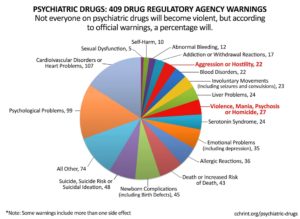
Fact: Despite 22 international drug regulatory warnings on psychiatric drugs citing effects of mania, hostility, violence and even homicidal ideation, and dozens of high profile shootings/killings tied to psychiatric drug use, there has yet to be a federal investigation on the link between psychiatric drugs and acts of senseless violence.

Fact: At least 31 school shootings and/or school-related acts of violence have been committed by those taking or withdrawing from psychiatric drugs resulting in 162 wounded and 72 killed (in other school shootings, information about their drug use was never made public—neither confirming or refuting if they were under the influence of prescribed drugs).

Fact: Between 2004 and 2011, there have been over 11,000 reports to the U.S. FDA’s MedWatch system of psychiatric drug side effects related to violence.  These include 300 cases of homicide, nearly 3,000 cases of mania and over 7,000 cases of aggression.  Note:  By the FDA’s own admission, only 1-10% of side effects are ever reported to the FDA, so the actual number of side effects occurring are most certainly higher.

Fact: It took months for  the release of information showing that police had found psychiatric drugs in the apartment of Aurora Colorado movie theater shooter, James Holmes—including the anti-anxiety drug clonazepam and the antidepressant sertraline, the generic version of the antidepressant Zoloft.

Colorado shooter James Holmes was under the care of psychiatrist Lynne Fenton prior to the shootings. Police found antidepressant and anti-anxiety drugs in Holmes apartment.

Click here to sign the Petition: Call for Federal Investigation of Psychiatric Drugs, School Shootings & Senseless Violence

Of the 31 people who committed acts of violence that were documented to be under the influence of psychiatric drugs, ten were seeing either a psychiatrist or psychologist.  See the list of school shootings and/or school-related acts of violence by those on psychiatric drugs here.

School-related acts of violence aren’t the only cases commonly found to be under the influence of psychiatric drugs.  There are 12 other recent acts of senseless violence committed by individuals taking or withdrawing from psychiatric drugs resulting in an additional 46 dead and 23 wounded.

A bill introduced in New York in 2000 proposed police investigate psychiatric drug in all cases of violent crimes and suicides. This is a bill that must be reintroduced and passed on state and federal levels. Click image to read the bill

Despite 22 international drug regulatory warnings on psychiatric drugs citing effects of mania, hostility, violence and even homicidal ideation, and dozens of high profile shootings/killings tied to psychiatric drug use, there has yet to be a federal investigation on the link between psychiatric drugs and acts of senseless violence.

The correlation between psychiatric drugs and acts of violence and homicide is well documented – both by international drug regulatory warnings and studies, as well as by hundreds of cases where high profile acts of violence/mass murder were committed by individuals under the influence of psychiatric drugs.

The New York State Senate recognized this as far back as 2000, introducing a bill which would “require police to report to the Division of Criminal Justice Services (DCJS), certain crimes and suicides committed by persons using psychotropic drugs,” citing “a large body of scientific research establishing a connection between violence and suicide and the use of psychotropic drugs.”

Unfortunately that bill stalled out in the finance committee.   By reviewing the international drug regulatory warnings, studies, and adverse reaction reports submitted to the US FDA below, it is evident that the reintroduction of the New York bill is needed on a federal level in order to determine just how many crimes and acts of violence are being committed by individuals under the influence of drugs documented to induce violence, mania, psychosis, aggression, hostility and  homicide.

As the world’s leading mental health watchdog, CCHR has for decades investigated hundreds of acts of senseless violence, working alongside investigative reporters,  law enforcement, as well as legislative hearings, such as those held in Colorado following the 1999 Columbine  massacre  (ringleader Eric Harris was found to be under the influence of the antidepressant Luvox, Dylan Klebold’s autopsy reports were never unsealed).

And while there is never one simple explanation for what drives a human being  to commit such unspeakable acts, all too often one common denominator has surfaced in hundreds of cases—prescribed psychiatric drugs which are documented to cause mania, psychosis, violence, suicide and in some cases,  homicidal ideation. It is an injustice that the general public are not being  informed about the well documented links between psychiatric drugs and violence, and so once again we present the facts:

There have been 22 international drug regulatory warnings issued on psychiatric drugs causing violence, mania, hostility, aggression, psychosis, and other violent type reactions.  These warnings have been issued in the United States, European Union, Japan, United Kingdom, Australia and Canada.

Click image to read MANIA—The shocking link between psychiatric drugs, suicide, violence and mass murder

In determining what would prompt a person  to commit such brutal and senseless crimes, the press must ask the right questions,  including:  What, if any, prescribed psychotropic drugs the perpetrator may have been on (or in withdrawal from).

Read the international drug regulatory warnings issued on psychiatric drugs causing violence, mania, hostility, aggression, psychosis, and other violent type reactions.

See the recent study from PLoS One here on psychiatric drugs being linked to violence.

Watch this short interview with Michael Moore, author, director and producer of Bowling for Columbine, where he calls for a federal investigation into the link between prescribed drugs and mass shootings such as the 1999 Columbine massacre.

At least 31 school shootings and/or school-related acts of violence were committed by those taking or withdrawing from psychiatric drugs. It is important to note the following lists cases where the information about the shooters psychiatric drug use was made public.

It took months for  the release of information showing that police had found psychiatric drugs in the apartment of Aurora Colorado movie theater shooter, James Holmes—including the anti-anxiety drug clonazepam and the antidepressant sertraline, the generic version of the antidepressant Zoloft.

Note that all these mass shootings didn’t just occur in the United States.

Of these 31, ten were seeing either a psychiatrist (8 of them) or psychologist (2 of them).  It is not known whether or not the others were seeing a psychiatrist, as it has not been published.

  1. St. Louis, Missouri – January 15, 2013: 34-year-old Sean Johnson walked onto the Stevens Institute of Business & Arts campus and shot the school’s financial aid director once in the chest, then shot himself in the torso. Johnson had been taking prescribed drugs for an undisclosed mental illness.
  2. Snohomish County, Washington – October 24, 2011: A 15-year-old girl went to Snohomish High School where police alleged that she stabbed a girl as many as 25 times just before the start of school, and then stabbed another girl who tried to help her injured friend. Prior to the attack the girl had been taking “medication” and seeing a psychiatrist. Court documents said the girl was being treated for depression.
  3. Planoise, France – December 13, 2010: A 17-year-old youth held twenty pre-school children and their teacher hostage for hours at Charles Fourier preschool.  The teen was reported to be on “medication for depression”.  He took a classroom hostage with two swords. Eventually, all the children and the teacher were released safely.
  4. Myrtle Beach, South Carolina – September 21, 2011: 14-year-old Christian Helms had two pipe bombs in his backpack, when he shot and wounded Socastee High School’s “resource” (police) officer. However the officer was able to stop the student before he could do anything further.  Helms had been taking drugs for attention deficit hyperactivity disorder and depression.
  5. Huntsville, Alabama – February 5, 2010: 15-year-old Hammad Memon shot and killed another Discover Middle School student Todd Brown.  Memon had a history for being treated for ADHD and depression.  He was taking the antidepressant Zoloft and “other drugs for the conditions.” He had been seeing a psychiatrist and psychologist.
  6. Kauhajoki, Finland – September 23, 2008: 22-year-old culinary student Matti Saari shot and killed 9 students and a teacher, and wounded another student, before killing himself.  Saari was taking an SSRI and a benzodiazapine. He was also seeing a psychologist.
  7. Fresno, California – April 24, 2008: 17-year-old Jesus “Jesse” Carrizales attacked the Fresno high school’s officer, hitting him in the head with a baseball bat.  After knocking the officer down, the officer shot Carrizales in self-defense, killing him.  Carrizales had been prescribed Lexapro and Geodon, and his autopsy showed that he had a high dose of the antidepressant Lexapro in his blood that could have caused him to be paranoid, according to the coroner.
  8. Dekalb, Illinois – February 14, 2008: 27-year-old Steven Kazmierczak shot and killed five people and wounded 21 others before killing himself in a Northern Illinois University auditorium. According to his girlfriend, he had recently been taking Prozac, Xanax and Ambien. Toxicology results showed that he still had trace amount of Xanax in his system. He had been seeing a psychiatrist.
  9. Jokela, Finland – November 7, 2007: 18-year-old Finnish gunman Pekka-Eric Auvinen had been taking antidepressants before he killed eight people and wounded a dozen more at Jokela High School in southern Finland, then committed suicide.
  10. Texas – November 7, 2007: 17-year-old Felicia McMillan returned to her former Robert E. Lee High School campus and stabbed a male student and wounded the principle with a knife.  McMillan had been on drugs for depression, and had just taken them the night before the incident.
  11. Cleveland, Ohio – October 10, 2007: 14-year-old Asa Coon stormed through his school with a gun in each hand, shooting and wounding four before taking his own life. Court records show Coon had been placed on the antidepressant Trazodone.
  12. Sudbury, Massachusetts – January 19, 2007: 16-year-old John Odgren stabbed another student with a large kitchen knife in a boy’s bathroom at Lincoln-Sudbury Regional High School. In court his father testified that Odgren was prescribed the drug Ritalin.
  13. North Vernon, Indiana – December 4, 2006: 16-year-old Travis Roberson stabbed another Jennings County High School student in the neck, nearly severing an artery. Roberson was in withdrawal from Wellbutrin, which he had stopped taking days before the attack.
  14. Hillsborough, North Carolina – August 30, 2006: 19-year-old Alvaro Rafael Castillo shot and killed his father, then drove to Orange High School where he opened fire. Two students were injured in the shooting, which ended when school personnel tackled him. His mother said he was on drugs for depression.
  15. Chapel Hill, North Carolina – April 2006: 17-year-old William Barrett Foster took a shotgun to school and took a teacher and a fellow student hostage at East Chapel Hill High School. After being talked out of shooting the hostages, Foster fired two shots through a classroom window before fleeing the school on foot. Foster’s father testified that his son had stopped taking his antidepressants and antipsychotic drugs without telling him.
  16. Red Lake, Minnesota – March 21, 2005: 16-year-old Jeff Weise, on Prozac, shot and killed his grandparents, then went to his school on the Red Lake Indian Reservation where he shot dead 5 students, a security guard, and a teacher, and wounded 7 before killing himself.
  17. Greenbush, New York – February 2004: 16-year-old Jon Romano strolled into his high school in east Greenbush and opened fire with a shotgun. Special education teacher Michael Bennett was hit in the leg. Romano had been taking “medication for depression”. He had previously seen a psychiatrist.
  18. Red Lion, Pennsylvania – February 2, 2001: 56-year-old William Michael Stankewicz entered North Hopewell-Winterstown Elementary School with a machete, leaving three adults and 11 children injured. Stankewicz was taking four different drugs for depression and anxiety weeks before the attacks.
  19. Ikeda, Japan – June 8, 2001: 37-year-old Mamoru Takuma, wielding a 6-inch knife, slipped into an elementary school and stabbed eight first- and second-graders to death while wounding at least 15 other pupils and teachers. He then turned the knife on himself but suffered only superficial wounds. He later told interrogators that before the attack he had taken 10 times his normal dose of antidepressants.
  20. Wahluke, Washington – April 10, 2001: Sixteen-year-old Cory Baadsgaard took a rifle to his high school and held 23 classmates and a teacher hostage. He had been taking the antidepressant Effexor.
  21. El Cajon, California – March 22, 2001: 18-year-old Jason Hoffman, on the antidepressants Celexa and Effexor, opened fire on his classmates, wounding three students and two teachers at Granite Hills High School. He had been seeing a psychiatrist before the shooting.
  22. Williamsport, Pennsylvania – March 7, 2001: 14-year-old Elizabeth Bush was taking the antidepressant Prozac when she shot at fellow students, wounding one.
  23. Oxnard, California – January 2001: 17-year-old Richard Lopez went to Hueneme High School with a gun and shot twice at a car in the school’s parking lot before taking a female student hostage.  Lopez was eventually killed by a SWAT officer.  He had been prescribed Prozac, Paxil and “drugs that helped him go to sleep.”
  24. Conyers, Georgia – May 20, 1999: 15-year-old T.J. Solomon was being treated with the stimulant Ritalin when he opened fire on and wounded six of his classmates.
  25. Columbine, Colorado – April 20, 1999: 18-year-old Eric Harris and his accomplice, Dylan Klebold, killed 12 students and a teacher and wounded 26 others before killing themselves. Harris was on the antidepressant Luvox.  Klebold’s medical records remain sealed. Both shooters had been in anger-management classes and had undergone counseling.  Harris had been seeing a psychiatrist before the shooting.
  26. Notus, Idaho – April 16, 1999: 15-year-old Shawn Cooper fired two shotgun rounds in his school, narrowly missing students. He was taking a prescribed antidepressant and Ritalin.
  27. Springfield, Oregon – May 21, 1998: 15-year-old Kip Kinkel murdered his parents and then proceeded to school where he opened fire on students in the cafeteria, killing two and wounding 25. Kinkel had been taking the antidepressant Prozac. Kinkel had been attending “anger control classes” and was under the care of a psychologist.
  28. Blackville, South Carolina – October 12, 1995: 15-year-old Toby R. Sincino slipped into the Blackville-Hilda High School’s rear entrance, where he shot two Blackville-Hilda High School teachers, killing one. Then Toby killed himself moments later. His aunt, Carolyn McCreary, said he had been undergoing counseling with the Department of Mental Health and was taking Zoloft for emotional problems.
  29. Chelsea, Michigan – December 17, 1993: 39-year-old chemistry teacher Stephen Leith, facing a disciplinary matter at Chelsea High School, shot Superintendent Joseph Piasecki to death, shot Principal Ron Mead in the leg, and slightly wounded journalism teacher Phil Jones. Leith was taking Prozac and had been seeing a psychiatrist.
  30. Houston, Texas – September 18, 1992: 44-year-old Calvin Charles Bell, reportedly upset about his second-grader’s progress report, appeared in the principal’s office of Piney Point Elementary School. Bell fired a gun in the school, and eventually wounded two officers before surrendering. Relatives told police on Friday that Bell was an unemployed Vietnam veteran and had been taking anti-depressants.
  31. Winnetka, Illinois – 20 May 1988: 30-year-old Laurie Wasserman Dann walked into a second grade classroom at Hubbard Woods School in Winnetka, Illinois carrying three pistols and began shooting children, killing an eight-year-old boy, and wounding five others before fleeing. She entered a nearby house where she shot and wounded a 20-year-old man before killing herself. Dann had been seeing a psychiatrist and subsequent blood tests revealed that at the time of the killings, she was taking the antidepressant Anafranil.

Note: Psychiatric Drugs Can Also Cause Severe Withdrawal Symptoms—Violent and Suicidal Thoughts – Watch This 2 Minute Video

12 additional recent murders and murder-suicides, resulting in 46 dead and 23 wounded:

  1. Pittsburgh, Pennsylvania – March 8, 2012:  30-year-old John Shick, former patient of University of Pittsburgh Medical Center (UPMC) and former student at nearby Duquesne University, shot and killed one and injured six inside UPMC’s Western Psychiatrist Institute. Nine antidepressants were identified among the drugs police found in Shick’s apartment.
  2. Seal Beach, California – October 12, 2011:  Scott DeKraai, a harbor tugboat worker, entered the hair salon where his ex-wife worked, killing her and seven others and injuring one. At DeKraai’s initial hearing, his attorney indicated to the judge that DeKraai was prescribed the antidepressant Trazodone and the “mood stabilizer” Topamax.
  3. Lakeland, Florida – May 3, 2009:  Toxicology test results showed that 34-year-old Troy Bellar was on Tegretol, a drug prescribed for “bi-polar disorder,” when he shot and killed his wife and two of his three children in their home before killing himself.
  4. Granberry Crossing, Alabama – April 26, 2009:  53-year-old Fred B. Davis shot and killed a police officer and wounded a sheriff’s deputy who had responded to a call that Davis had threatened a neighbor with a gun. Prescription drug bottles found at the scene showed that Davis was prescribed the antipsychotic drug Geodon.
  5. Middletown, Maryland – April 17, 2009:  Christopher Wood shot and killed his wife, three small children and himself inside their home. Toxicology test results verified that Wood had been taking the antidepressants Cymbalta and Paxil and the anti-anxiety drugs BuSpar and Xanax.
  6. Concord, California – January 11, 2009:  Jason Montes, 33, shot and killed his wife and then himself at home. Montes had earlier begun taking the antidepressant Prozac for depression related to his impending divorce and a recent bankruptcy.
  7. Little Rock, Arkansas – August 14, 2008:  Less than 48 hours after Timothy Johnson shot and killed Arkansas Democratic Party Chairman Bill Gwatney, the Little Rock Police declared they were investigating shooter’s use of the antidepressant Effexor, which was found in Johnson’s house.  A Little Rock city police report later stated that Johnson “was on an antidepressant and that the drug may have played a part in his ‘irrational and violent behavior.’”
  8. Omaha, Nebraska – December 5, 2007:  19-year-old Robert Hawkins killed eight people and wounded five before committing suicide in an Omaha mall. Autopsy results confirmed he was under the influence of the “anti-anxiety” drug Valium.
  9. North Meridian, Florida – July 8, 2003:  Doug Williams killed five and wounded nine of his fellow Lockheed Martin employees before killing himself. Williams was reportedly taking two antidepressants, Zoloft and Celexa, for depression after a failed marriage.
  10. Wakefield, Massachusetts – December 26, 2000:  42-year-old computer technician Michael McDermott had been taking three antidepressants when he hunted down employees in the accounting and human resources offices where he worked, killing seven.
  11. Buffalo, New York – May 1, 1998:  37-year-old Juan Roman, an Erie County sheriff’s deputy, pursued his estranged wife into their children’s elementary school and shot her dead, and a school aide was hit in the elbow. Roman was taking antidepressants and seeing a psychiatrist.
  12. St. Petersburg, FL – May 25, 1992:  30-year-old David Doyle Rittenhouse shot and killed a man that went on a date with his wife. Rittenhouse said he was taking a drug somewhat similar to the controversial drug Prozac, and that the drug impeded his perception abilities and he thought the man had raped his wife, though he said “He knows it didn’t happen that way – but he said that is what was in his mind.”

As far back as 1991, CCHR, along with numerous experts brought evidence before the US FDA that antidepressants were causing suicide and violence. The heavily Pharma-funded FDA panel ignored the evidence provided, and it would take 14 years, and a great deal of public pressure,  for the FDA to finally issue it’s strongest warning, the black box, on antidepressants inducing suicidal ideation.   21 years later, the FDA has yet to issue a black box warning on antidepressants and other classes of psychiatric drugs documented by international regulatory agencies and studies to cause violence.  This is not in the public’s interest, who deserve to be warned, it’s in Big Phama’s interest,  upon whose funding the FDA heavily relies on.

« Return to news items


Share

FDA’s Continual Responsibility for Making Our Children Into a Nation of Drug Addicts

Monday, March 28th, 2011

Salem-News.com
By Marianne Skolek
March 28, 2011

Dexedrine

In 1997, 5 million children were listed as using psychotropic drugs, Ritalin being among the most common.  Ritalin use has increased by 700% since 1990. By the year 2000, it was prescribed for approximately 7 million children.

Attention Deficit Hyperactivity Disorder (ADHD) is diagnosed eight times more often in boys than in girls.

Of these diagnosed children, 90% use a stimulant to help control the disorder. 70% of children with ADHD are prescribed Ritalin. 20% use its counterpart, the generic form known as methylphenidate and an amphetamine known as Dexedrine.

Beginning in the 1960s, it was used to treat children with ADHD, or Attention Deficit Disorder (ADD), known at the time as hyperactivity or minimal brain dysfunction (MBD).

Production and prescription of methylphenidate rose significantly in the 1990s, especially in the United States, as the ADHD diagnosis came to be better understood and more generally accepted within the medical and mental health communities.

The benefits and cost effectiveness of methylphenidate, i.e. Ritalin long term are unknown due to a lack of research.

There is a lack of evidence of the effectiveness in the long term of beneficial effects of methylphenidate (Ritalin) with regard to learning and academic performance.

An analysis of the literature concluded that methylphenidate quickly and effectively reduces the signs and symptoms of ADHD in children under the age of 18 in the short term but found that this conclusion may be biased due to the high number of low quality clinical trials in the literature.

Some adverse effects of stimulant therapy may emerge during long-term therapy, but there is very little research of the long-term effects of stimulants.

The United States produces 90% of the world’s Ritalin. It produces, sells and distributes more methylphenidate than any other country worldwide. In addition to the United States, methylphenidate is frequently used in the United Kingdom and Germany.

It is used in many European countries, but in much smaller percentages than in the United States. Some countries don’t use the drug at all, such as Sweden, which has banned its use.

Intuniv

The FDA approved ”Intuniv” – the first non-stimulant extended release medication for the treatment of ADHD in children.  This means it can be administered in one daily dose and given in the morning or at night as a stand-alone medication or in conjunction with another ADHD drug to boost overall effectiveness. Because Intuniv is not a stimulant, parents can feel better knowing that their child is being treated with a medication that does not have addictive properties and is less likely to be abused since it is not a controlled substance.

In clinical trials, Intuniv has been shown to boost the effectiveness of treatment when combined with a stimulant, resulting in greater attention span and reduced levels of impulsivity and hyperactivity.  One possible drawback, however, is that it has not been tested for extended use, beyond  that of 8 to 10 weeks.  For this reason, physicians who prescribe Intuniv must closely monitor patients to determine whether it continues to be a successful protocol for longer term management of ADHD symptoms.

At the present time, Intuniv’s longer term efficacy is unknown and will be determined by physicians who carefully monitor patients being treated and report associated outcomes.  Shire, Intuniv’s biopharmaceutical developer, continues to focus their research on this drug’s long term use potential for maintenance of children with ADHD who need drug treatment in order to succeed academically — as well as socially.

Dr. Ann Blake Tracy

Dr. Ann Blake Tracy, executive director of the International Coalition for Drug Awareness and author of Prozac: Panacea or Pandora? – Our Serotonin Nightmare is an expert consultant in cases like Columbine in which anti-depressant medications are involved.

Tracy says the Columbine killers’ brains were awash in serotonin, the chemical which causes violence and aggression and triggers a sleep-walking disorder in which a person literally acts out their worst nightmare.

Columbine shooter Eric Harris

Shortly before the Columbine shooting, Eric Harris (one of the shooters) had been rejected by Marine Corps recruiters because he was under a doctor’s care and had been prescribed an anti-depressant medication.  Harris was taking Luvox, an anti-depressant commonly used to treat patients with obsessive-compulsive disorder.

Luvox is in a class of drugs called selective serotonin reuptake inhibitors (SSRI).  Other SSRIs include Prozac, Paxil and Zoloft.  An estimated 10 million Americans take anti-depressant medications.

Harris was taking Luvox

Mark Taylor, the first student shot at Columbine, brought a lawsuit against Solvay, the international pharmaceutical company that produces Luvox.  Taylor’s 2001 lawsuit said Luvox had caused Harris to become manic, psychotic, and homicidal/suicidal and had brought about “emotional blunting,” or a lack of inhibition.

Tayor’s lawsuit also faulted Solvay for failing to warn of the “risks and dangers” associated with the drug. *

Columbine victim Mark Taylor

(*Taylor told American Free Press two years after the Columbine shooting, as a 17-year old recovering victim, he had been taken alone, without counsel, into a room with lawyers representing Solvay and threatened with court costs and counter suits.  The fear of financial ruin led Taylor and others to withdraw the lawsuit.  Solvay Pharmaceuticals was able to silence disclosure of exactly what had happened at Columbine — and why — even after its product had played ab obvious role in slaughtering 13 people).

Solvay Pharmaceuticals

In early 1998, according to Taylor’s lawsuit, Harris had taken Zoloft for two months, but soon became “obsessional.”  Harris became obsessed with homicidal and suicidal thoughts “within weeks” after he began taking Zoloft, according to Dr. Tracy.  Due to his obsession with killing, Harris was switched to Luvox, which was in his system at the time of the shooting, according to his autopsy.  The change from Zoloft to Luvox is like switching from Pepsi to Coke, Dr. Tracy said.

Read entire article here:  http://www.salem-news.com/articles/march282011/child-addicts-ms.php

« Return to news items


Share

Nation of Pill Poppers: 19 Potentially Dangerous Drugs Pushed By Big Pharma

Tuesday, December 7th, 2010
AlterNet — December 6, 2010
by Martha Rosenberg
Here are some of the dicey drugs many Americans are hooked on,
thanks to greedy pharmaceutical companies.

Since direct-to-consumer drug advertising was legalized 13 years ago, Americans have become a nation of pill poppers — choosing the type of drug they desire like a new toothpaste, sometimes whether or not they need it.

But if patients want the drugs, doctors and pharma executives want them to have the drugs and media gets full page ads and huge TV flights (when many advertisers have dried up), is the national pillathon really a problem?

Yes, when you consider the cost of private and government insurance and the health of patients who take potentially dangerous drugs like these.

Seroquel, Zyprexa, Geodon, atypical antipsychotics

Even though the antipsychotic Seroquel surpasses 71 drugs on the FDA’s January quarterly report with 1766 adverse events, even though it’s linked to eight corruption scandals, even though military parents blame Seroquel for unexplained troop deaths, it is the fifth biggest-selling drug in the world and netted AstraZeneca almost $5 billion last year.

Atypicals were originally promoted to replace side-effect prone drugs like Thorazine but soon became pharmaceutical Swiss Army Knives for depression, anxiety, insomnia, bipolar and conduct disorders and other off label uses — and betrayed the same side effects as older antipsychotics. (Especially tardive dyskinesia-linked Abilify.)

Foisted disproportionately on the young, poor and disadvantaged, atypicals cause such weight gain and metabolic derangement — 16 percent of Zyprexa patients gain 66 pounds and some gain over 100 — manufacturer Lilly Eli Lilly agreed to pay the state of Alaska $15 million in 2008 for the Medicaid costs of Zyprexa patients who developed diabetes.

Atypicals carry warnings of death in demented patients but are widely used in nursing homes. And even though Risperdal maker Johnson & Johnson, Geodon maker Pfizer, Abilify maker Bristol-Myers Squibb, Lilly and AstraZeneca have all entered into government settlements that acknowledge fraudulent or wrongful atypical marketing, FDA rewarded atypical makers by approving Zyprexa and Seroquel for children last year. And approved a new atypical antipsychotic, Latuda, in October. Maybe the FDA is bipolar.

Ritalin, Concerta, Strattera, Adderall and ADHD drugs

When it comes to the epidemic of 5.3 million US children between 3 and 17 diagnosed with ADHD, suspicions of pharma pushing the disorder are exceeded only by pharma’s admissions thereof.

During an August conference call with financial analysts, Shire specialty pharmaceuticals president Mike Cola credited the “very dynamic ADHD market” to Shire’s globalization efforts and “investments we have made in new uses for our existing products.”

Those uses, a.k.a. diagnoses, for Shire products like stimulants Adderall, Vyvanse and Intuniv include adult ADHD, cognitive impairment, depression and excessive daytime sleepiness.

Still, Cola says despite the 10 percent ADHD “new starts” that are helping Shire “grow the market,” and the “co-administration market” of add-on prescription drug$, the ADHD franchise suffers from patients who drop out when they quit seeing their pediatrician. “We don’t see those patients show up again until their mid-to-late 20s,” laments Cola.

ADHD drugs, in addition to “robbing kids of their right to be kids, their right to grow, their right to experience their full range of emotions, and their right to experience the world in its full hue of colors,” as Anatomy of an Epidemic author Robert Whitaker puts it, can also be deadly.

A 2009 article in the American Journal of Psychiatry called Sudden Death and Use of Stimulant Medications in Youths found 1.8 percent of youthful stimulant users died sudden deaths from cardiac dysrhythmia or unexplained causes versus 0.4 percent who were not on stimulants. Though it helped fund the study, the FDA said the results proved no “real risk” and kids should keep taking their meds.

Meanwhile, says Robert Whitaker, kids on ADHD meds “are told they are going to be on these drugs for life. And next thing they know, they’re on two or three or four drugs,” a phenomenon also known as the co-administration market.

Prozac, Paxil, Zoloft, SSRIs

Selective serotonin reuptake inhibitor (SSRIs) antidepressants like Prozac, Paxil, Zoloft and Lexapro probably did more to inflate pharma profits in the last decade than direct-to-consumer advertising and Viagra put together, no pun intended: over 60 million prescriptions were filled in the US in 2007 with many patients reporting their depression lifted.

But some critics say for mild depression, SSRIs don’t work at all and are no better than placebo.

And others say they can add aggression, bizarre behavior, self-harm and suicidal thoughts to depression. In fact, there are 4,200 published reports of SSRI-related violence, aggression, bizarre behavior, self-harm and suicide since the drugs were introduced in 1988 including the well known gun massacres at Columbine (1999), Red Lake (2005), NIU and likely, Virginia Tech (2007).

SSRIs have non-behavioral perks both sides agree on: life-threatening serotonin syndrome when taken with migraine drugs, gastrointestinal bleeding when taken with aspirin, Aleve or Advil and the bone condition, osteoporosis.

Paxil can reduce or abolish the effect of tamoxifen in breast cancer patients and increase deaths says British Medical Journal. It’s linked to a two-fold increased risk of cardiac birth defects in infants according to its own manufacturer, GSK.

And sex? SSRIs are so linked to dysfunction even the pharma-identified web site WebMD admits many will experience impotence, delayed ejaculation or no orgasm. But there is a solution (besides going off SSRIs) says WebMD: Add another antidepressant that’s not an SSRI, like Wellbutrin!

Effexor, Cymbalta, Pristiq, SNRIs

Selective norepinephrine reuptake inhibitors (SNRIs) are like their SSRIs chemical cousins except their norepinephrine effects can modulate pain, which has ushered in your-depression-is-really-pain, your-pain-is-really-depression and other crossover marketing. But the problem with giving a psychoactive drug for pain is that you’re giving a psychoactive drug for pain. “After three months of taking Savella [another SNRI], I started self-destructing and cutting myself,” writes a 40 year old woman on askapatient.com. “I don’t know why or anything, but it does similar to Prozac where it makes you think and do weird things.”

And Cymbalta, approved this fall for chronic back pain and osteoarthritis?

Cymbalta was the drug healthy 19-year-old volunteer Traci Johnson was testing when she hung herself in an Eli Lilly dorm in 2005. It was the drug Carol Anne Gotbaum killed herself on at Phoenix’s Sky Harbor airport in 2007.

SNRI’s are also harder to quit than SSRIs, especially Effexor. 25-year-old Chicagoan David F. told AlterNet he stood at the top of an 8-story parking lot contemplating jumping every day for weeks after quitting. It’s also the drug Andrea Yates was on when she drowned her five children in 2001.

But not all SNRI side effects are behavioral. The FDA would not approve Pristiq, a newer version of Effexor, when Wyeth/Pfizer tried to market it for vasomotor symptoms, because it caused heart attacks, coronary artery obstruction and hypertension in clinical trials. That’s similar to another SNRI, the diet pill Meridia, which was just withdrawn from the market for causing heart problems. Pristiq is still available.

Read the rest of the article here: http://www.alternet.org/story/149078/nation_of_pill_poppers_19_dangerous_drugs_shamelessly_pushed_by_big_pharma?page=entire

« Return to news items


Share

US Soldiers’ Suicides Caused by Prescription Drugs?

Monday, November 1st, 2010

The Epoch Times, November 1, 2010

by Martha Rosenberg

The suicide rate among U.S. troops is astonishing.

In 2009 there were 239 suicides within the Army, including the Reserves, 160 active duty suicides, 146 active duty deaths from drug overdoses and high-risk behavior, and 1,713 suicide attempts, says the Army’s suicide report released in July.

More troops are dying from their own hands than in combat, says the Army report, titled “Health Promotion, Risk Reduction, and Suicide Prevention.” Thirty-six percent of the suicides were among troops who were never deployed.

Also astonishing is the psychoactive prescription drug rate among active duty-aged troops, aged 18 to 34, which is up 85 percent since 2003, according to the military health plan, Tricare. Including family prescriptions, since 2001, 73,103 prescriptions for Zoloft have been dispensed, 38,199 for Prozac, 17,830 for Paxil, and 12,047 for Cymbalta. All of the drugs carry a suicide-warning label.

In addition to the spike in SSRI antidepressant prescriptions, prescriptions for the anticonvulsants Topamax and Neurontin rose 56 percent in the same group since 2005, says Navy Times. The FDA warned last year that taking these drugs doubles suicidal thinking.

In fact, 4,994 troops at Fort Bragg, N.C., are on antidepressants right now, says the Fayetteville Observer. Six hundred and sixty-four are on an antipsychotic and “many soldiers take more than one type of medication.”

Troops may also be taking Chantix, an antismoking drug so linked to violence and self-harm that Secretary of Veterans Affairs James Peake was forced to defend its use before the House Committee on Veterans Affairs in 2008 even in drug trials. Related Articles

“If you know the drug induces suicidal thoughts,” an unappeased committee chair Bob Filner, D-Calif., asked Rep. Filner, “Why don’t you just stop [prescribing it]?”

The FDA says that even widely prescribed asthma drugs like Singulair and Advair are linked to suicide and have been cited in young people’s deaths.

Who knows what happens when the drugs are mixed with mood stabilizers, insomnia meds, pain pills, anti-anxiety drugs, and antipsychotic pills? These drug combinations have never been tested for safety.

Links between suicide and even murder-suicide and selective serotonin reuptake inhibitors (SSRI) and serotonin-norepinephrine reuptake inhibitors (SNRI) antidepressants have been long recognized.

Traci Johnson, a healthy 19-year-old with no mental problems, hung herself during Lilly trials of Cymbalta in the drugmaker’s own clinic in 2004. Columbine shooter Eric Harris had reportedly just switched from Zoloft to Luvox.

Red Lake shooter Jeff Weise who killed 10 on a Minnesota Native American reservation in 2005 had just upped his Prozac dose. And the Virginia Tech shooter, Cho Seung-Hui, was also on psychoactive medications, say news reports.

Even though Americans have doubled their antidepressants since 1999 so that 10 percent of the population or 27 million now take them, suicides have climbed by 5 percent since 1999 and 16 percent in middle-aged adults, says an article in the American Journal of Preventive Medicine in 2008.

In fact, the high percentage of civilian suicides on psychoactive drugs is probably the clearest indication that military life is not the only cause of the shocking troop suicides.

In September alone, there were 18 civilian suicides, 11 murders, 2 murder-suicides, and other violence linked to people who were using or had used antidepressants, according to published reports. (Ssristories.com/index.php?sort=what&p=recent)

A 54-year-old patient with a breathing tube and an oxygen tank and no previous criminal record held up a bank in Mobile, Ala. She had gone off her antidepressants.

An enraged man in Australia, also off his antidepressants, chased his mailman and threatened to cut his throat for bringing him junk mail.

A 58-year-old Amarillo, Texas, man with no criminal history tried to abduct three people, killing an Oklahoma grandmother in the process. He had “an antidepressant in his blood,” said police.

Also in the 30-day period, a 60-year-old grandmother in Seattle killed three family members and herself; a disc jockey in Bristol, U.K., set himself on fire; and a man in Exeter, U.K., was found to have stabbed himself in the heart. All were on antidepressants.

Finally, in the month of September, legal proceedings began against two mothers and a father charged with killing their own children.

Over 4,000 published reports of violent and bizarre behavior of people affected by antidepressants on the Web archive ssristories.com reveal the same out-of-character violence and self-harm in civilians that is currently seen in the military.

Twenty people set themselves on fire. Ten bit their victims (including a biter who was sleepwalking and a woman, on Prozac, who bit her 87-year-old mother into a critical condition.) Three men in the 70s and 80s attacked their wives with hammers.

Many stabbed their victims obsessively—one even stabbed furniture after killing his wife—and 14 parents drowned their children, a crime seldom heard of before the 2001 Andrea Yates case. Yates, who drowned her five children, was on the antidepressant Effexor, which manufacturer Wyeth (now Pfizer) “issued no public warning” about [the possibility of violent behavior], says the Associated Press.

Then there was the North Carolina pilot on Zoloft who sang “I’m going down for the last time” into the cockpit voice recorder before he crashed his plane in June. And the mayor of Coppell, Texas, Jayne Peters, who killed herself and her daughter in July over the grief of losing her husband. Police found antidepressants at the home.

Such murder-suicides committed by women used to be rare, says Betty Henderson the ssristories.com moderator and researcher. “Before the SSRI antidepressants, women committed 5 percent of the murder-suicides, and now they account for almost 15 percent of this type of violence,” she said in an interview.

Antidepressants are also causing women to become sexual predators, says Henderson. “There have been more than a dozen recent cases of women school teachers molesting their young students under the influence or withdrawal of antidepressants. Who heard of this type of sexual aberration before the antidepressant craze?”

Why don’t doctors and media outlets publicize the names of these volatile drugs?

“It’s a good question,” said Dr. Gary Kohls, a Minnesota family practitioner, in an op-ed written after Iraq veteran Matthew Magdzas killed his pregnant wife, their 13-month-old daughter, their dogs, and himself in Wisconsin in August.

“Nobody in the media has, to my knowledge, had the courage to report what the drugs were, nor have they interviewed the physician or his clinic to find out the rationale for prescribing drugs that have common violence-inducing effects (with black box warnings stating that in the prescribing information),” he writes. “Therefore nothing has been learned from this important teachable moment, probably because revealing the common reality of prescription drug-induced violence would be economically harmful for the sacred cows of Big Pharma and Big Medicine.”

Sen. Jim Webb, D-Va., called the fact that one of every six troops are now on psychoactive drugs “pretty astounding and also very troubling,” in Senate hearings this year.

Retired Col. Bart Billings, a former Army psychologist who has also testified before Congress, says, “I feel flat-out that psychiatrists are directly responsible for deaths in our military, for some of these suicides,” in a March Marine Times article. “I think it’s criminal, what they are doing.”

Even Katie Bagosy, the wife of Marine Sgt. Tom Bagosy, who took his own life in May, indicts the Neurontin medication he was prescribed for his downfall.

“He told me, ‘It all started to get worse when I got on this medication.’ Looking back, that was the beginning of the end,” she says in an article called “A Prescription for Tragedy” in the current National Journal.

http://www.theepochtimes.com/n2/content/view/45181/

« Return to news items


Share

The real lowdown on Antidepressants: All Doped Up

Wednesday, August 5th, 2009

R. Cort Kirkwood
The New American
August 5, 2009

Between 1996 and 2005, Reuters reports, the use of anti-depressants doubled to nearly 10 percent of the American population. In 1996, the figure was 13 million. Now, it’s 27 million.

Those numbers, obviously, should cause some worry.

For one thing, the suicide rate for middle-aged people is rising, Reuters reported, suicide being a risk factor in taking antidepressants. According to the Journal of Preventative Medicine, the suicide rate for middle-aged Americans increased 16 percent from 1999 to 2008, which roughly coincides with the massive increase in anti-depressant use.

Indeed, such is the risk for suicide that each container carries a “black box warning.” The Food and Drug Administration issued the mandate to carry the warning in 2007. Studies had shown the drugs increased the risk of suicide in teens and children. Clearly, as the psychiatrist quoted for the Reuters piece suggested, they might just increase the risk for the middle-aged as well.

For another thing, while these folks, most of them baby boomers, are usually killing only themselves, their children aren’t. The baby boomers’ kids take others with them before they commit suicide.

Recall that several of the notorious school shooters were taking such medications, most notably Eric Harris, one of the two shooters at Columbine High in Colorado. Harris and his partner, Dylan Klebold, slaughtered 12 students and a teacher, while injuring 21, before killing themselves. Harris was taking Luvox.

Read entire article:  http://www.thenewamerican.com/index.php/usnews/health-care/1595

« Return to news items


Share