Posts Tagged ‘brain damage’

Australian Bill Allows Sterilizations, Electroshock & Psychosurgery Of Kids Without Parental Consent

Wednesday, March 7th, 2012

 (Note: CCHR has placed ads in Australian newspapers and distributed thousands of fliers to alert the public about this heinous bill.)
NaturalSociety- March 5, 2012
By Anthony Gucciardi

The bill allows for children—at any age, to be sterlized, electroshocked or undergo psychosurgery without parental consent at a psychiatrist's discretion

Australia is now paving the way for children of any age to consent to sterilization — without parental consent. That’s right, if a psychiatrist determines that a child under the age of 18 years is ‘sufficiently mature’, they will be sterilized without any say from the parents. Again, there is no age minimum, as long as they are ‘mature‘ enough.

The legislation, known as the ‘Draft Mental Health Bill 2011′, also allows for 12-year-olds to consent to psychosurgery and electroshock. You can view the bill for yourself on the Australian Mental Health government website. Written by the Western Australia Mental Health Commission (MHC) and overseen by Mental Health Commissioner and clinical psychologist Mr Eddie Bartnik, objections can still be submitted to Australian parliamentary members in each state until March 9th.

Some main points of the bill read:

  • CHILDREN OF ANY AGE TO CONSENT TO STERILISATION: If a psychiatrist decides that a child (under 18 years) has sufficient maturity, he or she will be able to consent to sterilisation. Parental consent will not be needed. Only after the sterilisation procedure has been performed does it have to be reported and then only to the Chief Psychiatrist. [Pages: 135 & 136 of the Draft Mental Health Bill 2011]
  • 12 YEAR OLDS WILL BE ABLE TO CONSENT TO PSYCHOSURGERY:Banned in N.S.W. and the N.T., psychosurgery irreversibly damages the brain by surgery, burning or inserting electrodes. This draft bill proposes to allow a 12 year old child, if considered to be sufficiently mature by a psychiatrist, to be able to consent to psychosurgery. Once the child has consented it goes before the Mental Health Tribunal (MHT) for approval. Parental consent is also not needed for the MHT to approve the psychosurgery. [Pages: 108, 109, 110, 197,198, 199, 213]
  • 12 YEAR OLDS WILL BE ABLE TO CONSENT TO ELECTROSHOCK (ECT): Electroshock is hundreds of volts of electricity to the head. Any child aged 12 and over, whom a child and adolescent psychiatrist decides is “mature” enough, will be able to consent to electroshock. Also, once consent is given, there is no requirement for parents or anyone, including the MHT, to approve the electroshock. Electroshock should be banned. Its use on the elderly, pregnant women and children is especially destructive. [Pages: 100, 101, 103, 104, 194, 105]
Action will need to be taken to make sure the bill does not pass. Objections can be sent to the Mental Health Commission and to Australian state legislators. Feedback options come to a close on the 9th of March at 5pm, so it is important to voice your opposition today. Here are a few ways to contact the Mental Health Commission and state your objection to the bill:
  • Mail: GPO Box X2299 Perth Business Centre, W.A. 6847

Read article here:  http://naturalsociety.com/australian-bill-allows-for-sterilizations-without-parental-consent-at-any-age/#ixzz1oNTpMpQ7

Note: CCHR has taken out ads in Australian newspapers and distributed thousands of fliers to alert the public about this heinous bill.

« Return to news items


Share

In Australia – Electric shock therapy on the rise for young

Saturday, June 25th, 2011

Note from CCHR:  More than 1 million people are electroshocked every year, including children, the elderly and pregnant women.   This is simply a brutal, invasive and damaging ‘treatment’ where up to 450 volts of electricity are sent through the skull.  Psychiatrists admit they don’t know how electroshock ‘works’ and the reason behind this is simple:  it doesn’t work.  Not unless you consider cognitive impairment, brain seizures, permament memory loss and death ‘workable.’ Now in Australia, the use of electroshock for the young is on the rise.   Mentioned in this article are the atrocities that were committed in Chelmsford psychiatric hospital where patients were put into drugged induced coma’s and electroshocked, killing dozens.  That lethal and inhumane practice was exposed and then banned due  to the efforts of CCHR.   No organization has done more to expose the deadly practice of electroshock, or helped enact more international laws restricting or prohibiting its use, than CCHR.    To get the facts about electroshock ‘treatment’ read this article by psychologist John Breeding, “Think They Don’t Electroshock People Anymore? Think Again” http://qr.net/edoh

Sydney Morning Herald – June 26, 2011

by Natalie O’Brien

Revelations about the practises at Chelmsford and the film One Flew Over the Cuckoo's Nest led to a major drop in treatments.

ELECTRIC shock treatments for mental health patients have increased by almost 30 per cent in the past five years in NSW, particularly among young women, Medicare figures show.Female patients – all aged under 24 – received almost 600 procedures last year, more than twice the rate of young women in Victoria.

The trend has sparked concern among some psychiatrists about the ”start of a slippery slope”.

An investigation by The Sun-Herald into the resurgence of the treatment, also known as electro-convulsive therapy, or ECT, reveals that the number of voluntary sessions received by young women rose from 184 in 2000 to 575 last year.

The figures do not specify how many women were involved in the procedures, as one patient can often undergo more than one session.

Electric shock treatment still carries the stigma from its brutal portrayal in the film One Flew over the Cuckoo’s Nest and from the Sydney experience of the horrific practices at the Chelmsford Hospital in the 1960s and ’70s, where dozens of patients died after being given deep sleep therapy and ECT. But doctors say they are working with new treatments and patients no longer suffer a physical convulsion.

The Medicare figures show that last year, NSW men aged under 24 were given the therapy at three times the rate of men in that age group in Victoria.

Across Australia, 24,714 ECT sessions were administered to patients of all ages. In NSW, 5733 treatments were carried out – slightly fewer than in Victoria.

A former president of the Royal Australian and New Zealand College of Psychiatrists, Dr Jonathan Phillips, who works as a private clinician, said he was worried by the number of sessions younger people had undertaken.

”In a way it is very easy to order ECT treatment,” he said. ”I would not like to think that it is being used just because it’s easy.”

He was especially surprised by the rate of young women receiving the treatment and said he would find it hard to explain.

”I don’t know why there is a such a difference in statistics. I do hope it is not the start of the slippery slope. Are we going back to an era where we resort to ECT rather than talking to people and using the art of psychiatry?

Read the rest of the article here -  http://www.smh.com.au/nsw/electric-shock-therapy-on-the-rise-for-young-20110625-1gklc.html#ixzz1QIdHnpE0

To get the FACTS about electroshock, watch this video:

Electroshock — It’s Not Treatment, It’s Torture


http://www.youtube.com/watch?v=QDR3cD8_kck&feature=channel_video_title

« Return to news items


Share

Survivors and supporters push for a ban on electroshock therapy in Ontario

Monday, May 9th, 2011

Rabble.ca
By John Bonnar
May 9, 2011

When Dorothy Washburn Dundas was 19 years old she became sad, felt lonely and attempted suicide by swallowing a half a bottle of aspirin. Her parents took her to the Massachusetts General Hospital where Dundas began what she called her “three-year hellish odyssey as a prisoner of the mental-health system.”

She was transferred to Balpate Hospital, a drug treatment centre in Georgetown, MA, diagnosed with schizophrenia and, in spite of her opposition, given 50 shock treatments. Fourty insulin and ten superimposed electric shocks.

————————————————-

Click here to see more photos from the rally and march

————————————————-

In 1961, during the early morning hours, three other teenaged girls and Dundas began their insulin injections. On ten of those mornings a man wearing a dark suit and carrying a small suitcase set up his electroshock machine behind their heads. One by one, the girls were forced on to their backs.

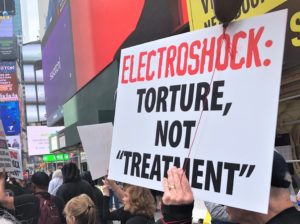
“Bare, open and vulnerable,” said Dundas in a statement read by a spokesperson from the Coalition Against Psychiatric Assault (CAPA) at Saturday’s fifth annual rally at Queen’s Park to raise awareness about the medical risks and sexist facts surrounding electroconvulsive therapy (ECT).

Dundas was second in line to receive ECT. She would often sneak a look to see what the doctors were doing to Susan, the first girl to receive the treatment. When Susan would shake violently, she could no longer watch and had to turn away.

Waiting for her turn, Dundas would shiver in fear beneath the bed sheets. “I can still feel the sticky, cold jelly they put on my temples,” she said. Her arms and legs were held down and just before the doctor pushed the shock button he would ask, “Is everybody ready?”

“Each time I expected I would die,” she said.

Later, she’d wake up with a violent headache and nausea. Her mind was blurred and she permanently lost eight months of memory immediately preceding the shock treatments. But she was lucky.

On one of those cold winter mornings, her 17-year-old friend Susan never woke up after an ECT treatment. “When she died, she became a part of me,” said Dundas.

Dr. Bonnie Burstow, a researcher, therapist and Chair of the Coalition Against Psychiatric Assault, said, “We demonstrate against ECT because it is an atrocity…on or around Mother’s Day because this is a deeply and profoundly sexist treatment. Two to three times as many women as men are shocked, even though women incur more damage from ECT than men do.”

Electroconvulsive therapy (ECT) is a procedure in which electric currents are passed through the brain, deliberately triggering a brief seizure to cause changes in brain chemistry that can immediately reverse symptoms of certain mental illnesses.

According to the Mayo Clinic, side effects can include confusion, memory loss, nausea, vomiting, headache, jaw pain, muscle ache or muscle spasms.

The Canadian Institute for Health Information (CIHI) estimates that in 2007, the procedure was used more than 15,000 times in this country. It’s endorsed by the Canadian Psychiatric Association that stated it is a safe and effective treatment for major depression and other severe mood disorders.

But Simon Adam, a nurse, educator and scientist, said he’s seen the effects of ECT on his patients and believes the procedure is dangerous and doesn’t help them at all.

A year ago, NDP MPP Cheri DiNovo introduced a private member’s bill to defund ECT in Ontario. CAPA and DiNovo would have preferred an outright ban, but DiNovo was forced to compromise after she received complaint letters from the psychiatric community and heard from patients who claimed they’d been helped by ECT.

“We know the same thing happened over lobotomies,” she said.

“We certainly know as women that the roots of gynecology were roots of abuse against women’s bodies. We know that the time will come for this as well.”

Every year, both new and familiar faces show up at the annual Mother’s Day weekend rally and march to abolish ECT.

“We will come again and again and again until we get rid of this,” said Burstow.

“We’re going to win this fight because that’s an atrocity, because we are the people and because unlike psychiatry which manufactures lies by the second, we stand in truth.”

« Return to news items


Share

Not the Only Psychiatrist Who Opposes ECT

Wednesday, January 26th, 2011

The Huffington Post – January 26, 2011

by Dr. Peter Breggin

Peter R. Breggin, MD is a psychiatrist in private practice in Ithaca, New York, and the author of dozens of scientific articles and more than twenty books. His first medical book was about ECT: Electroshock: Its Brain-Disabling Effects (1979).

Duff Wilson provided a service by presenting both sides of the controversy when he wrote his report “F.D.A. Is Studying the Risk of Electroshock Devices” in the January 24, 2011 New York Times. The FDA is proposing to move ECT from the high risk category to the medium risk category to avoid the necessity of any testing for safety or efficacy. As a result, ECT would be grandfathered into continued use without ever being tested. This would place ECT in the same category as syringes which no longer need proof of safety or efficacy. The FDA hearings will be held January 27-28, 2011, and I hope some of my more courageous colleagues will attend and testify against approving ECT without testing.

Mr. Wilson quotes me correctly in the article: “It’s a big money-maker,” he [Breggin] said. “I would say if anything it’s been on the increase because there’s a market that’s been exploited, that is the elderly depressed women on Medicare. The reason for that is they’re covered, and there’s no one to protect them. What commonly stops shock treatment is a family member saying ‘over my dead body.’ ”

However, Mr. Wilson misunderstood what I meant to say when, without quoting me, he wrote in the original published edition that Breggin “says he is the only American psychiatrist he knows who opposes the treatment.” He and I have chatted since the publication of his article in the NYT and he has generously edited the current on-line copy of the article and posted a correction indicating that I actually said that I am the only psychiatrist I know of who publicly opposes the treatment. I don’t know anyone else who has taken a very visible public stand–publishing anti-ECT views in the scientific literature, and presenting them in the media and the courts. Similarly, I am the only psychiatrist to have testified in a successful ECT malpractice suit.

The same was true when I conducted my successful campaign to stop the resurgence of lobotomy and other forms of psychosurgery in the 1970s. At that time, most psychiatrists probably opposed lobotomy, but I was the first and still only one to oppose it publically in the scientific literature, the media, and the courts, as well as in Congressional testimony. The success of my campaign required putting outside pressure on facilities, psychiatrists and neurosurgeons who were involved in this barbaric “treatment” and cutting off federal funding for some of their projects. I’m also the only psychiatrist to testify in a successful psychosurgery malpractice trial. My reform efforts against ECT and lobotomy are described Brain-Disabling Treatments in Psychiatry (2008, p. 230-232), ECT is especially harmful to the more fragile brains of the elderly.

ECT causes closed head injury by means of electrically-induced seizures. There can be no doubt that the treatment causes trauma to the brain. The patient is comatose for several minutes in the recovery room and after a few treatments becomes confused and disoriented. A recent study confirms long-term memory loss and other cognitive deficits, which by definition is dementia. As I review in Brain-Disabling Treatments in Psychiatry (2008, pp. 237-241), large animal studies have shown brain cell death using ECT dosages less than those routinely inflicted today. My website has a very extensive ECT bibliography that can be downloaded for free. It includes a variety of the original large animal ECT research projects.

After John Read and Richard Bentall published their recent scientific review, Professor Bentall declared, “The very short- term benefit gained by a small minority cannot justify the risks to which all ECT recipients are exposed. The use of ECT therefore represents a failure to introduce the ideals of evidence-based medicine into psychiatry. It seems there is resistance to the research data in the ECT community, and perhaps in psychiatry in general.”

In a sane society, ECT would be abandoned as a treatment. In an insane society, a government agency would approve it without requiring testing for safety and efficacy. That may be about to happen.

Peter R. Breggin, MD is a psychiatrist in private practice in Ithaca, New York, and the author of dozens of scientific articles and more than twenty books. His first medical book was about ECT: Electroshock: Its Brain-Disabling Effects (Springer Publishing Company, New York, 1979). His most recent medical book dealing with ECT is Brain-Disabling Treatments in Psychiatry: Drugs, Electroshock and the Psychopharmaceutical Complex, Second Edition (2008). Dr. Breggin’s professional website is www.breggin.com.

You can meet and hear presentations by Dr. Breggin and some of his closest colleagues at the annual Empathic Therapy Conference to be held April 8-10, 2011 in Syracuse, New York. Click here to learn more about the conference and to register. Professionals and non-professionals alike are welcome.

http://www.huffingtonpost.com/dr-peter-breggin/not-the-only-psychiatrist_b_813863.html

« Return to news items


Share

Americas Mental Illness Epidemic

Thursday, August 26th, 2010

Rense.com
By Gary G. Kohls, MD
August 25, 2010

Tens of millions of innocent, unsuspecting Americans, who are mired deeply in the mental “health” system, have actually been made crazy by the use of or the withdrawal from commonly-prescribed, brain-altering, brain-disabling, indeed brain-damaging psychiatric drugs that have been, for many decades, cavalierly handed out like candy ­ often in untested and therefore unapproved combinations of drugs – to trusting and unaware patients by equally unaware but well-intentioned physicians who have been under the mesmerizing influence of slick and obscenely profitable psychopharmaceutical drug companies aka, BigPharma.

That is the conclusion of two books by investigative journalist and health science writer Robert Whitaker. His first book, entitled Mad in America: Bad Science, Bad Medicine and the Enduring Mistreatment of the Mentally Ill noted that there has been a 600% increase (since Thorazine was introduced in the US in the mid-1950s) in the total and permanent disabilities of millions of psychiatric drug-takers. This uniquely First World mental ill health epidemic has resulted in the life-long taxpayer-supported disabilities of rapidly increasing numbers of psychiatric patients who are now unable to be happy, productive, taxpaying members of society. Whitaker has done a powerful, albeit unwelcome job of presenting previously hidden, but very convincing evidence to support his thesis, that it is the drugs and not the diagnosis that is causing the epidemic of mental illness disability. Many open-minded physicians and many aware psychiatric patients are now motivated to be wary of any and all synthetic chemicals that can cross the blood/brain barrier because all of them are capable of altering the brain in ways totally unknown to medical science, especially when the patients are taking the drugs long-term..

In Whitaker’s second book Anatomy of an Epidemic: Magic Bullets, Psychiatric Drugs, and the Astonishing Rise of Mental Illness in America, he goes much further in advancing this sobering reality. He documents the history of the powerful forces behind the relatively new field of psychopharmacology and its major shaper and beneficiary, BigPharma. Psychiatric drugs, whose developers, marketers and salespersons are all in the employ of the giant drug companies, are far more dangerous than the drug and psychiatric industries are willing to admit: These drugs, it turns our, are fully capable of disabling ­ often permanently – body, brain and spirit.

More evidence to support Whitaker’s well-documented claims are laid out in two important new books written by psychiatrist and scholar Grace Jackson. Jackson did a beautiful job of researching and documenting, from the voluminous basic neuroscience research (which is uniformly ignored by the clinical sciences) the unintended and often disastrous consequences of the chronic ingestion of any of the five major classes of psychiatric drugs. Her second and most powerful book: Drug-Induced Dementia: A Perfect Crime, proves beyond a shadow of a doubt, that any of the five classes of drugs that are commonly used in psychiatric patients (antidepressants, antipsychotics, psychostimulants, tranquilizers and anti-seizure/”mood-stabilizer” drugs) have shown microscopic, macroscopic, biochemical, clinical and/or radiological evidence of brain shrinkage and other signs of brain damage, which can result in clinically-diagnosable, permanent dementia, premature death and a variety of other related brain disorders that can mimic mental illnesses. Jackson’s first book, Rethinking Psychiatric Drugs: A Guide for Informed Consent was an equally sobering book warning about the many hidden dangers of psychiatric drugs.

This sad truth is that the seemingly knee-jerk prescribing (without very much information being given to patients about the long list of serious long-term adverse effects) of potent and often addicting/dependency-inducing psychiatric drugs has become the standard of care in American psychiatry since the introduction of the so-called anti-schizophrenic “miracle” drug Thorazine in the mid-1950s. (Thorazine was the offending drug that all of Jack Nicholson’s fellow patients were coerced into taking at “medication time” in the Academy Award-winning movie “One Flew Over the Cuckoo’s Nest”.) Thorazine and all the other “me-too” early antipsychotic drugs are now universally known to have been an iatrogenic (= doctor or other treatment-caused) disaster because of their serious long-term, initially unsuspected, brain-damaging effects that resulted in a number of incurable neurological disorders such as tardive dyskinesia and Parkinson’s disease.

Thorazine and all the other knock-off drugs like Prolixin, Mellaril, Navane. etc, are synthetic “tricyclic” chemical compounds similar in molecular structure to the tricyclic “antidepressants” like imipramine and the similarly toxic, obesity-inducing, diabetogenic, “atypical” anti-schizophrenic drugs like Clozaril, Zyprexa and Seroquel.

Thorazine, incidentally, was originally developed in Europe as an industrial dye. That doesn’t sound so good although it may not be so unusual in the closely related fields of psychopharmcology and the chemical industry, especially when one considers that Depakote, a popular drug marketed initially as an anti-epilepsy drug but now is being heavily used as a so-called “mood stabilizer”. Depakote, known to be a hepatotoxin and renal toxin, was originally developed as an industrial solvent capable of dissolving fat – including, presumably, the fatty tissue in human livers and brains.

Some sympathy and understanding needs to be generated for the various victims of BigPharma’s compulsive drive to expand market share and “shareholder value” (share price, dividends and the next quarter’s financial report) by whatever means necessary. Both the prescribers and the swallowers of BigPharma’s drugs have succumbed to BigPharma’s cunning marketing campaigns, the prescribers having been seduced by attractive drug company representatives and their “pens, pizzas and post-it note” freebies in the office, and the patients being brain-washed by the inane and unbelievable (if one has intact critical thinking skills) commercials on TV that quickly gloss over the lethal adverse effects in the fine print while urging the watcher to “ask your doctor” about the latest unaffordable wannabe blockbuster drug..

For a quick overview of these issues, I recommend that everybody with an open mind read a long essay written by Whitaker that persuasively identifies the source of America’s epidemic of mental illness disability (a phenomenon that doesn’t exist in Third World nations because costly psych drugs are not prescribed so cavalierly as in the US).

Whitaker and Jackson (among a number of other ground-breaking and whistle-blowing authors who have been essentially black-listed by the mainstream media and mainstream medical journals) have proven to most critically-thinking scientists, alternative practitioners and assorted “psychiatric survivors” that it is the drugs – and not the so-called “disorders” – that are causing our nation’s epidemic of mental illness disability. The Whitaker essay, plus other pertinent information about his books can be accessed at www.madinamerica.com A recent interview on Wisconsin Public Radio can be accessed at www.wpr.org (at their radio archives link) and a long interview with Dr.Joseph Mercola can be heard at: http://articles.mercola.com/sites/articles/archive/2010/05/08/robert-whitaker-interview.aspx

After reading and studying all these inconvenient truths, mental health practitioners must consider the medicolegal implications for them, especially if the information is ignored or if the information is dismissed out of hand by practitioners who might be tempted to not take the time to study this new information. Those people who are hearing about this for the first time need to pass the word on to others, especially their prescribing healthcare practitioners who should be equally concerned. This is important because the opinion leaders in the highly influential (for good or ill) psychiatric and medical industries have been marketed into submission without hearing the all the facts (which may have been intentionally hidden from them. If that is the case, they cannot be automatically blamed for proceeding in a practice that some day might represent malpractice. It shouldn’t have to be pointed out that is the solemn duty of ethical practitioners who are in positions of authority to fully examine potential malpractice issues and then warn others, especially their patients, of the dangers.

Sadly, it must be admitted that most of the over-worked, double-booked care-givers in medical clinics have not yet heard the news that most if not all of the brain-altering synthetic chemicals known as psychotropic drugs (which are treated as hazardous waste unless they are packaged in a swallowable capsule!) have been marketed as safe and effective – but only for short-term use. The captains of the drug industry know that the psychotropic drugs that they present for the FDA-approval have only been tested in animal trials for days and in clinical trials for 6 weeks. They also know ­ indeed they hope – that patients will be taking their drugs for years (despite no long-term trials proving safety and efficacy) as the only “treatment” for mental ill health. They know that their brain-altering drugs are also dependency-inducing (aka addicting, causing withdrawal symptoms when stopped), neurotoxic and increasingly ineffective (a la “Prozac Poop-out”) as time goes by.

The truth is that the people diagnosed as “mentally ill” for life are often simply those unfortunates who find themselves in acute or chronic states of crisis or “overwhelm” due to any number of preventable, curable and treatable (without the use of drugs) bad luck accidents such as poverty, abuse, violence, torture, homelessness, discrimination, underemployment, brain malnutrition, addictions/withdrawal, brain damage from electroshock “therapy” and/or exposure to neurotoxic chemicals in their food, air, water or prescription bottles.

Those labeled as the “mentally ill” are just like us “normals” who have not yet decompensated because of some yet-to-happen, crisis-inducing, overwhelming (however temporary) life situation. And thus we have not yet been given a billable code number (accompanied by the seemingly obligatory – and unaffordable – drug prescription or two signifying we are now chronically mentally ill. Unlabeled, we are likely to remain off prescription drugs but with a label and in “the system”, it is hard to “just say no to drugs.”

The victims of hopelessness-generating situations like simple bad luck, bad circumstances, bad company, bad choices, bad government, big business, and a competitive society that generates a few winners but mostly losers. America tolerates, indeed celebrates, punitive and thus fear-inducing social systems resembling in many ways the infamous police state realities of 20th century European totalitarianism, where people who were different or just dissidents were thought to be abnormal and therefore “disappeared” into insane asylums, jails or concentration camps without just cause or competent legal defense. And many of them were and are drugged with disabling psychoactive chemicals against their will.

The truth is that most, if not all, of BigPharma’s psychotropic drugs are lethal at some dosage level (the LD50, the lethal dose that kills 50% of lab animals, is calculated before efficacy testing is done), and therefore the drugs must be regarded as dangerous. The chronic use of these drugs is a major cause of cognitive disorders, brain damage, loss of creativity, loss of spirituality, loss of empathy, loss of energy, loss of strength, fatigue and tiredness, permanent disability and a multitude of metabolic adverse effects that can readily sicken the body, brain and soul by causing insomnia or somnolence, increased depression or anxiety, delusions, psychoses, paranoia, mania, etc. So before filling the prescription, it is advisable to read the product insert labeling under WARNINGS, PRECAUTIONS, ADVERSE EFFECTS, CONTRAINDICATIONS, TOXICOLOGY, OVERDOSAGE and the ever-present BLACK BOX WARNINGS ABOUT SUICIDALITY.

Long-term, high dosage or combination psychotropic drug usage could be regarded as a chemically traumatic brain injury (TBI) or, as drugs like Thorazine were known in the 1950s and 60s, a “chemical lobotomy”. That is a useful way to conceptualize this serious issue, because such chemically brain-altered patients are often indistinguishable from those who have suffered a physically traumatic brain injuries or been subjected to ice-pick lobotomies which were popular in the 1940s and 50s – before the drugs came on the market.

America has a mental ill health epidemic on its hands that is grossly misunderstood because it is worsening, not by the supposed disease progression, but because of the neurotoxic, non-curative drugs that are somehow regarded as first-line “treatment.”
Read the rest of this article here: http://www.rense.com/general91/edi.htm

« Return to news items


Share

New study linking anti-psychotics to brain damage raises alarm bells with health campaigners & human rights groups

Monday, July 19th, 2010

Black Mental Health UK
By Zephaniah Samuels
July 18, 2010

Findings from a new study that shows that anti-psychotic drugs are likely to cause brain damage has raised alarm bells among  health campaigners and human rights groups.

Effects of antipsychotics on brain volume

Entitled ‘A systematic review of the effects of antipsychotic drugs on brain volume ,’ the results of this study dispel the widely-held view that schizophrenia itself causes brain structural changes.  ‘Some evidence points towards the possibility that antipsychotic drugs reduce the volume of brain matter and increase ventricular or fluid volume. Antipsychotics may contribute to the genesis of some of the abnormalities usually attributed to schizophrenia,’ the report says.

Published in the journal of Psychological Medicine these new findings are based on a review of the effects of antipsychotic drugs on the brain. The findings  published earlier this year, have raised alarm among race equality and human rights groups who are increasingly concerned  about the over-diagnosis of  ‘schizophrenia’ among  people from  African Caribbean people communities.

The annual Count Me In Census report logs the ethnic origin of those admitted into psychiatric care including those detained against their will under the Mental Health Act.

For the past four years census findings have shown that rates of forced detention of black people under the Act continue to rise while falling for the rest of the population.  The results of the latest 2009 Census published earlier this year again confirmed health campaigners worst fears, that absolutely no improvement has been made to reduce the detention rate of black people sectioned under the Mental Health Act despite the former government’s million pound programmed to address the racism and  within mental health service.

African Caribbean’s routinely given diagnosis of schizophrenia

Once in the system evidence shows that black people are routinely given a diagnosis of schizophrenia even though there is no biological evidence to show that this group have higher rates of mental ill health than their white counter parts.

The diagnosis of schizophrenia is routinely accompanied by a regime of antipsychotic medication, with little evidence of those who enter the system ever making a full recovery.

A report by the now defunct Mental Health Act Commission  entitled, Risks, Rights and Recovery published in 2008 show that over stretched staff are regularly  give patients high doses of medication in order to make patients more easy to manage.

This latest paper challenges the view that schizophrenia itself causes brain structural changes, such as less brain grey matter, larger ventricles and more cerebrospinal fluid (CSF) spaces, researchers say.  The team responsible for this work reviewed magnetic resonance imaging studies, which had assessed brain changes in patient on anti-psychotic and those of patients not on the drugs.

Over half of the 26 studies showed that the brains of patients on anti-psychotics had shrunk. This was compared to the 21 studies of patients who had not be given anti-psychotics, where just five showed brain size decreases.  However no differences were reported in three studies of non-drug patients who had been ill for a long time.

Read entire article:  http://www.blackmentalhealth.org.uk/index.php?option=com_content&task=view&id=805&Itemid=117

« Return to news items


Share

Exclusive: Anti-Psychotics Likely to Cause Brain Damage, New Study Says

Wednesday, July 7th, 2010

(See also these related articles from CCHR International:)

http://www.cchrint.org/2010/06/29/pre-crime-try-pre-diagnose-and-pre-drug-psychiatrists-target-infants-as-mental-patients-2/

http://www.cchrint.org/2010/06/16/australian-psychiatrist-patrick-mcgorry-wants-his-pre-drugging-agenda-to-go-global/

PSYCHMINDED.CO.UK

EXCLUSIVE
July 7, 2010
by Angela Hussain

Anti-psychotic drugs are likely to cause brain damage, according to a new study.

The results challenge the widely-held view that schizophrenia itself causes brain structural changes, such as less brain grey matter, bigger ventricles and larger cerebrospinal fluid (CSF) spaces, claim researchers.

The results are published in an edition earlier this year of the Psychological Medicine journal.

Researchers reviewed magnetic resonance imaging studies which had examined brain changes in patients on anti-psychotics and those of patients not on the drugs.

More than half (14) of 26 studies showed that the brains of patients on anti-psychotics had shrunk.

Of the 21 studies of patients not on anti-psychotics, five suggested brain size decreases. But no differences were reported in three studies of non-drug (known as ‘drug-naïve’) patients who had been ill for a long time.

The results are “remarkable”, claim the study’s researchers, because they contradict research purporting to rule out anti-psychotic drug-induced effects on brain size.”

Most studies of drug-naïve patients did not report or detect differences in total brain volume, global grey matter or CSF volumes between patients and controls, including three studies of untreated patients with long-term illness,” stated the researchers, including Dr Joanne Moncrieff, of the Department of Mental Health Sciences, University College London.

Up to now few studies have investigated primarily the effects of anti-psychotic treatment on brain structure.

“Overall there seems to be enough evidence to suggest that antipsychotic drug treatment may play a role in reducing brain volume and increasing CSF or ventricular spaces,” the researchers wrote. Further research is urgently required, stated the paper, entitled A Systematic Review of the Effects of Antipsychotic Drugs on Brain Volume.

Read the rest of the article here: http://psychminded.co.uk/news/news2010/july10/Anti-psychotics-likely-to-cause-brain-damage001.html

Note from CCHR:  The importance of this study cannot be stated strongly enough, given the world-wide current push from the psychiatric/pharmaceutical industries for pre-diagnosing patients, including infants and children,  using faulty and misleading research to try and validate schizophrenia as a brain abnormality or disease (which has never been proven) in order to push a pre-diagnosing and pre-drugging agenda.  See these articles for more information;

http://www.cchrint.org/2010/06/29/pre-crime-try-pre-diagnose-and-pre-drug-psychiatrists-target-infants-as-mental-patients-2/

http://www.cchrint.org/2010/06/16/australian-psychiatrist-patrick-mcgorry-wants-his-pre-drugging-agenda-to-go-global/

« Return to news items


Share

Hidden Facts About Ritalin; Side Effects include brain damage, psychosis, severe dependence, paranoia

Monday, July 5th, 2010

New With Views
By Jon Rappoport
July 5, 2010

In 1986, The International Journal of the Addictions published a very important literature review by Richard Scarnati. It was called “An Outline of Hazardous Side Effects of Ritalin (Methylphenidate)” [v.21(7), pp. 837-841].

Scarnati listed a large number of adverse affects of Ritalin and cited published journal articles which reported each of these symptoms.

For every one of the following Ritalin effects, there is at least one confirming source in the medical literature:

• Paranoid delusions
• Paranoid psychosis
• Hypomanic and manic symptoms, amphetamine-like psychosis
• Activation of psychotic symptoms
• Toxic psychosis
• Visual hallucinations
• Auditory hallucinations
• Can surpass LSD in producing bizarre experiences
• Effects pathological thought processes
• Extreme withdrawal
• Terrified affect
• Started screaming
• Aggressiveness
• Insomnia
• Since Ritalin is considered an amphetamine-type drug, expect amphetamine-like effects
• Psychic dependence
• High-abuse potential DEA Schedule II Drug
• Decreased REM sleep
• When used with antidepressants one may see dangerous reactions including hypertension, seizures and hypothermia
• Convulsions
• Brain damage may be seen with amphetamine abuse.

Many parents around the country have discovered that Ritalin has become a condition for their children continuing in school. There are even reports, by parents, of threats from social agencies: “If you don’t allow us to prescribe Ritalin for your ADHD child, we may decide that you are an unfit parent. We may decide to take your child away.”

This mind-boggling state of affairs is fueled by teachers, principals, and school counselors, none of whom have medical training. Yet even if they did…

The very existence of the “illnesses” for which Ritalin would be prescribed is unproven. It is merely assumed.

In commenting on Dr. Lawrence Diller’s book, Running on Ritalin, Dr. William Carey, Director of Behavioral Pediatrics, Children’s Hospital of Philadelphia, has written, “Dr. Diller has correctly described… the disturbing trend of blaming children’s social, behavioral, and academic performance problems entirely on an unproven brain deficit…”

On November 16-18, 1998, the National Institute of Mental Health held the prestigious “NIH Consensus Development Conference on Diagnosis and Treatment of Attention Deficit Hyperactivity Disorder [ADHD].” The conference was explicitly aimed at ending all debate about the diagnoses of ADD, ADHD, and about the prescription of Ritalin. It was hoped that at the highest levels of medical research and bureaucracy, a clear position would be taken: this is what ADHD is, this is where it comes from, and these are the drugs it should be treated with. That didn’t happen, amazingly. Instead, the official panel responsible for drawing conclusions from the conference threw cold water on the whole attempt to reach a comfortable consensus.

Read entire article:  http://www.newswithviews.com/Rappoport/jon101.htm

« Return to news items


Share

Think They Don’t Electroshock People Anymore? Think Again–Even toddlers and pregnant women are being shocked

Sunday, January 24th, 2010

By Dr. John Breeding, author of The Wildest Colts Make the Best Horses

child close-upAsk the average person about the use of electroshock treatment in today’s society and 9 out of 10 will respond, “They still shock people?”

They do. It’s estimated that more than 100,000 Americans are electroshocked each year; half are 60 and older, and two-thirds are women. In Australia, it was recently revealed that psychiatrists had electroshocked 55 toddlers age four and younger. In the UK, three year olds have been brutalized with it. And one of the country’s leading mental health “patients’ rights” groups—the National Alliance of Mental Illness (NAMI)—recently endorsed the use of electroshock on pregnant women. One would wonder why a patients’ rights group would endorse such an obviously harmful procedure if not for the fact that the group has recently been exposed as a major front for the psycho/pharmaceutical industry.

The FDA reports pregnant women miscarrying following ECT, while studies show that in addition to the risk of death, the fetus can suffer malnutrition, dehydration and violent injury. Electroshocking children, pregnant women and the unborn is tantamount to torture and should not only be banned but those administering it prosecuted.

Given the factual truths of sending up to 360 volts of electricity searing through the brain – the obvious question is why the “treatment” has not gone by the wayside like its psychiatric sister treatments during the 1940s and 1950s, insulin coma shock and lobotomy.

Electroshock was indeed challenged, and its low point pretty much coincided with the release in 1975 of the Academy Award-winning film version of Ken Kesey’s One Flew Over the Cuckoo’s Nest and Jack Nicholson’s portrayal of the feisty Randle Patrick McMurphy. The horrible scene of his undergoing “unmodified” shock treatment, i.e., without anesthetic and muscle-paralyzing drugs, along with his reduction to a vegetative state was seared in the public’s mind. This, together with public exposure of the shameful state of psychiatric institutions, certainly gave electroshock treatment a bad name—so much so that the treatment was renamed Electroconvulsive Therapy (ECT). The bad publicity caused its use in public institutions to fall sharply, and its overall use was also considerably diminished. It would be naïve, however, to think that this curtailment was strictly due to increased public awareness about the brutalities of the procedure. The advent of neuroleptics (nerve-seizing drugs) was perhaps the major factor in this development. The indiscriminate use of these drugs replaced the indiscriminate use of ECT as the primary means of subduing and pacifying inmates who resisted incarceration and wouldn’t cooperate.

In the last two decades, however, electroshock has made a comeback.

Most electroshock is insurance-covered. ECT specialists on average have incomes twice that of other psychiatrists. The cost for inpatient ECT ranges from $50,000 to $75,000 per series (usually 8 to 12 individual sessions). Electroshock is a multibillion-dollar-a-year industry—yet its damaging effects are well known to those who endorse it.

Max Fink, a professor of psychiatry and the “Grandfather of American ECT” believed the “therapeutic” effect from ECT is produced by brain dysfunction and damage. “Effects on memory, common in ECT, come in two flavors,” wrote Fink in Psychiatric Times in 2006. “Delirium is common with each seizure and is well documented by immediate measurable changes in brain chemistry and physiology” and “the second complaint is of a persistent loss of personal memories…They do not recall the names of their children, family holidays, or personal events….Their complaints cast a public shadow on ECT practice.”

The Procedure

Electroshock is a psychiatric procedure that involves the production of a grand mal convulsion, similar to an epileptic seizure, by passing from 70 to upwards of 600 volts of electric current through the brain for one-half second to four seconds. Before application, ECT subjects are typically given anesthetic, tranquilizing and muscle-paralyzing drugs to reduce fear, pain, and the risk (from violent muscle spasms) of fractured bones (particularly of the spine, a common occurrence in the early history of ECT before the introduction, in the mid-1950s, of the muscle-paralyzing drug succinylcholine [Anectine]). The ECT-induced convulsion usually lasts from thirty to sixty seconds and may immediately produce disorienting, painful, and even life-threatening complications, such as apnea (temporary suspension of breathing) and cardiac arrest. The convulsion is followed by a period of unconsciousness of several minutes’ duration. Electroshock is usually administered in hospitals because they are equipped to handle emergency situations that often develop during or soon after an ECT session.

Brain Damage

The brain naturally operates in millivolts of electricity, and ECT administers on average between 150 and 400 volts of electricity to the brain, a force sufficient to induce a grand mal seizure, rupture the protective blood-brain barrier and incite glutamate toxicity (glutamate is a powerful neurotransmitter released by nerve cells in the brain and is responsible for sending signals between nerve cells. In glutamate toxicity there is too much glutamate that leads to over-excitation of the receiving nerve cell, which can cause cell damage and/or death). It is prima-facie, common sense obvious fact that ECT causes brain damage. After all, the rest of medicine, as well as the building trades, do their best to prevent people from being hurt or killed by electrical shock. People with epilepsy are given anticonvulsant drugs to prevent seizures because they are known to damage the brain. The Electroshock Quotationary, a collection of quotations, excerpts, and essays about the history and nature of electroshock, by shock survivor Leonard Roy Frank, includes the testimony of Peter Sterling, a University of Pennsylvania neuroscience professor, describing the nature of ECT-caused brain damage, dated May 31, 2001, to the New York Assembly Standing Committee on Mental Health at a public hearing on ECT.

Sterling affirms the obvious: that massive amounts of electricity directly into the brain cause profound damage.

Lack of Efficacy

Not only does electroshock directly violate the Hippocratic oath to do no harm, the practice has never been proven effective. There are no lasting beneficial effects of electroshock; sham-electroshock (anesthesia but no electroshock) has the same short-term outcomes as electroshock (Ross, 2006). Even leading shock researcher and advocate Harold Sackeim now provides a proof. In an article from 2001, he and his colleagues conclude, “Our study indicates that without active treatment, virtually all remitted patients relapse within 6 months of stopping ECT.” (Italics mine)

The FDA

The battle against electroshock has been ongoing since its advent. The two recent chronicles by electroshock survivor activist leaders, Leonard Roy Frank (The Electroshock Quotationary) and Linda Andre (Doctors of Deception), tell the story best. Just now, the fight has centered on the FDA review of the “efficacy and safety” of ECT machines.

Many activists, including myself, have submitted testimony urging the FDA NOT to reclassify these devices from Class III (high risk) to Class II (low risk). I have worked with scores of electroshock survivors, and I can tell you the damage is consistent and terrible. I can also tell you as a psychologist that there are methods so much gentler, safer and more effective to help people with depression.

A Repackaged Product

The reason for electroshock’s endurance and resurgence is best described by Linda Andre, shock survivor and leader of the Committee for Truth in Psychiatry, in her masterful new work, Doctors of Deception: What They Don’t Want You to Know About Shock Treatment—it is simply the triumph of public relations over science. A concerted PR campaign has allowed electroshock to continue despite clear scientific evidence of its dismal and tragic record on safety and efficacy.

The industry repackaged the product to keep it selling. They touted a “newer and safer ECT,” bragging about improved equipment and the introduction of anesthesia and muscle paralysants, which actually came on the market in the 1950s. While the muscle paralysants greatly reduced the risk of broken bones from unrestrained convulsions, there was no lessening of permanent damage to the brain caused by the electroshocks. The drugs made the procedure appear much more benign because they suppressed the body’s natural, violent reaction to a grand mal convulsion. However, as Doug Cameron (1994) and other researchers have shown, the new machines, because they are more powerful than ever are capable of releasing greater amounts of electricity into the brain thus causing more damage than the older devices.

With the newer technique modifications there is also an added risk. The drugs used to prevent bone complications raise the seizure threshold so that more electrical current is required to induce the convulsion, which in turn increases brain damage. Moreover, whereas ECT specialists formerly tried to induce seizures with minimal current, they commonly use suprathreshold amounts in the belief that they are more effective. Again, the more current, the more brain damage. Proponents, and the public, have missed the point that the supposed “effectiveness” of ECT is in direct ratio to the amount of brain damage it causes.

In addition to the propaganda effect and the financial incentives, there is a less well-considered reason for ECT’s popularity among psychiatrists. Although electroshock is often described as psychiatry’s “treatment of last resort,” it is actually psychiatry’s “treatment of next resort.” Next resort after psychiatric drugs, which are the main “treatment”—a treatment whose lack of effectiveness and lack of safety are well documented. Like ECT, these drugs can damage and disable the brain. Like ECT, they can cause a fully justified resentment that goes with the experience of having been betrayed by one’s supposed helpers.

Activist and electroshock survivor Leonard Roy Frank’s recent letter to the FDA in regards to their review of ECT devices is one of the best. I end this blog article with his conclusion:

As a destroyer of memories and thoughts, electroshock is a direct, violent assault on these hallmarks of American liberty: freedom of conscience, freedom of belief, freedom of thought, freedom of religion, freedom of speech, freedom from assault, and freedom from cruel and unusual punishment. Tens of thousands of people every year in the United States are deceived or coerced into undergoing electroshock. The FDA should do everything in its power to discourage the use of electroshock by:

  • keeping ECT’s Class III, high-risk rating;
  • insisting that electroshock psychiatrists, manufacturers of ECT devices, and executives and administrators in hospitals where ECT is administered, substantiate with scientific proof their claims that the procedure is “safe and effective”;
  • and calling upon the Congress and the Department of Justice to investigate the fraudulent and coercive use of this cruel and inhuman procedure.

Despite the evidence of grievous harm and failure to help, electroshock’s proponents rave on; as an example, an electroshock psychiatrist told Washington Post reporter Sandra Boodman in 1996, that, “ECT is one of God’s gifts to mankind. There is nothing like it, nothing equal to it in efficacy or safety in all of psychiatry.”

Given that ECT causes brain damage, memory loss, and other serious cognitive impairment, electroshock serves to cover up and impede any potential malpractice or personal injury litigation. It generally takes years for a shock survivor to recover enough to figure out what has happened to them, and most states have a statute of limitations (usually one or two years) on medical malpractice and personal injury suits. As a result, electroshock survivors are effectively prevented from pursuing litigation against those who harmed them, making electroshock psychiatrists almost malpractice-proof.


John Breeding, Ph.D. has been a counseling psychologist in Austin, Texas for 25 years.
He is an outspoken critic of electroshock treatment and has testified against its use before legislative bodies on numerous occasions. Dr. Breeding is also the director of Texans For Safe Education, a citizens group dedicated to challenging the ever-increasing role of psychiatric drugs in schools. He is the author of numerous articles and four books including:
The Wildest Colts Make the Best Horses and True Nature and Great Misunderstandings.

For more information on the damage caused by ECT, visit www.endofshock.com

References

Ayd Jr., F.T. (November-December 1963). “Guest editorial: Ugo Cerletti, M.D. (1877-1963),” Psychosomatics, Vol. 4, pp. A-6 – A-7.

Boodman, S.G. (September 24, 1996). “Shock therapy: It’s back,” Washington Post (Health Section), pp. 14-20.

Frank, Leonard Roy, The Electroshock Quotationary, June 2006, www.endofshock.com/102C_ECT.PDF.

Andre, Linda, Doctors of Deception, www.doctorsofdeception.com.

Kalinowsky, L.B. (1988). Quoted in R. Abrams, “Interview with Lothar Kalinowsky, M.D.,” Convulsive Therapy, Vol. 4.

Ross, C.A. (Spring 2006). “The sham ECT literature: Implications for consent to ECT,” Ethical Human Psychology and Psychiatry, Vol. 8.

Sackeim, H.A. et al. (March 14, 2001). “Continuation pharmacotherapy in the prevention of relapse following electroconvulsive therapy,” Journal of the American Medical Association.

Sackeim, H.A. (2001). “Memory loss: From polarization to reconciliation,” Journal of ECT, vol. 17, no. 3, p. 229. Sackeim, H.A., Prudic, J. et al. (January 2007). “The cognitive effects of electroconvulsive therapy in community settings,” Neuropsychopharmacology, Vol. 32, pp. 244-254.

RETURN TO BLOGS PAGE


Share