

by Kelly Patricia O’Meara
October 30, 2012
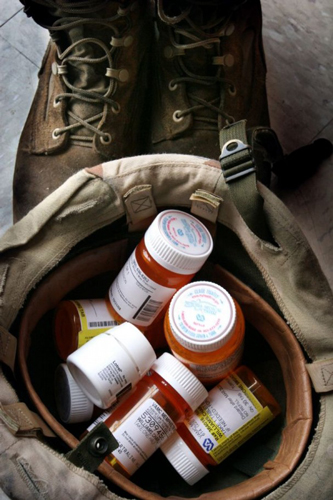 The devastating adverse effects mind-altering psychiatric drugs may be having on the nation’s military troops are best summed up by Mary Shelley’s Dr. Frankenstein, writing “nothing is so painful to the human mind as a great and sudden change.”
Just as the fictional character, Dr. Frankenstein, turned to experiments in the laboratory to create life with fantastically horrific results, the psychiatric community, along with its pharmaceutical sidekicks, has turned to modern day chemical concoctions to alter the human mind. The result is what many believe is a growing number of equally hideous results culminating in senseless deaths, tormented lives and grief-stricken families.
The nation’s military troops are taking their lives at record numbers and seemingly healthy soldiers are dying from sudden unexplained deaths. That’s a fact. The data are clear, yet, despite growing evidence pointing to the enemy among us, the monstrous psycho-pharmacological experiment continues (see Part 1: Psychiatric Drugs and War: A Suicide Mission).
To truly understand the madness that has become the military’s mental health services, one only need review a few cases before the horror of these unorthodox and destructive psycho-pharmacological experiments is exposed. Marine Corporal Andrew White and Senior Airman Anthony Mena are just two examples of psycho-pharma’s disastrous chemical experimentation.
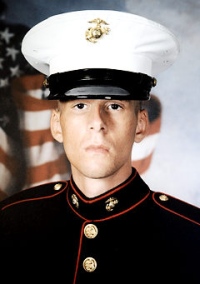
Marine Corporal Andrew White was prescribed 19 drugs in less than one year
White was a healthy 23-year-old, gung-ho Marine returning from a nine-month tour in Iraq, who, like so many of his brothers in arms, suffered from the seemingly normal stresses of war—insomnia, nightmares and restlessness. The young corporal turned to the military’s mental health system for help. Within a few short months, White became unrecognizable to his family.
According to Andrew’s mother, Shirley White, “he couldn’t function.” White explains, “he was a Zombie… it was like we were caring for an elderly person.” White’s sudden and shocking decline began shortly after beginning a multi-drug treatment.
Among the first of the VA’s pharmacological concoctions in March of 2007, White was prescribed Seroquel, or “Serokill” as it is being referred of late, a powerful antipsychotic approved by the Food and Drug Administration (FDA) to treat bipolar disorder and Schizophrenia, along with the antidepressant, Paxil. These mind-altering psychiatric drugs made up the first “sudden change” to White’s mind.
The off-label prescription of Seroquel (AstraZeneca) carries with it the following adverse reactions: irregular heartbeat, hallucinations, mood changes, panic attacks, insomnia, restlessness and suicidal thoughts or actions. These are just a few of the more than one hundred possible side effects.
The second part of White’s prescribed pharmacological cocktail was the antidepressant, Paxil, an SSRI approved by the FDA to treat symptoms of PTSD, which also carries its own lengthy list of severe side effects, including restlessness, insomnia and irregular heartbeat—the very symptoms for which White had sought treatment.
Given that Seroquel was not approved to treat White’s symptoms, and it carried with it all the possible severe side effects White actually complained of, one has to wonder why it was chosen as part of the VA’s mind-altering cocktail. The answer may lie in the cozy relationship between top staff at the VA and the pharmaceutical industry.
Matthew J. Friedman, the executive director of the Department of Veterans Affairs National Center for PTSD, and Professor of Psychiatry and Pharmacology at Dartmouth Medical School, was on the payroll of AstraZeneca, the maker of Seroquel. And, while a consultant to AstraZeneca, Friedman was one of four authors of the American Psychiatric Association’s 2009 Practice Guide for the Treatment of Patients with Acute Stress Disorder and PTSD.[1] Additionally, as a proponent of SSRI medications to treat PTSD, Friedman also sat on the PTSD Scientific Advisory Boards for GlaxoSmithKline and Pfizer—the makers of the antidepressants Paxil and Zoloft.[2]
Despite Dr. Friedman’s belief that cocktails of mind-altering drugs will “help” those suffering from combat related symptoms, White’s symptoms not only persisted but worsened, and VA, military and civilian psychiatrists returned to their laboratories, ever convinced the next multi-drug elixir would elicit remarkable results.
Apparently the physicians and psychiatrists caring for White worked from some twisted, mad scientist laboratory mentality that if-this-cocktail-of-five-mind-altering-drugs-doesn’t-work-let’s-try-upping-the-dosage-and-adding-drugs-we-haven’t-tried. One “sudden change” to another. The problem is the more drugs that were mixed, matched and increased, the worse White’s symptoms became.
And what was the explanation White’s parents were provided when they questioned Andrew’s doctors about his deteriorating health? “We asked his doctors,” says his mother, “but they just said ‘it takes time (for the pills to work).’”
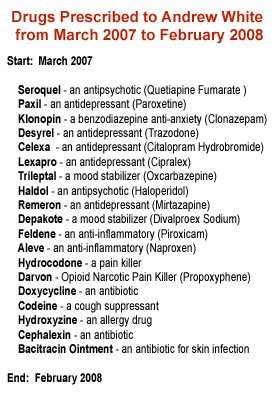
Click image to view increasing dosages of drugs prescribed to Andrew White.
But time ran out for White when, eleven months after beginning his first cocktail of mind-altering drugs, he died in his sleep from what the medical examiner ruled an “accidental overdose of medication.” After reviewing White’s list of prescribed mind-altering drugs, some may seriously wonder if “accident” is a grotesquely distorted word for negligent or, perhaps, criminal? (See complete list of drugs White had been taking here.)
Since taking his first multi-drug cocktail to the date of his death, White had been prescribed no less than nineteen different drugs with many at ever-increasing dosages, including antidepressants, antipsychotics, anti-anxiety, pain killers and antibiotics. The prescribed drugs Methadone, Oxycodone, Paxil and Seroquel were found in his system at the time of death.
Perhaps more shocking is that White had been prescribed 1600mg of Seroquel—more than double the maximum recommended dose for someone “schizophrenic” or “psychotic.” White was neither of these and, yet, the dosage of Seroquel climbed from 20mg to 1600mg over an eleven month period.
Shirley and Stan White can’t prove it, but they believe it was the cocktail of the high level of Seroquel and another, or several, of the drugs White had been prescribed that caused their son’s death. Given the changes that have occurred in the military and VA’s prescribing, there may be some truth to these suspicions.
In 2009, the FDA expressed worries about Seroquel and, in 2011, the federal agency issued new warnings for the antipsychotic as it “may be associated with sudden cardiac arrest…in some who took high doses of Seroquel.” Additionally the concerns about Seroquel, and the sudden unexplained deaths within the military, have not been ignored by the top brass at the Pentagon. In March of this year, U.S. Central Command removed Seroquel from the “approved” formulary, but there’s no guarantee that it won’t still be prescribed.
White’s parents believe this is a good first step, but more needs to be done to stop the chemical experimentation on the troops. “Andrew’s real problems,” says Shirley White, “did not start until after he was medicated.” Too many other parents mimic Shirley White’s sentiments, including Pat Mena who suddenly lost her son, Anthony, in July of 2009.
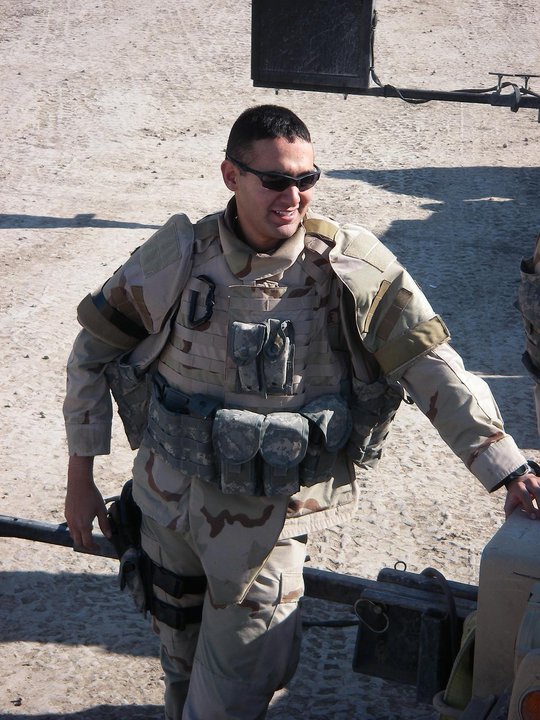
Senior Airman Anthony Mena was prescribed 35 drugs over an 18 month period
Twenty-three-year old Anthony (Tony) Mena did two tours in Iraq as part of Kirtland Air Force Base’s 377th Security Forces Squadron. Like so many others returning from combat, Mena suffered from insomnia, restlessness and nightmares—and like White, Mena received treatment from military, VA and civilian doctors.
Mena also complained of severe back pain and was routinely told by the military and VA doctors that it was “all in his head.” As it turned out, it actually was “all in his back” and when Mena was referred for help outside the military establishment, a very real medical condition was diagnosed by a civilian doctor.
By this time, however, Mena already had become a victim of the military’s mental health mind-altering multi-drug approach to treatment. Between January of 2008 and his death in July 2009, Mena had been prescribed no less than 35 prescription drugs, including numerous antidepressants, pain killers, tranquilizers and muscle relaxers.
The toxicology report revealed that Mena had nine different prescription medications in his system at the time of his sudden death—Xanax, Ambien, Dilaudid, Fentanyl, Paxil, Remeron, Skelaxin and Desyrel. Despite the numerous combinations of mind-altering drugs prescribed to Mena, he did not get “better” but, rather, became another psycho-pharma experiment gone deadly wrong. (See complete list of drugs Anthony had been taking here.)
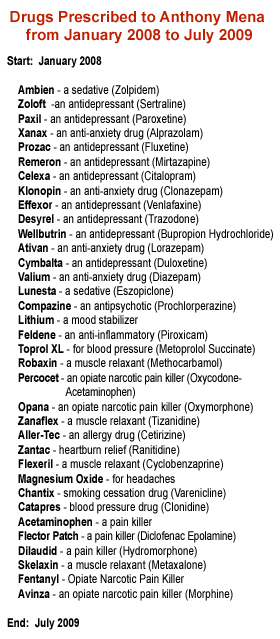
Click image to view increasing dosages of drugs prescribed to Anthony Mena.
According to Tony’s mother, Pat Mena, “Tony didn’t die from PTSD, he died from the combination—cocktail—of the drugs they gave him. Tony never got better and they tried almost every antidepressant on the market.” “None of the drugs,” explains Mena, “helped my son and that’s what I’d tell his doctors. I’d say ‘you gave him a tranquilizer and I don’t see him calm, you gave him an antidepressant and I don’t see him happy and he’d take pain killers and he still had pain.’”
Like Stan and Shirley White, Tony’s parents repeatedly questioned doctors about the number of drugs their son was taking and were continually assured that the treatment “takes time.” But, like White, time ran out for Senior Airman Anthony Mena, and no crazed combination of psycho-pharma’s multi-drug concoctions can turn back the clock.
Andrew White and Anthony Mena have become part of ever-increasing numbers of young, seemingly healthy soldiers who survived the horrors of war only to return home to fight, and lose, their toughest battle. Their deaths were not suicides. Rather, they are among a growing list of sudden deaths among military personnel, which many believe is due to sudden cardiac arrest brought on by the drug cocktails being prescribed. Fred Baughman Jr., MD has been researching these questionable deaths and believes the few that are known are just the “tip of the iceberg.”
There have been a number of peer-reviewed papers regarding the increased risks of sudden cardiac arrest deaths associated with antipsychotics and antidepressants. Baughman looked into the fatal heart attacks of four soldiers who died in their sleep. All four soldiers were given Seroquel, Paxil and Klonopin for treatment of PTSD—all in their twenties, no signs of suicide or drug overdose. According to Baughman, “antipsychotics and antidepressants alone or in combination, are known to cause Sudden Cardiac Death [SCD].”
“The drugging in the military doesn’t make any sense,” says Baughman. “When we get information from the families,” explains Baughman, “we’re finding that these guys are on five to fifteen different drugs at any one time. If these soldiers are dying from these drugs and the military is refusing to cut back on the drugs, this is scandalous. I think they are just calling these sudden cardiac arrests suicides and I don’t think we’ve begun to see the true numbers.”
Baughman continues to research SCD data and is working with families whose sons and daughters have fallen victim to the multi-drug cocktail experiment. “The military,” says Baughman, “has to come clean on these deaths.” The families of the fallen also want answers and are working to bring the issue to the forefront.
Both the White and Mena families feel a responsibility to their sons to warn others about their experiences within the military mental health system. With the hope that the story of Tony’s downward spiral will help others, Pat Mena has written a book titled, You’ll Be Fine, Darling: Struggling With PTSD After Trauma of War. The Whites are vocal opponents of the excessive drugging and have lobbied Congress about the dangers of the psychiatric medications being prescribed to the nation’s troops.
One can only admire the courage of these families and hope that with their voices fighting on their behalf, other warriors will be spared the nightmare that is this horrific pharmacological experiment. The military is a powerful family and they take care of their own.
Perhaps it is time for them to sever their ties to the psycho-pharma community, reconsider the benefit of modern day pharmacological experimentation and heed the dire warning to Mary Shelley’s, Dr. Frankenstein… “You have created a monster, and it will destroy you.”
Kelly Patricia O’Meara is an award-winning investigative reporter for the Washington Times, Insight Magazine, penning dozens of articles exposing the fraud of psychiatric diagnosis and the dangers of the psychiatric drugs – including her ground-breaking 1999 cover story, Guns & Doses, exposing the link between psychiatric drugs and acts of senseless violence. She is also the author of the highly acclaimed book, Psyched Out: How Psychiatry Sells Mental Illness and Pushes Pills that Kill. Prior to working as an investigative journalist, O’Meara spent sixteen years on Capitol Hill as a congressional staffer to four Members of Congress. She holds a B.S. in Political Science from the University of Maryland.
[1] David M. Benedek, M.D.; Matthew J. Friedman, M.D., Ph.D.; Douglas Zatzick, M.D.; Robert J. Ursano, M.D., “Guideline Watch (March 2009): Practice Guideline for the Treatment of Patients With Acute Stress Disorder and Posttraumatic Stress Disorder,” APA Practice Guidelines, PsychiatryOnline, http://psychiatryonline.org/content.aspx?bookid=28§ionid=1682793.
[2] Matthew J. Friedman, MD, PhD, “Pharmacologic Management of Posttraumatic Stress Disorder,” Primary Psychiatry, 2003;10(8):66-68, pp. 71, http://www.primarypsychiatry.com/aspx/article_pf.aspx?articleid=1237.
SHARE YOUR STORY/COMMENT