

With millions of people prescribed psychiatric drugs, clearly not everyone taking them (or in withdrawal) will experience violence, mania, psychosis or homicidal ideation. However, according to international drug regulatory agency warnings, a percentage of them will. And no one knows who will be next. Read CCHR International’s comprehensive report on psychiatric drugs causing violence here https://www.cchrint.org/pdfs/violence-report.pdf
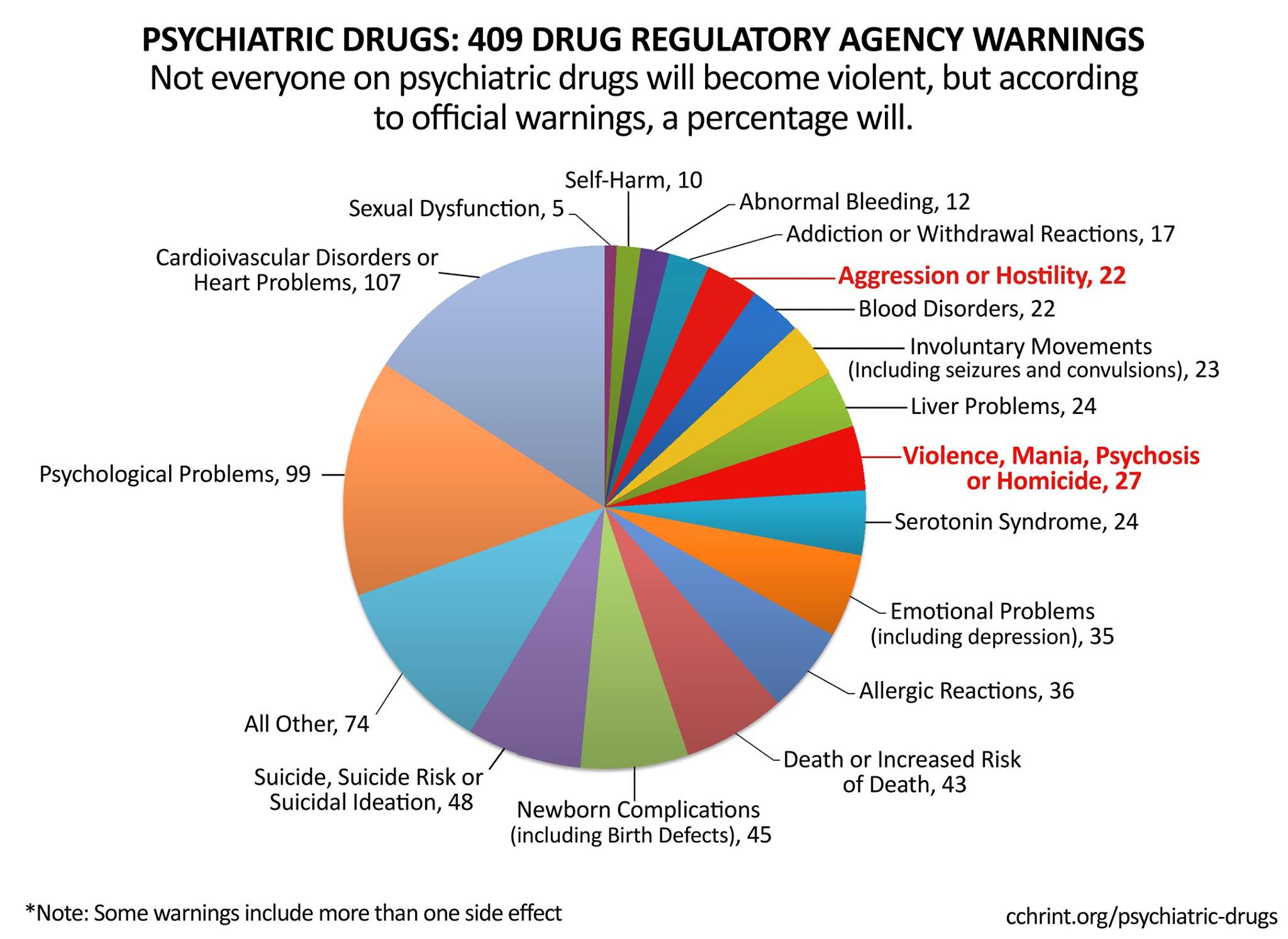
Fact: Despite 49 international drug regulatory warnings on psychiatric drugs citing side effects of mania, hostility, violence, aggression and even homicidal ideation, and dozens of high profile shootings/killings tied to psychiatric drug use, there has yet to be a federal investigation on the link between psychiatric drugs and acts of senseless violence. Clearly not everyone taking these drugs will become violent, but according to official drug regulatory agency warnings, a percentage of them will. And no one knows who will be next.
Fact: At least 39 school shootings and/or school-related acts of violence have been committed by those taking or withdrawing from psychiatric drugs resulting in 200 wounded and 100 killed (in other school shootings, information about their drug use was never made public—neither confirming or refuting if they were under the influence of prescribed drugs).
Watch this short interview with Michael Moore, author, director and producer of Bowling for Columbine, on the link between antidepressants and school shootings.
Fact: School shootings are not the only mass killings tied to psychiatric drug use. There are 64 other acts of senseless violence committed by individuals taking or withdrawing from psychiatric drugs resulting in an additional 432 dead and 773 wounded.
Fact: Between 2004 and 2012, there have been 14,773 reports to the U.S. FDA’s MedWatch system on psychiatric drugs causing violent side effects including: 1,531 cases of homicidal ideation/homicide, 3,287 cases of mania & 8,219 cases of aggression. Note: The FDA estimates that less than 1% of all serious events are ever reported to it, so the actual number of side effects occurring are most certainly higher.
Fact: The perpetrator’s psychiatric drug use, is often not made public. It took months for the release of information showing that police had found psychiatric drugs in the apartment of Aurora Colorado movie theater shooter, James Holmes—including the anti-anxiety drug clonazepam and the antidepressant sertraline, the generic version of the antidepressant Zoloft. And despite official, legal requests for the release of Sandy Hook school shooter Adam Lanza’s toxicology reports and medical history to ascertain whether psychiatric drugs played a role in the school massacre, the office of the Connecticut medical examiner has refused to release this crucial information to the public, prompting a parent’s rights organization to take the matter to court.
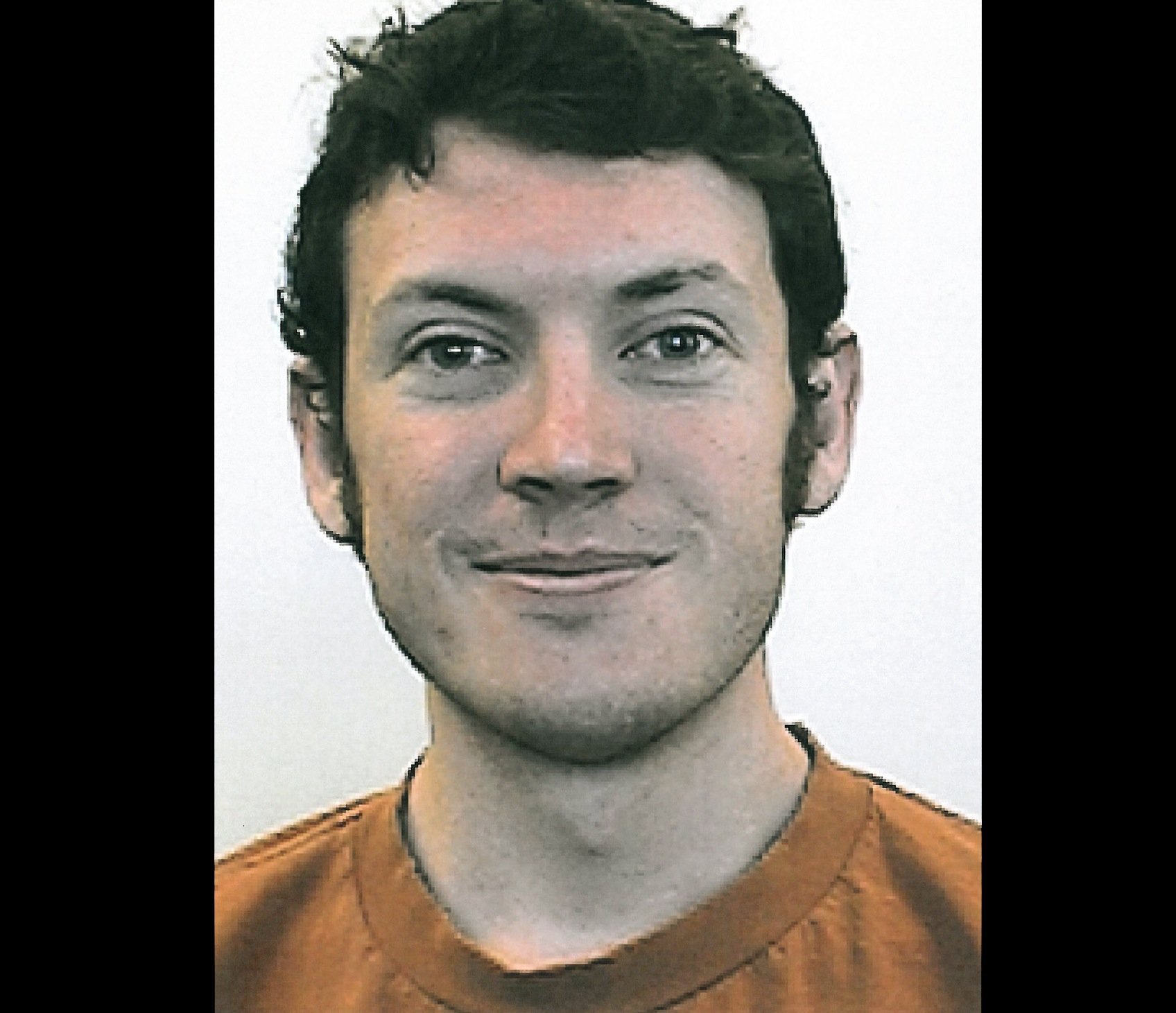
Colorado shooter James Holmes was under the care of psychiatrist Lynne Fenton prior to the shootings. Police found antidepressant and anti-anxiety drugs in Holmes apartment.
Of the 39 people who committed school-related acts of violence that were documented to be under the influence of psychiatric drugs, at least 14 were seeing either a psychiatrist or psychologist. See the list of school shootings and/or school-related acts of violence by those on psychiatric drugs here.
The correlation between psychiatric drugs and acts of violence and homicide is well documented—both by international drug regulatory warnings and studies, as well as by hundreds of cases where high profile acts of violence/mass murder were committed by individuals under the influence of psychiatric drugs.

A bill introduced in New York in 2000 proposed police investigate psychiatric drug in all cases of violent crimes and suicides.
The New York State Senate recognized this as far back as 2000, introducing a bill which would “require police to report to the Division of Criminal Justice Services (DCJS), certain crimes and suicides committed by persons using psychotropic drugs,” citing “a large body of scientific research establishing a connection between violence and suicide and the use of psychotropic drugs.”
Unfortunately that bill stalled out in the finance committee. By reviewing the international drug regulatory warnings, studies, and adverse reaction reports submitted to the US FDA below, it is evident that the reintroduction of the New York bill is needed on a federal level in order to determine just how many crimes and acts of violence are being committed by individuals under the influence of drugs documented to induce violence, mania, psychosis, aggression, hostility and homicide.
49 international drug regulatory warnings have been issued on psychiatric drugs citing effects of mania, hostility, violence and even homicidal ideation.
As the world’s leading mental health watchdog, CCHR has for decades investigated hundreds of acts of senseless violence, working alongside investigative reporters, law enforcement, as well as legislative hearings, such as those held in Colorado following the 1999 Columbine massacre (ringleader Eric Harris was found to be under the influence of the antidepressant Luvox, Dylan Klebold’s autopsy reports were never unsealed). Moreover, Coroner’s in cases such as the Sandy Hook shooting, can refuse to release toxicology reports, despite the fact that this would violate no privacy laws and the public has the right to the information given the heinous nature of the crime. See Attorney Jonathan Emord video on his suit against the Sandy hook Coroner below
And while there is never one simple explanation for what drives a human being to commit such unspeakable acts, all too often one common denominator has surfaced in hundreds of cases—prescribed psychiatric drugs which are documented to cause mania, psychosis, violence, suicide and in some cases, homicidal ideation. It is an injustice that the general public are not being informed about the well documented links between psychiatric drugs and violence, and so once again we present the facts:
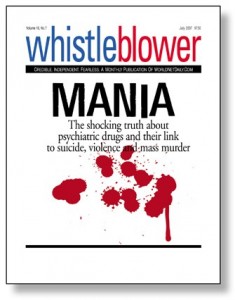
Click image to read MANIA—The shocking link between psychiatric drugs, suicide, violence and mass murder
There have been 49 international drug regulatory warnings issued on psychiatric drugs causing violence, mania, hostility, aggression, psychosis, and other violent type reactions. These warnings have been issued in the United States, European Union, Japan, United Kingdom, Australia and Canada.
In determining what would prompt a person to commit such brutal and senseless crimes, the press must ask the right questions, including: What, if any, prescribed psychotropic drugs the perpetrator may have been on (or in withdrawal from).
Read the international drug regulatory warnings issued on psychiatric drugs causing violence, mania, hostility, aggression, psychosis, and other violent type reactions.
See the recent study from PLoS One here on psychiatric drugs being linked to violence.
At least 39 school shootings and/or school-related acts of violence were committed by those taking or withdrawing from psychiatric drugs. It is important to note the following lists cases where the information about the shooters psychiatric drug use was made public.
It took months for the release of information showing that police had found psychiatric drugs in the apartment of Aurora Colorado movie theater shooter, James Holmes—including the anti-anxiety drug clonazepam and the antidepressant sertraline, the generic version of the antidepressant Zoloft.
Note that all these acts of violence didn’t just occur in the United States.
Of these 39, fourteen were seeing either a psychiatrist or psychologist.
- May 7, 2019 – Denver, Colorado: Alec McKinney, 16, and Devon Erickson, 18, opened fire on a classroom of students at STEM (Science, Technology, Engineering, and Mathematics) School Highland Ranch and killed one and injured 8 others. The shootings stopped when three students charged Erickson when his gun jammed. McKinney attempted to commit suicide after the shooting, but couldn’t figure out how to operate the gun safety. McKinney had been hospitalized twice in the previous few years, once for mixing the anti-anxiety drug Xanax (a benzodiazepine) with alcohol and for cutting himself while on vacation, according to witness testimony from Robert Benge, a psychiatric nurse practitioner who counseled McKinney. In 2018, he prescribed McKinney ADHD medication in addition to antidepressants and mood stabilizers that the teen was already taking.
- February 14, 2018 – Parkland, Florida: Nikolas Cruz, 19, carried out a deadly shooting at his alma mater, Marjory Stoneman Douglas High School in Parkland, Florida, killing 17 people and injuring 17 more. He had an extraordinarily long history of failed psychiatric assessments and treatment, including psychotropic drugs. He saw his first psychologist at age 3 and psychiatric drugs were prescribed from aged 6 and continued off and on throughout his life. On June 5, 2014, a school psychiatrist and therapist wrote to Cruz’s then-treating psychiatrist, Brett J. Negin warning that Cruz “dreams of killing others.” Negin said that he never received the letter under cross-examination in Cruz’s sentencing trial in 2022, and said: “There is nothing in the record that would signify that whatsoever.” That begs the question of how, even without the letter, a psychiatrist could have treated the teen for five years and missed the warning signs. Between 2012 and 2017, Cruz was prescribed clonidine, a “non-stimulant” ADHD drug, the stimulant Focalin XR (extended-release), and the antipsychotic Risperdal. The stimulant alone has side effects that include anxiety and mental/mood/behavior changes (such as agitation, aggression, mood swings, abnormal thoughts, and thoughts of suicide). For 7 years, Cruz also received hundreds of hours of therapy sessions from Henderson Behavioral Health. On September 24, 2017, 6 weeks after Cruz’s last visit with Dr. Negin, a concerned businessman reported Cruz to the FBI for leaving a message on his YouTube channel: “I’m going to be a professional school shooter.” Five months later, the teen carried out his massacre. While in custody, Cruz sat in a police station—no longer defiant and muttering to himself: “Kill me. Just f**king kill me” and “I want to die.” The end result of 16 years of mental health “treatment.” During his sentencing trial, experts testified that Cruz may not have been taking his medication for the 5 months leading up to the killings, but that was never substantiated, and aggressive post-withdrawal symptoms from some drugs may last several months to years.
- May 1, 2017 – Austin, Texas: Kendrex J. White, 21, stabbed four people with a machete-like hunting knife at the University of Texas, killing one and wounding three. The stabbings occurred within a one-block area as the attacker “calmly walked around the plaza,” according to the chief of police. After he was arrested, White told police he did not remember the attack. The police department said that White had recently been involuntarily committed in another city, and county records showed that he had been arrested and charged with a DWI (Driving While Intoxicated) on April 4, 2017. When an officer spoke to him, White said he had taken two “happy pills,” listed as the antidepressant Zoloft.
- November 20, 2014 – Tallahassee, Florida: 31-year-old Myron May, a Florida State University alum, opened fire in the school’s library where hundreds of students were studying, wounding three before he was shot and killed by police. According to May’s friends, after going to see a psychologist because of trouble concentrating, he had been prescribed the antidepressant Wellbutrin and the ADHD drug Vyvanse, a combination that can cause paranoia. He started acting strangely and hearing voices, convinced that he was being spied on. He then checked himself into a mental health center called Mesilla Valley Hospital around September of 2014. Shortly after this, his friends discovered a new pill bottle among his prescriptions, the antipsychotic Seroquel. In addition, ABC Action News found a half-filled prescription for the antianxiety drug Hydroxyzine in his apartment after the shooting.
- June 5, 2014 – Seattle, Washington: 26-year-old Aaron Ybarra opened fire with a shotgun at Seattle Pacific University, killing one student and wounding two others. Ybarra planned to kill as many people as possible and then kill himself. In 2012, Ybarra reported that he had been prescribed the antidepressant Prozac and the antipsychotic Risperdal. A report from his counselor in December 2013 said that he was taking Prozac at the time and planned to continue to meet with his psychiatrist and therapist as needed. His lawyer said Ybarra had a long history of mental health issues. The county prosecutor said he was taking Prozac and Risperdal up to six months prior to the shooting but had stopped taking them.
- April 25, 2014 – Milford, Connecticut: 16-year-old Chris Plaskon stabbed Maren Sanchez, also 16, to death in a stairwell at Jonathan Law High School after she turned down his prom invitation. According to classmates and a former close friend, Chris was taking drugs for ADHD.
- October 21, 2013 – Sparks, Nevada: 12-year-old Jose Reyes opened fire at Sparks Middle School, killing a teacher and wounding two classmates before committing suicide. The investigation revealed that he had been seeing a psychotherapist 3 days before the shooting and was prescribed an antidepressant. He had a generic form of the antidepressant Prozac (fluoxetine) in his system at the time of death, police said.
- January 15, 2013 – St. Louis, Missouri: 34-year-old Sean Johnson walked onto the Stevens Institute of Business & Arts campus and shot the school’s financial aid director once in the chest, then shot himself in the torso. Johnson had been taking prescribed drugs for an undisclosed mental illness.
- October 24, 2011 – Snohomish County, Washington: A unnamed 15-year-old girl went to Snohomish High School where police alleged that she stabbed a girl as many as 25 times just before the start of school, and then stabbed another girl who tried to help her injured friend. Prior to the attack, the girl had been taking “medication” and seeing a psychiatrist. Court documents said the girl was being treated for depression.
- September 21, 2011 – Myrtle Beach, South Carolina: 14-year-old Christian Helms had two pipe bombs in his backpack when he shot and wounded Socastee High School’s “resource” (police) officer. However, the officer was able to stop the student before he could do anything further. Evidence showed that he was planning an attack similar to the Columbine High School shooting and had even made a list of who he was going to kill. Helms had been taking drugs for attention deficit hyperactivity disorder and depression.
- December 13, 2010 – Planoise, France: An unnamed 17-year-old youth held twenty preschool children and their teacher hostage with two swords for hours at Charles Fourier preschool. The teen was reported to be on “medication for depression.” Eventually, all the children and the teacher were released safely.
- February 5, 2010 – Huntsville, Alabama: 15-year-old Hammad Memon shot and killed another Discover Middle School student Todd Brown. Memon had a history of being treated for ADHD and depression. He was taking the antidepressant Zoloft and “other drugs for the conditions.” He had also been seeing a psychiatrist and psychologist.
- September 23, 2008 – Kauhajoki, Finland: 22-year-old culinary student Matti Saari shot and killed 9 students and a teacher, and wounded another student, before killing himself. Saari was taking an SSRI and alprazolam (Xanax). He was also seeing a psychologist.
- April 24, 2008 – Fresno, California: 17-year-old Jesus “Jesse” Carrizales attacked an officer at Fresno high school, hitting him in the head with a baseball bat. After knocking the officer down, the officer shot Carrizales in self-defense, killing him. Carrizales had been prescribed Lexapro and Geodon, and his autopsy showed that he had a high dose of the antidepressant Lexapro in his blood that could have caused him to be paranoid, according to the coroner.
- February 14, 2008 – DeKalb, Illinois: 27-year-old Steven Kazmierczak shot and killed five people and wounded 21 others before killing himself in a Northern Illinois University auditorium. According to his girlfriend, he had recently been taking prescribed drugs Prozac, Xanax and Ambien but had stopped taking Prozac three weeks before the shooting. Toxicology results showed that he still had a trace amount of Xanax in his system. He had been seeing a psychiatrist.
- November 7, 2007 – Jokela, Finland: 18-year-old Finnish gunman Pekka-Eric Auvinen shot and killed eight people and wounded a dozen more at Jokela High School in southern Finland before committing suicide. He had been taking antidepressants.
- November 7, 2007 – Tyler, Texas: 17-year-old Felicia McMillan returned to her former Robert E. Lee High School campus and stabbed a male student, and wounded the principal with a knife. McMillan had been on drugs for depression and had just taken them the night before the incident.
- October 10, 2007 – Cleveland, Ohio: 14-year-old Asa Coon stormed through his school with a gun in each hand, shooting and wounding four before taking his own life. Coon had been prescribed the antidepressant Trazodone.
- January 19, 2007 – Sudbury, Massachusetts: 16-year-old John Odgren stabbed another student to death with a large kitchen knife in a boy’s bathroom at Lincoln-Sudbury Regional High School. In court, his father testified that Odgren was prescribed the drug Ritalin.
- December 4, 2006 – North Vernon, Indiana: 16-year-old Travis Roberson stabbed another Jennings County High School student in the neck, nearly severing an artery. Roberson was in withdrawal from Wellbutrin, which he had stopped taking days before the attack.
- August 30, 2006 – Hillsborough, North Carolina: 19-year-old Alvaro Rafael Castillo shot and killed his father, then drove to Orange High School where he opened fire. Two students were injured in the shooting, which ended when school personnel tackled him. His mother said he was on drugs for depression.
- April 24, 2006 – Chapel Hill, North Carolina: 17-year-old William Barrett Foster took a shotgun to school and took a teacher and a fellow student hostage at East Chapel Hill High School. After being talked out of shooting the hostages, Foster fired two shots through a classroom window before fleeing the school on foot. Foster’s father testified that his son had stopped taking his antidepressants and antipsychotic drugs without telling him.
- November 8, 2005– Jacksboro, Tennessee: Kenneth Bartley, 14, a student at Campbell County Comprehensive School, shot and killed the assistant principal and wounded another assistant principal and the principal. He was taking Xanax at the time of the shooting. Just before the shooting, Bartley had also snorted a crushed Valium pill.
- March 21, 2005 – Red Lake, Minnesota: 16-year-old Jeff Weise, on Prozac, shot and killed his grandfather and his grandfather’s girlfriend, then went to his school on the Red Lake Indian Reservation where he shot dead 5 students, a security guard, and a teacher, and wounded 7 before killing himself.
- February 9, 2004 – Greenbush, New York: 16-year-old Jon Romano strolled into his high school in east Greenbush and opened fire with a shotgun. Special education teacher Michael Bennett was hit in the leg. Romano had been taking the antianxiety drug Xanax. He had previously spent time in a psychiatric care facility.
- June 8, 2001 – Ikeda, Japan: 37-year-old Mamoru Takuma, wielding a 6-inch knife, slipped into an elementary school and stabbed eight first- and second-grade students to death while wounding at least 15 other pupils and teachers. He then turned the knife on himself but suffered only superficial wounds. He later told interrogators that before the attack he had taken 10 times his normal dose of antidepressants. Police said he had been under the care of a psychiatrist.
- April 10, 2001 – Wahluke, Washington: Sixteen-year-old Cory Baadsgaard took a rifle to his high school and held 23 classmates and a teacher hostage. Three weeks earlier, his doctor had switched Baadsgaard’s prescription from Paxil to Effexor. The morning of the incident, his dosage of Effexor had been increased. Baadsgaard said he had no memory of the incident.
- March 22, 2001 – El Cajon, California: 18-year-old Jason Hoffman, on the antidepressants Celexa and Effexor, opened fire on his classmates, wounding three students and two teachers at Granite Hills High School. He had been seeing a psychiatrist before the shooting.
- March 7, 2001 – Williamsport, Pennsylvania: 14-year-old Elizabeth Bush was taking the antidepressant Prozac when she shot at fellow students, wounding one.
- February 2, 2001 – Red Lion, Pennsylvania: 56-year-old William Michael Stankewicz entered North Hopewell-Winterstown Elementary School with a machete, leaving three adults and 11 children injured. Stankewicz was taking four different drugs for depression and anxiety weeks before the attacks.
- January 10, 2001 – Oxnard, California: 17-year-old Richard Lopez went to Hueneme High School with a gun and shot twice at a car in the school’s parking lot before taking a female student hostage. A SWAT officer eventually killed Lopez, who had been prescribed Prozac, Paxil and “drugs that helped him go to sleep.”
- May 20, 1999 – Conyers, Georgia: 15-year-old T.J. Solomon was being treated with the stimulant Ritalin when he opened fire on and wounded six of his classmates.
- April 20, 1999 – Columbine, Colorado: 18-year-old Eric Harris and his accomplice, Dylan Klebold, killed 12 students and a teacher and wounded 26 others before killing themselves. Harris was on the antidepressant Luvox. Klebold’s medical records remain sealed. Both shooters had been in anger-management classes and had undergone counseling. Harris had been seeing a psychiatrist before the shooting.
- April 16, 1999 – Notus, Idaho: 15-year-old Shawn Cooper fired two shotgun rounds in his school, injuring one student. He was taking a prescribed antidepressant and Ritalin.
- May 21, 1998 – Springfield, Oregon: 15-year-old Kip Kinkel murdered his parents and then proceeded to school where he opened fire on students in the cafeteria, killing two and wounding 25. Kinkel had been taking the antidepressant Prozac. Kinkel had been attending “anger control classes” and had previously been under the care of a psychologist.
- October 1, 1997 – Pearl, Mississippi:Luke Woodham, 16, shot and killed two students at Pearl High School and wounded seven others after beating and stabbing his mother to death. Public reports said the boy was taking Prozac. In June 1998, Woodham was found guilty of two counts of murder and seven counts of aggravated assault and was sentenced to two consecutive life sentences for the murder convictions and seven 20-year sentences for the aggravated assault convictions.
- October 12, 1995 – Blackville, South Carolina: 15-year-old Toby R. Sincino slipped into the Blackville-Hilda High School’s rear entrance, where he shot two Blackville-Hilda High School teachers, killing one. Then Toby killed himself moments later. His aunt, Carolyn McCreary, said he had been undergoing counseling with the Department of Mental Health and was taking Zoloft for emotional problems.
- December 16, 1993 – Chelsea, Michigan: 39-year-old chemistry teacher Stephen Leith, facing a disciplinary matter at Chelsea High School, shot Superintendent Joseph Piasecki to death, shot Principal Ron Mead in the leg, and slightly wounded journalism teacher Phil Jones. Leith was taking Prozac and had been seeing a psychiatrist.
- September 18, 1992 – Houston, Texas: 44-year-old Calvin Charles Bell, reportedly upset about his child’s second-grade progress report, appeared in the principal’s office of Piney Point Elementary School. Bell fired a gun in the school and eventually wounded two officers before surrendering. Relatives told police that Bell was an unemployed Vietnam veteran and had been taking anti-depressants.
Note: Psychiatric Drugs Can Also Cause Severe Withdrawal Symptoms—Violent and Suicidal Thoughts – Watch This 2 Minute Video
64 additional murders and murder-suicides, resulting in 432 dead and 773 wounded:
- November 19-20, 2022 – Colorado Springs, Colorado: Anderson Lee Aldrich (22) fatally shot five people and wounded 19 others at an LGBTQ nightclub. Police received several 911 calls about the shooting beginning at 11:56 p.m. local time and officers were dispatched with one officer arriving at the club at midnight. Aldrich was detained at 12:02 a.m., according to police. During a preliminary hearing, the defense showed photos of various prescription bottles collected by the FBI from Aldrich’s apartment. The purposes of the medications range from “treating symptoms of depression, anxiety, schizophrenia, nightmares from PTSD, bipolar disorder, and heroin addiction.” The defense, however, stated that law enforcement would not know if the suspect was off this medication or taking them at the time of the shooting. But it was reported that on the night of the shooting, Aldrich had consumed four grams of cocaine, two pills of Adderall, and six Xanax bars.
- May 26, 2021 – San Jose, California: Samuel Cassidy, 57, fatally shot nine coworkers at a Santa Clara Valley Transportation Authority (VTA) rail yard before killing himself as law enforcement rushed the shooting scene. Cesar Chavez Quinteros, a friend of Cassidy, told DailyMail.com that Cassidy suffered from depression and was on medication: “I know he had some issues with depression and was on meds,” Quinteros said.
- April 5, 2021 – Allen, Texas: Brothers Farhan (19) and Tanvir Towhid (21) killed four members of their family before then killing themselves in a murder-suicide pact. The family members killed were their sister, Farbin Towhid, their parents, Iren and Towhidul Islam, and their grandmother, Altafun Nessa. In a suicide note left on Instagram, Farhan Towhid wrote, “All my brother had to do was go to the gunshop, say something about wanting a gun for home defense, sign some forms, and that was it. There was a question asking if he had any mental illnesses but—get this—he lied. He literally just said no. They didn’t ask for proof or if he was taking any medication (he was),” he wrote. He continued, “I’ve had depression since 9th grade (2016).” Farhan said his brother’s condition “was much worse.” He also wrote: “Eventually I was thrown in some teen mental camp where I was finally diagnosed and got medication (25mg of desvenlafaxine if you’re curious)….”
- June 12, 2020 – Te Teko, New Zealand: Tehiritanga “Hiri” Hill, 24, took a hammer and struck his mother’s partner, Pania Melrose, eight or nine times about the head and face, fatally wounding her. She died shortly afterwards. Just two days before the incident, Hiri’s father took him back to the GP and he was given risperidone, an anti-psychotic. He’d never taken such medication before, she says, and it made him worse.
- January 24, 2020 – Newcastle, South Dublin, Ireland: Deirdre Morley, 44, smothered and killed her two sons Conor, 9, and Darragh, 7, and her three-year-old daughter Carla McGinley in their family home. She had been taking antidepressants since October 2018 and was admitted to St. Patrick’s Mental Health Services on July 6, 2019, but was discharged after a short period, but was put on a combination of two antidepressants and a sedative.
- August 4, 2019 – Dayton, Oregon: Connor Betts, 24, opened fire outside a bar in the Oregon District of Dayton at 1 a.m., killing nine people, including Bett’s 22-year-old sister. The shooting ended rapidly when police moved in and shot Betts dead. The county coroner reported that Betts had cocaine, Xanax and alcohol in his system at the time of the shooting rampage.
- January 26, 2019 – Baton Rouge, Louisiana: Dakota Theriot, 21, is accused of killing five people in Louisiana on January 26th, 2019, using a handgun stolen from his father. The victims include his parents and three members of a family with whom he’d been living for a short time. Investigators said he smoked weed and drank alcohol that mixed poorly with the antipsychotic drugs he’d been prescribed. His wife had told police he was diagnosed with schizophrenia.
- December 17, 2018 – Providence, Massachusetts: Andrew Soto-Bonnett, 27, stabbed his mother a dozen times in her head, neck, and face, and stabbed her husband six times in his upper body and torso. Luckily, they both survived. Soto-Bonnett told police he was schizophrenic but that he takes his “medication.”
- July 25, 2018 – Phoenix, Arizona: Isaac Damon King, 20, suspected of throwing objects at cars, fatally shot Arizona Department of Public Safety (DPS) Trooper Tyler Edenhofer (24) and wounded another trooper. King had no criminal history but did have a mental health history and was on “medication for anxiety and depression.”
- July 7, 2018 – Melbourne, Australia: Daniel Eckersley, 39, a Melbourne, Australia man, stabbed his partner, Amanda Harris, to death in front of their young children before setting fire to their family home. Prosecutor Brendan Kissane said Eckersley had sought medical assistance for depression in the week before the murder and began taking antidepressants on top of pain medication he was abusing.
- June 14, 2018 – Westminster, Colorado: Jeremy Webster, 23, killed a 13-year-old and injured the boy’s mother and brother in a road rage shooting. A man in another car was also shot. Webster is accused of shooting the mother multiple times and then shooting Vaughn Bigelow Jr. “execution-style” and then driving away. Webster has a psychiatric history and had changed medication that day. Webster had been diagnosed with bipolar disorder and had been prescribed an antidepressant and an antipsychotic.
- May 11, 2018 – Osmington, Western Australia: Peter Miles, 61, shot his 35-year-old daughter and four grandchildren, aged 8 through 13, while they slept in their beds, in a shed that had been converted to a second house on the property. He then turned the gun on his 58-year-old wife in the living room of their house, before placing a call to police alerting them to his crimes. When they arrived, Miles was also found dead from a gunshot wound. Miles had started taking antidepressant medication just weeks before.
- April 6, 2018 – Wadsworth, Ohio: Gavon Ramsay, 17, strangled his neighbor, 98-year-old Margaret Douglas in her own home. His parents blame his actions on his having been misprescribed Zoloft. After a report by his school principal that the teen was depressed and might harm himself, he “returned to therapy,” and after a recommendation by a psychologist, the family’s pediatrician prescribed the antidepressant Zoloft. From January through March leading up to the incident, the dosages were increased. During this time, his mother said she observed her son’s behavior change—becoming increasingly irritable and hostile and saying bizarre things.
- February 28, 2018 – Walsall, United Kingdom: Gregory Irvin, 26, was accused of murdering his 74-year-old grandmother on February 28, by stabbing her to death and slitting her throat. His girlfriend told a jury that he stopped taking medication for his anxiety five days before the murder. She said his anxiety medication made Irvin feel “a bit withdrawn” and that taking a break from the tablets made Irvin feel “less shy, more confident.” A medical examination revealed he had taken cocaine the day before. Irvin told police he took cocaine three or four times a week “as a relief from problems he could not cope with.”
- November 5, 2017 – Sutherland Springs, Texas: Devin Patrick Kelley, 26, opened fire during church services on the First Baptist Church in Sutherland Springs, killing 26 people and injuring 20 more, with victims ranging in age from 18 months to 77 years old. He was later found dead in a vehicle after he was shot and chased by two men who heard the gunfire at the church. The autopsy released by the Travis County Medical Examiner’s Office reported that Kelley died from a self-inflicted gunshot wound. The autopsy also reported that toxicology tests detected marijuana and anti-anxiety drugs in his system.
- October 1, 2017 – Las Vegas, Nevada: Stephen Craig Paddock, 64, opened fire on thousands of concertgoers on the Las Vegas Strip, from a room on the 32nd floor of the Mandalay Bay Resort and Casino. He killed 58 and wounded 546 before taking his own life. According to the autopsy report, Paddock had an anti-anxiety drug in his system at the time of the shooting.
- May 30, 2017 – Liverpool, United Kingdom: Sami Salem, 30, suffocated his wife and drowned their two kids. His brother, Nabeel Salem, told the jury that Sami Salem had been “acting paranoid” for weeks and he had taken him to see a mental health crisis team in the Royal Liverpool Hospital only 10 days before the killings. Nabeel said his brother was prescribed the anti-anxiety drug, diazepam, and discharged, with the promise of home visits and a referral to his doctor.
- March 6, 2017 – Franklin County, North Carolina: Oliver Funes Machada (18), was accused of decapitating his mother after stabbing her eight times, leaving the knife in her mouth, because he “felt like it.” His 4-year-old sister and 2-year-old brother were in the home at the time. The first deputy on the scene saw the suspect leave the house “carrying a knife in one hand and a severed human head in the other.” He was on four prescription drugs that “could be used to treat psychosis and schizophrenia.”
- January 29, 2017 – Quebec City, Canada: Alexandre Bissonnette, age 27, walked into a Quebec City mosque and opened fire into a crowd of men, women and children during evening prayers, killing six Muslim men and wounding 18. His mother told police that his doctor had recently given him a new prescription for the antidepressant paroxetine (Paxil) and that he was very “anxious and unstable” in the week before the shooting. When he pleaded guilty in 2018, he did not explain why he targeted the mosque but said he had “suicidal thoughts” and an “obsession” with death and said he was “not a terrorist, nor an Islamophobe.”
- November 30, 2016 – Northern Territory, Australia: Pande Valeski, 37, stabbed a backpacker 20 times with a pair of scissors while the victim and his wife were at a rest stop 100k away from Alice Springs. Veleski had stopped taking his antipsychotic medication in the days leading up to the killing, and left his home in Melbourne to start driving to the Northern Territory where he intended to engage in a “civil war.”
- October 2, 2016 – Sydney, Australia: Daniel Chapman, 22, stabbed his father in the back with a 14 centimeter blade knife, killing him. Mr. Chapman died from a loss of blood on the way to hospital. Daniel had been on the antidepressant Prozac, but had stopped taking it around two weeks before the incident.
- September 23, 2016 – Burlington, Washington: 20-year-old Arcan Cetin opened fire in a Macy’s department store at the Cascade Mall, killing 5 people. Cetin had seen at least four mental-health treatment providers in his life and was involuntarily committed to a psychiatric hospital in November 2015 after a suicide attempt. He was on three different psychiatric drugs—the antidepressant Prozac and ADHD drugs Concerta and guanfacine—as of 2015. Additionally, records obtained by investigators from an NBC affiliate in Washington found that he had been diagnosed with autism, depression and ADHD, and had been receiving drugs “like Prozac” in the months before the shooting.
- July 22, 2016 – Munich, Germany: 18-year-old Ali David Sonboly shot and killed 9 people, injured 27 others, then killed himself. According to CNN, he had a history of psychiatric care at a hospital for two months in 2015 and was suffering from depression and anxiety. The Guardian reported that after leaving the hospital, Sonboly “continued to receive outpatient treatment for social anxiety disorder and depression for which he was receiving medication.”
- July 17, 2016 – Baton Rouge, Louisiana: Former Marine Gavin Long, age 29, went on a shooting rampage, killing three law officers and wounding three others before being shot dead by a SWAT team officer. He told friends he had post-traumatic stress disorder. CNN reported that Long had filled a prescription for Ativan, an anti-anxiety drug, as recently as June, and also had prescriptions for Valium (also an anti-anxiety drug) and the sleep aid Lunesta.
- March 17, 2016 – Benbrook, Texas: Sofya Tsygankova, 31, smothered her 5-year-old and 20-month-old daughters with pillows inside the family’s home and then tried to kill herself. An empty prescription bottle for the antipsychotic drug Quetiapine, filled March 16, 2016, for Tsygankova, was found on the kitchen counter. At John Peter Smith Hospital on the day of the incident, Tsygankova spoke with police and said she thought she committed suicide and that she remembered taking a lot of pills, according to the warrant.
- June 17, 2015 – Lexington, South Carolina: Dylann Storm Roof (21) confessed to killing nine people at a historic black church, Emanuel African Methodist Episcopal Church, in Charleston because he hoped to start a race war. “I chose Charleston because it is the most historic city in my state, and at one time had the highest ratio of blacks to whites in the country,” he wrote. Roof walked into a Bible study class, stayed until it was just about over and then began shooting the victims. John Mullins, who went to school with Roof, said: “He used drugs heavily a lot” and said he was a pill-popper, “Like Xanax, and stuff like that.” On February 28, 2015, Roof was arrested for drug possession at a mall in Columbia. The Wall Street Journal reported that a police incident document said Roof was found to have strips of Suboxone. He did not have a prescription for the drug, which is commonly sold illegally on the street. He was sentenced to death.
- March 24, 2015 – Southern France: According to medical records, Andreas Lubitz, the pilot who deliberately crashed a Germanwings plane in a remote, mountainous area of Southern France killing all 150 people on board, was on medications for depression, anxiety and panic attacks, including lorazepam and an antidepressant. Lubitz had increased the dosage of antidepressants prescribed to him to twice the amount and also reportedly blamed the drug for loss of sleep and panic attacks. He also spent a year and a half in “psychiatric treatment” six years prior to the crash.
- December 15, 2014 – Montgomery County, Pennsylvania: Iraq War veteran Bradley Stone, 35, killed his ex-wife plus her mother, grandmother and sister, and the sister’s husband and 14-year-old daughter and then committed suicide. According to the Medical Examiner, he had both the antidepressant trazodone and the antipsychotic risperidone in his system at the time of his death. Just one week prior to the murders, he had seen his Veterans Affairs psychiatrist, whose evaluation stated Stone had no suicidal or homicidal ideation.
- May 23, 2014 – Santa Barbara, California: 22-year old Elliot Rodger stabbed three roommates to death at his apartment then drove to a sorority house where he shot three women, killing two of them. Driving again, he exchanged fire with deputies, hit a bicyclist, fired on other people in multiple locations and then killed himself having killed 6 and wounded 13 others. In his own 137-page document outlining his plans, he stated: “To end my life, I will quickly swallow all of the Xanax and Vicodin pills I have left…” He had also been seeing mental health professional for years.
- April 2, 2014 – Fort Hood, Texas: Specialist Ivan Lopez had been prescribed Ambien, antidepressants and other medications to treat anxiety and depression when opened fire at Fort Hood military base, killing three people, wounding 16 others and then taking his own life. He had also been examined by a psychiatrist within the month prior and was being evaluated for PTSD.
- September 16, 2013 – Washington, DC: Aaron Alexis, a Navy contractor, opened fire inside a building at the Washington Navy Yard, killing 12 and wounding eight others before he was killed by police. Alexis had received prescriptions from two Veterans Administration hospitals in August 2013 for the antidepressant Trazodone.
- September 12, 2013 – West Palm Beach, Florida: According to toxicology results, Pamela Brooks had a prescribed dosage of the antidepressant Prozac in her system when she killed her 10-year-old daughter by stabbing her more than 20 times and committed suicide by stabbing herself more than 150 times with a kitchen knife.
- March 13, 2013 – Harlem, New York: Cynthia (Cindy) Wachenheim, 44, strapped her 10-month-old son to her chest in a baby carrier and leapt to her death from the eighth-floor window of her apartment. The baby miraculously survived with little more than scratches, police sources said. Just a few months earlier, in 2012, Cindy began seeing a psychiatrist, who prescribed Zoloft, an antidepressant. A police source also said Wachenheim was taking antidepressants and that pills were found in the apartment.
- February 2, 2013 – Chalk Mountain, Texas: Eddie Ray Routh, 28, shot and killed Chris Kyle, the former Navy SEAL who was the subject of the movie, American Sniper, and Kyle’s friend, Chad Littlefield, at a firing range. In February 2015, the former U.S. Marine was found guilty and sentenced to life in prison without parole for the killings. In late July 2011, a little more than a year after he had received an honorable discharge from the military, Routh, then aged 24, had been diagnosed with PTSD at the Dallas Veterans Affairs Medical Center and prescribed risperidone, an antipsychotic and generic of Risperdal, as well as the antidepressant, Zoloft, which is not recommended for anyone aged younger than 25 because of the risk that it may cause suicide. Routh’s father would later report that the cocktail of pharmaceuticals “made Eddie worse,” adding, “I ain’t no doctor. I ain’t no rocket scientist or nothing, but I could tell a difference in him.” He had various hospitalizations over the next few years, and was said to be “paranoid and impulsively violent” and was prescribed a cocktail of psychotropic drugs that included two powerful antipsychotics, Haldol and Seroquel and the antidepressant Paxil. He was also mixing prescription drugs known to cause aggressive and psychotic behavior with alcohol and marijuana.
- September 8, 2012 – Jackson County, Michigan: Michael Hamilton shot to death Robert Marcyan, attempted to kill Robert’s twin brother, Richard, and stole two cars to try to flee police. Robert was a handyman who had gone to the Hamilton house with his brother to fix some deck issues. Just months before the shooting, Michael’s daily dosage of Adderall had more than doubled.
- July 20, 2012 – Aurora, Colorado: 24-year-old James Holmes entered a movie theater where about 420 people were watching a midnight showing of “The Dark Knight Rises” and opened fire, killing 12 people and wounding 70. Officers found Holmes by his car behind the theater and arrested him. During court testimonies, his psychiatrist, Lynne Fenton, said that she had prescribed Holmes the antidepressant sertraline and antianxiety drug clonazepam. In a recorded interview with Holmes, he was asked if the shootings would not have taken place if he hadn’t taken the prescribed drugs. Holmes answer was, “I’d say it was a possibility.”
- March 8, 2012 – Pittsburgh, Pennsylvania: 30-year-old John Shick, former patient of University of Pittsburgh Medical Center (UPMC) and former student at nearby Duquesne University, shot and killed one and injured six inside UPMC’s Western Psychiatric Institute. He was shot and killed by police responding to the scene. Eight antidepressants were identified among the drugs police found in Shick’s apartment.
- January 16, 2012 – El Cajon, California: An unidentified 10-year-old boy killed his best friend, 12-year-old Ryan Carter, by stabbing him to death with a kitchen knife. The boy’s mother said that about a month before the attack, he was prescribed the antidepressant At this point, his personality changed and he became “much more aggressive.”
- January 8, 2012 – Fort Carson, Colorado: Vincinte Jackson, 40, stabbed Spc. Brandy Fonteneaux 74 times before choking her to death. Jackson doesn’t know why he did it. Capt. Jeremy Horn, one of Jackson’s defense lawyers,said that a combination of heavy drinking and a prescription antidepressant, Celexa, left Jackson unable to control his own actions.
- October 12, 2011 – Seal Beach, California: Scott DeKraai, a harbor tugboat worker, entered the hair salon where his ex-wife worked, killing her and seven others and injuring one. At DeKraai’s initial hearing, his attorney indicated to the judge that DeKraai was prescribed the antidepressant Trazodone and the “mood stabilizer” Topamax.
- December 14, 2010 – Panama City, Florida: Clay Allen Duke, 56, killed himself after firing several shots at Bay District School Board members during a public meeting. A toxicology report revealed that at the time of Duke’s death, he had citalopram, an antidepressant, in his system, among other drugs.
- October 17, 2010 – Afghanistan: Indiana soldier David Lawrence was taking the two antidepressants – Trazodone and Zoloft – when he killed a top Taliban commander by shooting him in the face in a prison cell. During questioning, David said he imagined all the people he knew being blown up and blacked out before the shooting.
- October 26, 2009 – Newport, Maine: Perley Goodrich Jr. beat his mother and then shot his father dead shortly after being injected with Trazodone in a psychiatric hospital. Goodrich had complained that he didn’t want to take the medication because it made him feel “violent.”
- September 20, 2009 – Winnipeg, Canada: An unnamed 15-year-old high school student with no prior history of violence, while chatting in his home with two friends, abruptly stabbed one of them, 15-year-old Seth Ottenbreit, to death with a single wound to the chest. The unnamed teenager was on Prozac at the time. The boy’s primary care physician and his parents alerted the prescribing psychiatric clinic to his deteriorating condition, which included agitation, anger and mood swings. But the clinic continued the Prozac and then doubled it. Seventeen days later, the teen knifed his friend to death.
- August 21, 2009 – Pasadena, Texas: Sergio Robles, 24, was charged with capital murder and aggravated assault for shooting to death Pasadena police officer Jesse Hamilton, 29, who was responding to a domestic disturbance call. Another officer later shot Robles, seriously injuring him. Robles’ mother, Olga Garcia, said her son was “on his medication.” He had a history of mental illness. His attorney said Robles had recently been diagnosed as schizophrenic and was prescribed medication. Robles had been released from Harris County jail less than 24 hours prior to the incident. He was sentenced to 40 years in prison.
- August 15, 2009 – Bray, Ireland: Shane Clancy, 22, attacked his ex-girlfriend and her new boyfriend with a knife. The new boyfriend died from a knife-wound to the heart. His brother was also stabbed nine times when he came to his aid. The young woman was stabbed in the back but managed to escape. The following afternoon, Clancy’s body was found. He had stabbed himself 19 times. Clancy had been prescribed the SSRI antidepressant Citalopram by his doctor (a general practitioner) over the grief of the breakup with his girlfriend. He went on the deadly spree just 17 days after being prescribed the drug.
- May 3, 2009 – Lakeland, Florida: Toxicology test results showed that 34-year-old Troy Bellar was on Tegretol, a drug prescribed for “bi-polar disorder,” when he shot and killed his wife and two of his three children in their home before killing himself.
- April 26, 2009 – Granberry Crossing, Alabama: 53-year-old Fred B. Davis shot and killed a police officer and wounded a sheriff’s deputy who had responded to a call that Davis had threatened a neighbor with a gun. Prescription drug bottles found at the scene showed that Davis was prescribed the antipsychotic drug Geodon.
- April 17, 2009 – Middletown, Maryland: Christopher Wood shot and killed his wife, three small children and himself inside their home. Toxicology test results verified that Wood had been taking the antidepressants Bupropion (Wellbutrin), Amitriptyline (Elavil) & Nortriptyline (Pamelor) and the anti-anxiety drugs Zolipdem (Ambien) & Alprazolam (Xanax).
- March 29, 2009 – Carthage, North Carolina: Robert Kenneth Stewart killed eight people and wounded three others during a shooting rampage at a Carthage nursing home. He was under the influence of the antidepressant Lexapro and the sedatives Ambien and Xanax. Tests run on Stewart’s blood following the shooting showed he had 12 times the therapeutic dose of Ambien in his system. Two days before the shooting he attempted to see a doctor. The doctor wasn’t there, but a nurse prescribed Lexapro and Xanax. The day before the shooting, Stewart became agitated because of the antidepressants he was taking. Stewart’s attorney said Stewart’s problems with the anti-depressants prompted him to overdose on Ambien. His attorney also said, “Robert Stewart does not remember what happened on March 29, 2009, and he has never been able to tell anyone about it.”
- January 11, 2009 – Concord, California: Jason Montes, 33, shot and killed his wife and then himself at home. Montes had earlier begun taking the antidepressant Prozac for depression related to his impending divorce and a recent bankruptcy.
- August 14, 2008 – Little Rock, Arkansas: Less than 48 hours after Timothy Johnson shot and killed Arkansas Democratic Party Chairman Bill Gwatney, the Little Rock Police declared they were investigating shooter’s use of the antidepressant Effexor, which was found in Johnson’s house. A Little Rock city police report later stated that Johnson “was on an antidepressant and that the drug may have played a part in his ‘irrational and violent behavior.’”
- December 5, 2007 – Omaha, Nebraska: 19-year-old Robert Hawkins killed eight people and wounded five before committing suicide in an Omaha mall. Autopsy results confirmed he was under the influence of the “anti-anxiety” drug Valium.
- December 31, 2006 – Fallujah, Iraq: Marine Lance Cpl. Delano Holmes killed Iraqi soldier Mutather Jasem Muhammed Hassin by stabbing him 40 times with a combat knife, with some of the wounds piercing his spine. Holmes had been prescribed Trazodone (an antidepressant), Ambien and Valium (both anti-anxiety drugs).
- January 20, 2006 – Charlotte, North Carolina: David Crespi, 45, a bank auditor, was being treated with a cocktail of drugs for depression when he stabbed and killed his five-year-old twin girls, Sam and Tess. Seven days before the killings David was prescribed a new drug for his depression, Prozac, as well as taking Lunesta and Ambien. After pleading guilty to murder in a deal struck to avoid execution, he began serving two life sentences.
- July 8, 2003 – North Meridian, Florida: Doug Williams killed five and wounded nine of his fellow Lockheed Martin employees before killing himself. Williams was reportedly taking two antidepressants, Zoloft and Celexa, for depression after a failed marriage.
- January 3, 2003 – Ellicott City, Maryland: Ryan T. Furlough, 18, killed a Centennial High School classmate by spiking his soda with cyanide. He was being treated with Effexor. In July 2004, he was sentenced to life in prison for the poisoning of his best friend, with a potential for parole.
- June 20, 2001 – Houston, Texas: Mother and housewife Andrea Yates, 37, filled the bathtub and drowned her five children, ages six months to seven years. For many years, Mrs. Yates had struggled through hospitalizations, prescribed psychiatric drugs and suicide attempts. At the time of the tragedy, she was taking Effexor and Remeron, both anti-depressants, and had been previously taking Wellbutrin, another anti-depressant, as well as Haldol. Science consultant Edward G. Ezrailson, Ph.D., reported that the cocktail of drugs prescribed to Mrs. Yates caused involuntary intoxication. The “overdose” of one antidepressant and “sudden high doses” of another, “worsened her behavior,” he said. This “led to murder.”
- December 26, 2000 – Wakefield, Massachusetts: 42-year-old computer technician Michael McDermott had been taking three antidepressants, Paxil, Prozac and Desyrel, when he hunted down employees with a shotgun and a rifle in the accounting and human resources offices where he worked, killing seven.
- April 28, 2000 – Pittsburgh, Pennsylvania: Richard Baumhammers, 34, shot six people, killing five and paralyzing the sixth. He considered Hitler and the Oklahoma City Bomber to be heroes. Baumhammers had frequented white supremacist websites, tried to form a Free Market political party and created a website opposing non-white, non-European immigration. He then chose his victims accordingly. The killing spree was described as a “20-mile trail of blood across two counties” that was carried out in a “chilling,” “unhurried, methodical” manner. Prior to the killing spree, he had been under treatment by 12 different psychologists and psychiatrists and had taken up to 17 different psychiatric drugs.
- January 30, 1999 – Grand Forks, North Dakota: Ryan Ehlis, 26, of Grand Forks, had been taking Adderall when he shot his 5-day-old daughter. Psychiatrists testified in court and the judge agreed that Ehlis lacked the capacity to understand what he was doing because of the drug. He was acquitted of the killing. The drug’s label warns that it can cause “psychotic episodes at recommended doses.”
- May 1, 1998 – Buffalo, New York: 37-year-old Juan Roman, an Erie County sheriff’s deputy, pursued his estranged wife into their children’s elementary school and shot her dead, and a school aide was hit in the elbow. Roman was taking antidepressants and seeing a psychiatrist.
- February 13, 1998 – Gillette, Wyoming: In June 2001, a Wyoming jury awarded $8 million to the relatives of Donald Schell, 60, who went on a shooting rampage after taking an antidepressant. According to the study, “Antidepressants and Violence: Problems at the Interface of Medicine and Law,” Schell (“DS” in the study) had no history of suicidality, aggressive behavior or other serious disturbance. Earlier prescribed fluoxetine (generic of Prozac), he had experienced agitation, restlessness and hallucinations which ended after fluoxetine was discontinued. In 1998, a different doctor, unaware of this adverse reaction, prescribed paroxetine (generic of Paxil) for anxiety. Two days later, Schell put three bullets each through the heads of his wife, his daughter who was visiting, and his nine-month-old granddaughter before killing himself. The jury determined that paroxetine “can cause some people to become homicidal and/or suicidal” and that the drug was 80 percent responsible for the ensuing acts.
- May 25, 1992 – St. Petersburg, Florida: 30-year-old David Doyle Rittenhouse shot and killed a man that went on a date with his wife. Rittenhouse said he was taking a drug somewhat similar to the controversial drug Prozac, and that the drug impeded his perception abilities and he thought the man had raped his wife, though he said “He knows it didn’t happen that way – but he said that is what was in his mind.”
As far back as 1991, CCHR, along with numerous experts brought evidence before the US FDA that antidepressants were causing suicide and violence. The heavily Pharma-funded FDA panel ignored the evidence provided, and it would take 14 years, and a great deal of public pressure, for the FDA to finally issue it’s strongest warning, the black box, on antidepressants inducing suicidal ideation. Twenty-one years later, the FDA has yet to issue a black box warning on antidepressants and other classes of psychiatric drugs documented by international regulatory agencies and studies to cause violence. This is not in the public’s interest, who deserve to be warned, it’s in Big Phama’s interest, upon whose funding the FDA heavily relies on.
SHARE YOUR STORY/COMMENT